
These picks apply to B2B teams that must report how AI assistants mention and cite their brand across several engines, not to one-off manual checks. AI answers vary from run to run, so every platform's numbers are samples: judge tools on visibility share across many prompts, not on single positions.
What Is an AI Visibility Platform?
An AI visibility platform measures how often AI assistants such as ChatGPT, Gemini, Perplexity and Google's AI Overviews mention and cite your brand, and it matters because Google users clicked a result in 8% of visits with an AI summary versus 15% without one, according to Pew Research Center's March 2025 browsing study of 900 US adults.
The mechanics are simple. You give the platform the questions your buyers ask, such as "best payroll software for a 50-person company". The platform sends those prompts to each AI engine you select, stores the answers and parses them. It then reports four things:
- Mentions: whether your brand appears in the answer, and how often across runs.
- Citations: which web pages the engine links or credits as its sources.
- Sentiment: whether the answer describes your brand positively, neutrally or negatively.
- Share of voice: how your presence compares with the competitors you name.
This is the measurement layer of AI search visibility. A rank tracker tells you where a page sits in a list of links. An AI visibility platform tells you whether the answer itself names you, and which pages taught the engine what to say.
The case for paying for one is the click data. In the same Pew study, users clicked a link inside the AI summary itself in about 1% of visits, and about 18% of the 68,879 unique searches in the panel produced an AI summary. Ahrefs found a similar pattern at larger scale: across 300,000 keywords, the presence of an AI Overview correlates with a 58% lower average clickthrough rate for the top-ranking page, comparing December 2023 with December 2025. Ahrefs presents that as a correlation, not proof of cause.
Both studies point the same way. When the answer sits on the results page, fewer people click through, so being named in the answer carries more of the weight. Search Console and web analytics cannot show you that answer. An AI visibility platform can.
How We Chose These AI Visibility Platforms
Each platform here had to track brand mentions and citations across more than one AI engine and was then judged on three criteria: how many engines it names, how much answer evidence it shows (sources, sentiment, the answers themselves) and how much control it gives over reporting.
The inclusion bar was a dedicated product, or a dedicated toolkit, that tracks mentions and citations in several AI engines, benchmarks named competitors and exports its reporting. Candidates were the platforms that recur across the leading ranking lists for this search. Five cleared the bar.
The three criteria, in practice:
- Multi-engine coverage: the engines the vendor names in its own documentation.
- Answer evidence: cited sources, sentiment and access to the raw answers, not only a score.
- Reporting controls: segmentation, exports, data access, single sign-on and roles, and multi-brand workspaces.
Engines and features are described as each vendor documents them, and AI answers vary from run to run, so treat any engine list as the vendor's statement of scope.
One more point a buyer should know. Several of the most visible "best AI visibility platform" lists are written by vendors that rank themselves first: Conductor's guide puts Conductor first in its overall and enterprise lists, and Frase's list puts Frase first. This list includes Conductor and judges it on the same three criteria as every other tool.
AI Visibility Platforms Considered but Not Included
Otterly.ai, AthenaHQ, ZipTie, SE Ranking and Writesonic appear on several leading AI visibility lists but sit outside this shortlist because they focus on entry-level monitoring, audits, an SEO-suite add-on or content writing rather than multi-engine reporting.
Tools considered but not included
| Tool | Why it is not on the shortlist |
|---|---|
| Otterly.ai | Entry-level monitoring tiers, not enterprise reporting controls |
| AthenaHQ | Growth-stage GEO analytics overlapping the enterprise picks |
| ZipTie | Technical GEO audits and prompt suggestions, not reporting |
| SE Ranking | AI visibility as an add-on to a budget SEO suite |
| Writesonic | An AI content writer with GEO features added |
Best AI Visibility Platforms Compared
Profound, Scrunch, Peec AI, Conductor and Semrush all track brand mentions and citations across several AI engines, but they split on who they serve: Profound and Conductor on enterprise governance, Scrunch on multi-brand and agency reporting, Peec AI on lean daily prompt tracking and Semrush on teams already running SEO in its suite.
- ProfoundBest for enterprise brands needing many engines and governance
- ScrunchBest for agencies and multi-brand teams
- Peec AIBest for lean in-house teams tracking prompts daily
- ConductorBest for enterprise SEO teams tying AI data to content
- SemrushBest for teams already running SEO in Semrush
AI visibility platforms side by side
| Tool | Pricing model | Free trial | G2 rating | Best for | Engines named | Reporting extras |
|---|---|---|---|---|---|---|
| Profound | 4.5/5 (1,137 reviews) | Enterprise brands | ChatGPT, Claude, Gemini +4 | SSO, roles, Slack support | ||
| Scrunch | Paid | 7 days, no card needed | 4.6/5 (74 reviews) | Agencies, multi-brand teams | ChatGPT, Claude, Meta AI +3 | Multi-client workspaces, SSO |
| Peec AI | Paid | 4.7/5 (21 reviews) | Lean in-house teams | ChatGPT, Gemini, Perplexity, AI Mode | Looker Studio, MCP, CSV | |
| Conductor | Enterprise SEO teams | ChatGPT, Perplexity, AI Overviews, more | BI feeds, MCP, Creator | |||
| Semrush | Freemium | Existing Semrush SEO users | ChatGPT, Gemini, AI Mode +2 | Bundled with SEO Toolkit |
The order reflects the three criteria. Profound names seven engines in full and pairs them with detailed answer-evidence modules and enterprise controls. Scrunch is close behind, with a multi-brand and multi-client workspace model built for agencies. Peec AI gives lean teams daily, filterable prompt data and easy exports. Conductor and Semrush are SEO platforms first: both are strong choices when you want AI tracking inside a suite you already use, and weaker value when AI tracking is the only job.
Profound
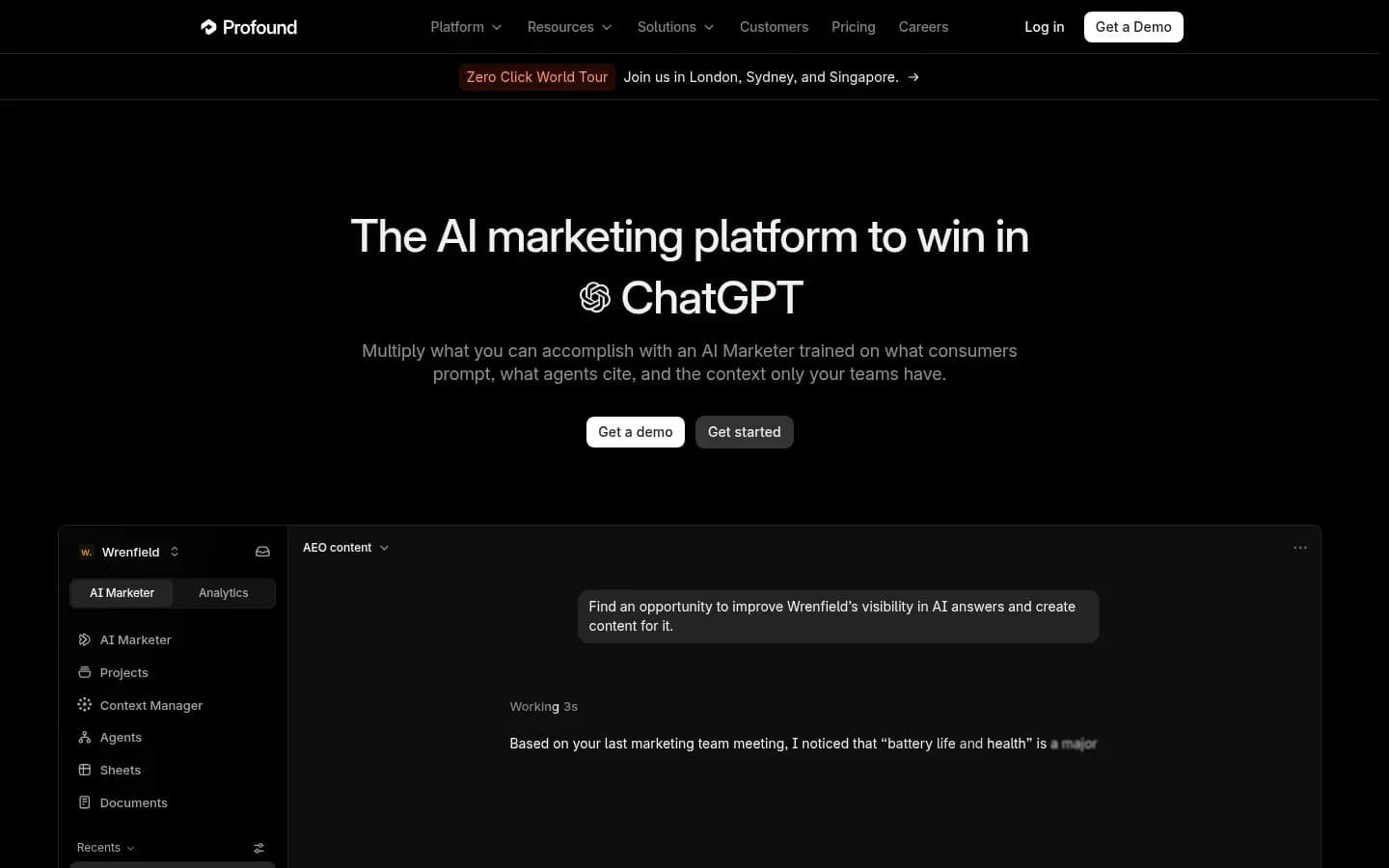
Profound tracks how ChatGPT, Perplexity, Claude, Gemini, Microsoft Copilot, DeepSeek and Google AI Overviews describe a brand, and the company raised a $96 million Series C at a $1 billion valuation in February 2026 and reports more than 700 enterprise customers.
Profound
AI marketing platform that shows marketing and AEO teams what customers ask AI tools and how their brand appears in the answers.
Profound is an AI marketing platform that shows marketing and AEO teams what customers ask AI tools and how their brand appears in the answers. It is built and sold for large organisations that need many engines, detailed answer evidence and strict access controls.
- Free plan
- No
- Compliance
- SOC 2
- Ratings
- G2 4.5/5 (1,137 reviews)
Verdict: a complete enterprise package, for brands that can commit to a sales-led contract.
What it does: Profound's core module, Answer Engine Insights, records how each engine answers your prompts and breaks the answers down with Citation Analytics, Sentiment and FactCheck. Prompt Volumes estimates what people actually ask AI assistants.
Standout features:
- Prompt Volumes from panel data: licensed from double opt-in consumer panel providers, updated on a rolling weekly basis with under two weeks' latency.
- Answer analysis: Citation Analytics, Sentiment and FactCheck sit inside Answer Engine Insights.
- Wider modules: Shopping, Agent Analytics with Benchmarking, and Context Manager. Profound also lists Agents, a newer module.
- Scale claims: Profound says it offers 200+ integrations and is used by a third of the Fortune 100 (vendor claims).
Engines named: ChatGPT, Perplexity, Claude, Gemini, Microsoft Copilot, DeepSeek and Google AI Overviews.
Pricing:
Profound pricing
| Plan | Price | Billing | Notes |
|---|---|---|---|
| Agency Enterprise (agency tab) | Custom pricing | ||
| Agency Growth (agency tab) | Custom pricing | ||
| Enterprise | Custom pricing | ||
| Trial | Custom pricing |
Best fit: large organisations that need single sign-on via SAML or OIDC, fine-grained role-based permissions and priority support by email or Slack.
Best for
- Enterprise brands reporting AI presence across many engines and markets
- Teams that need SSO, granular roles and a dedicated support channel
Not for
- Small teams that want self-serve setup and a fixed monthly plan
- Buyers who need prompt volume data outside the US in every country
Limitations: Profound is designed around enterprise buying. Plan limits and regional features are set through a Profound representative, so you cannot size a deployment yourself before talking to sales. Prompt Volumes coverage is strongest in the US, where ChatGPT, Gemini, Claude and Perplexity data is available; other regions vary by country.
Integrations and data access: Profound offers API access for automated agents and data exchange, which lets a data team move answer data into its own warehouse or dashboards.
Ownership status: Profound is venture-backed. Lightspeed Venture Partners led its Series C, with Sequoia and Kleiner Perkins participating, for total funding of $155 million; the company told Fortune it works with 10% of the Fortune 500.
Scrunch
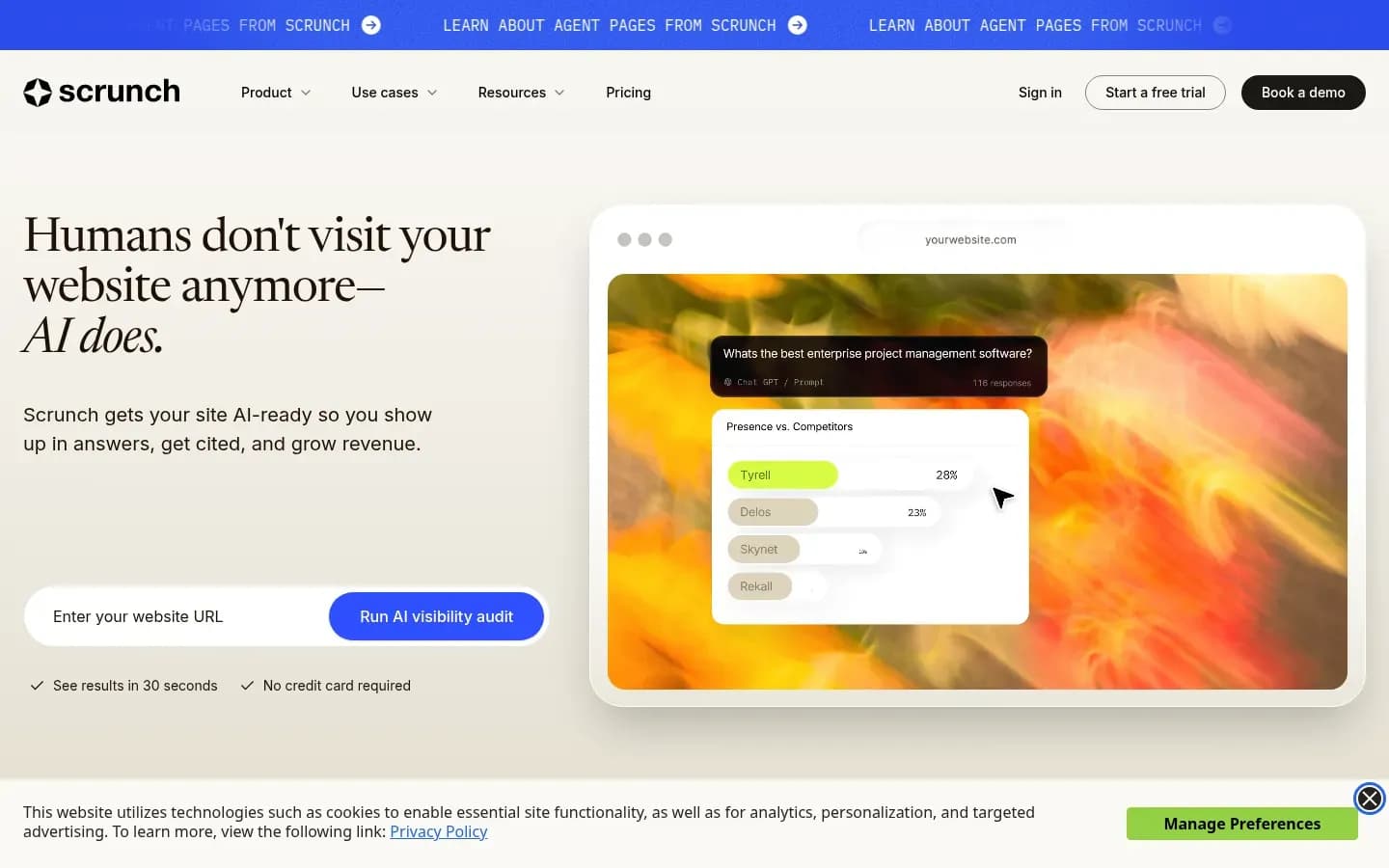
Scrunch monitors brand mentions and citations across ChatGPT, Perplexity, Gemini, Claude and Meta AI for multiple brands, regions and client accounts in one workspace, and Sitecore announced its acquisition of Scrunch in June 2026 to build its insights into SitecoreAI.
Scrunch
AI search visibility platform for marketing teams and agencies that tracks how a brand appears in AI answers and serves AI-optimized pages to AI agents.
Scrunch is an AI search visibility platform for marketing teams and agencies. It tracks how a brand appears in AI answers and can serve AI-optimised versions of pages to AI agents.
- Free trial
- 7 days, no card needed
- Compliance
- SOC 2
- Ratings
- G2 4.6/5 (74 reviews)
Verdict: a strong fit for agencies and multi-brand teams, with a roadmap now tied to Sitecore.
What it does: Scrunch's Monitoring module tracks performance, prompt analytics and AI traffic, and benchmarks you by competitor, persona, topic and geography. Its Insights module adds optimisation guidance, citation analysis and AI bot crawl error detection.
Standout features:
- Segmented benchmarking: compare against competitors by persona, topic and geography, not only by brand.
- AI bot crawl error detection: shows where AI crawlers fail to read your site.
- Agent Experience Platform (AXP): builds a lightweight, AI-translated version of a site for agents to read.
- Agent Traffic Monitoring: connects through Cloudflare Workers, Akamai DataStream 2, Vercel or WordPress.
Engines named: ChatGPT, Perplexity, Google Gemini, Anthropic Claude and Meta AI on the enterprise page, with Copilot also named on the homepage.
Pricing:
Scrunch pricing
| Plan | Price | Billing | Notes |
|---|---|---|---|
| Starter |
|
| |
| Growth |
|
| |
| Enterprise | Custom pricing |
Best fit: agencies and multi-brand companies. One workspace can hold multiple brands, domains, regions and languages, and agencies can monitor many clients and segment reports by brand, region, topic or product line.
Best for
- Agencies reporting AI visibility for many clients in one workspace
- Multi-brand or multi-region companies, especially on Sitecore
Not for
- Teams wary of a roadmap set by a CMS vendor they do not use
- Single-brand teams that only need a basic prompt tracker
Limitations: the Sitecore deal is the main question. Scrunch's insights, recommendation tools and AXP are to be brought into SitecoreAI content management, content marketing and digital asset management, which helps Sitecore customers and may matter less to everyone else. Scale claims, such as analysing over 6 million citations and 1.5 million prompts a week, are the vendor's own figures.
Integrations and data access: SAML and OAuth single sign-on, role-based access control and a Data API for internal systems, dashboards and AI workflows.
Ownership status: owned by Sitecore, which is bringing Scrunch's insights, recommendation tools and AXP into SitecoreAI.
Peec AI
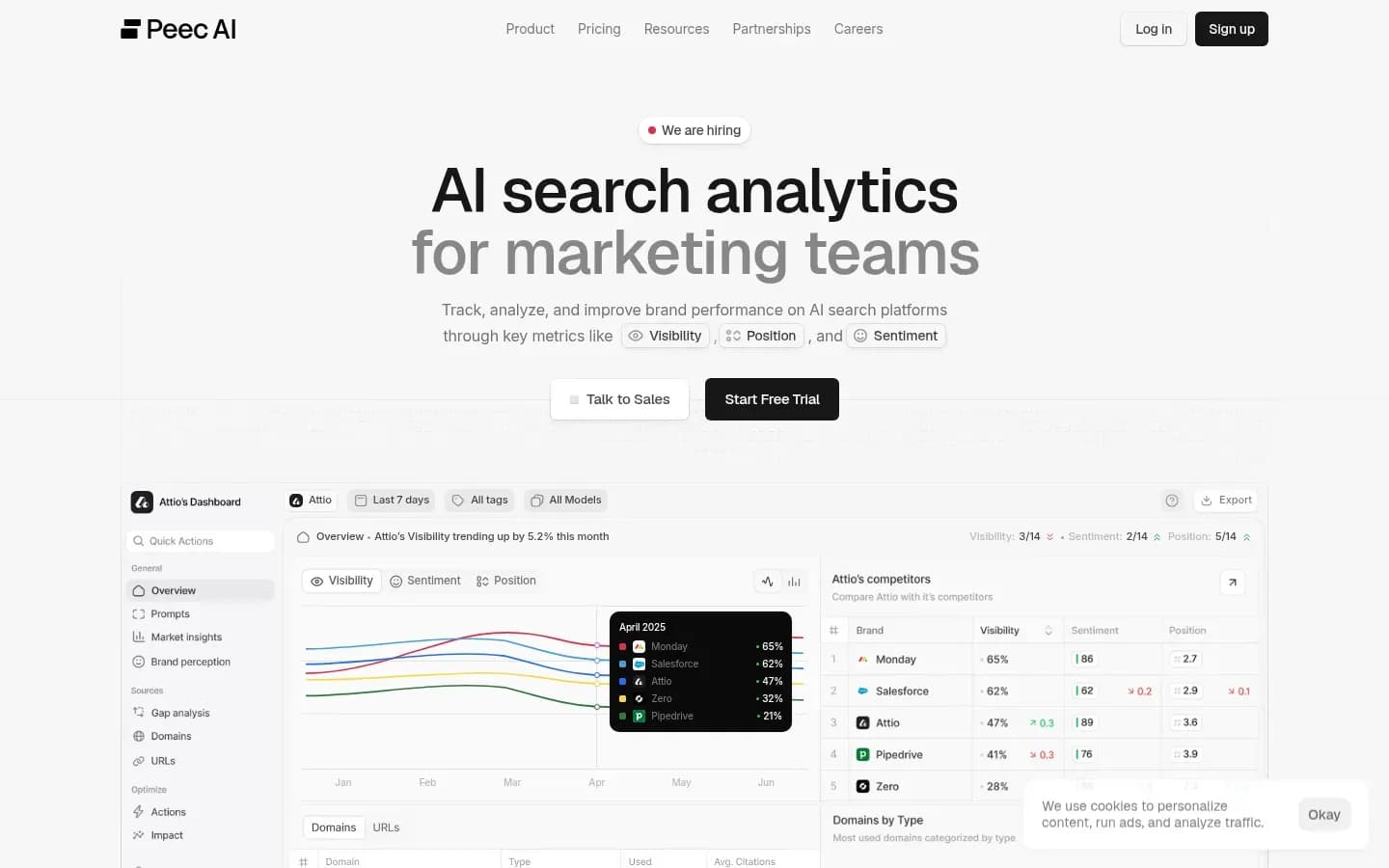
Peec AI runs each tracked prompt once every 24 hours on each AI model a team selects and reports visibility, position, sentiment and cited sources, collecting answers from logged-out web interfaces rather than from model APIs.
Peec AI
AI search analytics platform for marketing teams and agencies that tracks brand visibility, position and sentiment in AI search tools.
Peec AI is an AI search analytics platform for marketing teams and agencies. It tracks brand visibility, position and sentiment in AI search tools, with filters and tags that make daily prompt data easy to slice.
- Ratings
- G2 4.7/5 (21 reviews)
Verdict: a practical choice for a lean team that wants daily prompt data in the reporting tools it already uses.
What it does: Peec AI defines visibility as the share of chats that mention your brand, and reports it alongside position, sentiment and sources. You can filter by model, country and prompt tag, and tag prompts by persona or funnel stage.
Standout features:
- AI-suggested prompts with search volumes: a quicker start than writing every prompt yourself.
- Daily runs per model: each prompt runs once every 24 hours on each model you select.
- Recommendations: practical actions such as earning G2 reviews or joining relevant subreddit discussions.
- MCP server: a live server that works with Claude, Cursor and n8n, so answer data can feed AI workflows.
Engines named: dedicated trackers for ChatGPT, Gemini and Google AI Mode, with Perplexity also named.
Pricing:
What drives cost: the number of prompts multiplied by the models you select, because each prompt runs daily on each model. Programmatic access is the other driver: Peec AI's REST API is currently limited to Enterprise customers.
Best fit: in-house marketing teams and smaller agencies that want filterable daily data and a Looker Studio dashboard without an enterprise contract. Peec AI says more than 3,000 brands and agencies use it (vendor claim).
Best for
- Lean teams that want daily prompt tracking in Looker Studio
- Teams building AI workflows over MCP with Claude, Cursor or n8n
Not for
- Teams that need API access without an Enterprise agreement
- Buyers who need answers as seen by logged-in, personalised users
Limitations: Peec AI collects answers by browser automation of logged-out web interfaces. Peec AI treats a logged-out session as the closest match to an average user, but that session does not reflect logged-in, personalised use. The API gate means a team that wants to pipe raw data into a warehouse needs the Enterprise tier.
Integrations and data access: a Looker Studio community connector, CSV exports, the MCP server and, for Enterprise customers, a REST API that returns JSON, with keys generated from the Account page.
Conductor
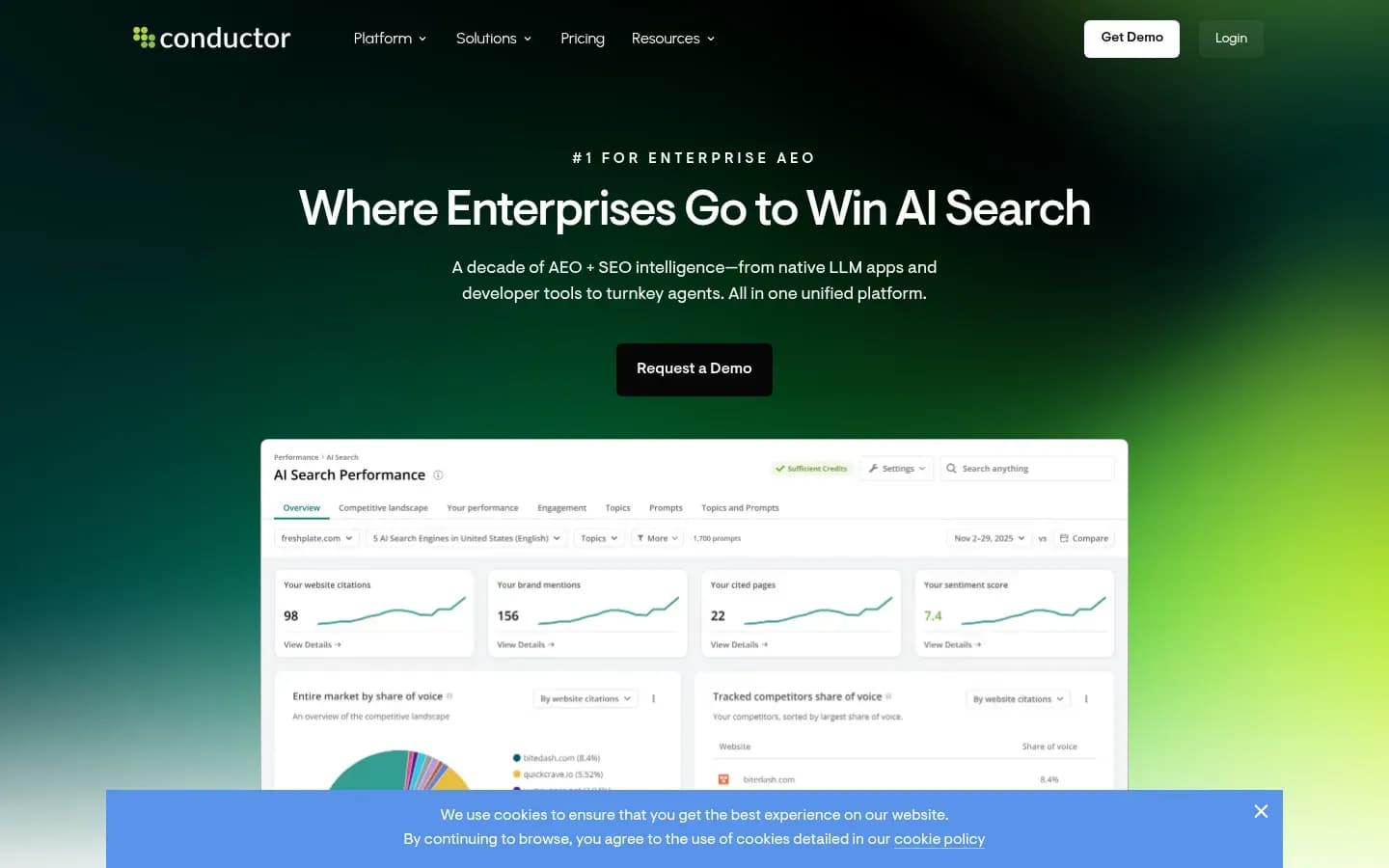
Conductor tracks brand mentions, citations, sentiment and share of voice in ChatGPT, Perplexity and Google AI Overviews using an API-first collection method, and pipes the data into BI tools through its Data API and into content work through Conductor Creator.
Conductor
Enterprise SEO and answer engine optimization platform for tracking and improving visibility in search and AI answers.
Conductor is an enterprise SEO and answer engine optimisation platform. Its AI Search Performance features sit alongside its SEO data, so a team can track visibility in search and AI answers in one place.
- Compliance
- GDPR, ISO 27001, SOC 2
Verdict: the right pick for an enterprise SEO team that wants AI visibility inside its SEO and content workflow, not as a separate tool.
What it does: Conductor's AI Search Performance tracks brand mentions and website citations, sentiment tied to the sources the answers cite, and share of voice by topic.
Standout features:
- Sentiment tied to sources: shows which cited pages drive how an answer describes you.
- AI Bot Crawling Reports: shows how AI crawlers reach your site.
- Conductor Creator hand-off: moves a visibility gap straight into content work.
- MCP: connects Conductor data to custom AI workflows.
Engines named: ChatGPT, Perplexity, Google AI Overviews and more. Conductor's own guide claims API-based tracking across nine AI engines; that is the vendor's claim.
Pricing:
Conductor pricing
| Plan | Price | Billing | Notes |
|---|---|---|---|
| Enterprise | Custom pricing | ||
| Essentials | Custom pricing | ||
| Growth | Custom pricing |
Best fit: enterprise SEO and content teams that already plan content in an SEO platform and want AI answer data to feed the same plan.
Best for
- Enterprise SEO teams joining AI visibility to content planning
- Data teams that want AI visibility data in their BI tools
Not for
- Teams that only need AI tracking and no SEO suite
- Buyers who want answers collected from logged-out web interfaces
Limitations: Conductor is an enterprise SEO platform first, so a team that only wants AI tracking pays for a broader suite than it needs. Its own best-list ranks Conductor first, so read its comparison material as vendor content. Its services are hosted in AWS Virginia region data centres with backups in Northern California, which matters to teams with data-residency rules.
Integrations and data access: a Data API that feeds BI tools, MCP for custom AI workflows and the hand-off to Conductor Creator. Conductor says it uses official APIs wherever possible, arguing that scraping is fragile, risks IP blocking and can break terms of service.
Semrush
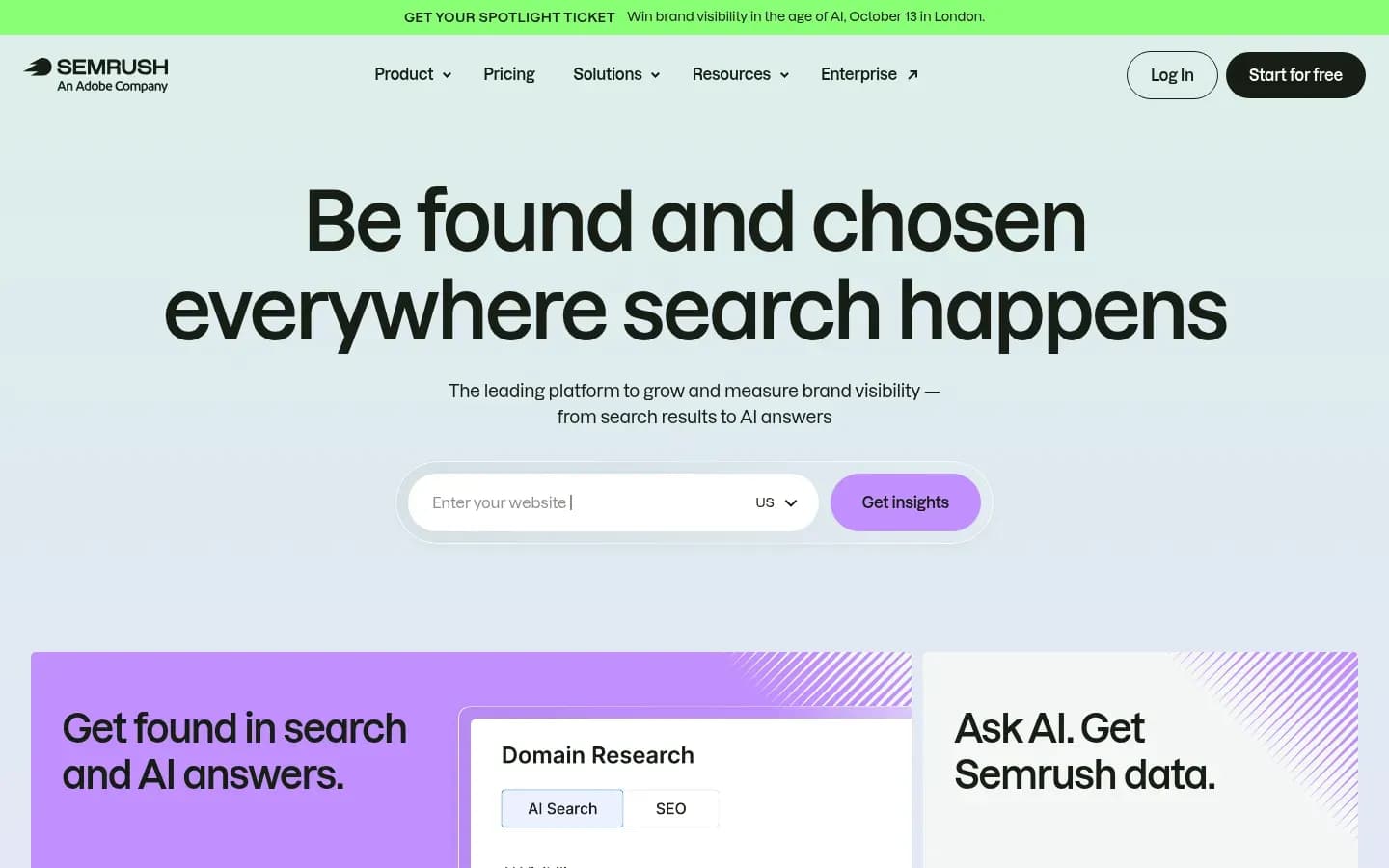
Semrush's AI Visibility Toolkit tracks brand presence in Google AI Overviews, AI Mode, ChatGPT, Gemini and Perplexity alongside its SEO data in Semrush One, but each user in a corporate account needs a separate licence and extra prompts are sold in blocks of 50.
Semrush
Online visibility platform covering SEO, AI search visibility, advertising and content for marketers, agencies and businesses of all sizes.
Semrush is an online visibility platform covering SEO, AI search visibility, advertising and content. Its AI Visibility Toolkit can be bought on its own or bundled with the SEO Toolkit in Semrush One.
- Free plan
- Yes
Verdict: the sensible add-on when your SEO reporting already runs in Semrush and only a few people need access.
What it does: the AI Visibility Toolkit gives an AI Visibility Score in its Visibility Overview, worldwide or by region, and tracks your prompts daily.
Standout features:
- Competitor Research: finds prompts where competitors are cited and you are not.
- Prompt Research: shows topic volume, difficulty and intent before you pick prompts.
- Brand Performance: share of voice, sentiment, key narratives and AI recommendations.
- AI Search Site Audit: flags issues that block AI crawlers from your site.
Engines named: Google AI Overviews, AI Mode, ChatGPT, Gemini and Perplexity in Semrush One.
Pricing:
Semrush pricing
| Plan | Price | Billing | Notes |
|---|---|---|---|
| Free | $0 | per month | |
| SEO |
|
| |
| Starter |
|
| |
| Pro+ |
|
| |
| Advanced |
|
|
What drives cost: tracked prompts rise with the tier, from 25 in the standalone toolkit to 50, 100 and 200 across the Semrush One tiers. An add-on of 50 more prompts costs $60 a month. One Brand Performance domain is included and extra domains cost $99 each. Each user in a corporate account needs their own licence, and the standalone toolkit covers one project. Exports are capped at 10 CSV exports a day of up to 1,000 rows.
Best fit: SEO teams already paying for Semrush who want AI visibility next to their keyword and site audit data, with a small number of users.
Best for
- SEO teams already running keyword and audit work in Semrush
- Small teams that need prompt research with volume and difficulty
Not for
- Large teams, because every user needs a separate licence
- Agencies tracking many brands, given per-domain add-on costs
Limitations: per-user licences and prompt caps mean large teams pay more as they scale, and multi-brand tracking adds a cost per extra domain.
Ownership status: Adobe announced the completion of its acquisition of Semrush Holdings on April 28, 2026. Semrush says customers can expect continued investment and an expanded product roadmap.
How to Choose an AI Visibility Platform
Choose an AI visibility platform by checking four things in a demo: whether it names the AI engines your buyers use, whether it shows the actual answers and cited sources behind each score, whether it reports visibility share across many prompt runs, and whether its exports, API and access controls fit your reporting stack.
Those four checks map onto the three criteria used in this guide and onto what the leading lists in search and AI visibility agree on: multi-engine coverage, prompt-level tracking, competitive benchmarking, sentiment, citation source attribution and a path from insight to action.
Run this checklist with each vendor on the call:
- The vendor names every AI engine your buyers use, including Google AI Overviews or AI Mode if search matters to you
- You can open the raw answer, the cited sources and the sentiment behind each score
- The headline metric is visibility share across many prompts and runs, not a single position
- Prompts can be tagged by persona, funnel stage and country
- Exports, a BI connector or API, single sign-on and roles match how you report
- The vendor explains how it collects answers and how often each prompt runs
- Each insight points to an action: a page to fix, a source to earn or content to brief
Start with engines. List the assistants your buyers use and check the vendor names them. Engine lists differ: Peec AI has a dedicated Google AI Mode tracker, Semrush One covers AI Overviews and AI Mode, and Profound and Conductor name Google AI Overviews.
Then ask for evidence. A score without the answer behind it cannot be acted on. Ask to see the full answer text, the pages cited and how sentiment was assigned. Profound's Citation Analytics and FactCheck, and Conductor's sentiment tied to cited sources, are examples of what good evidence looks like.
Insist on share, not rank. The SparkToro and Gumshoe study found that AI brand lists rarely repeat and that positions are close to meaningless, while visibility share held up. A tool that sells "AI rank" movement is reporting noise.
Check prompt design. Peec AI tags prompts by persona and funnel stage and filters by country; Scrunch benchmarks by persona, topic and geography. Without this, one blended number hides where you win and lose.
Match the reporting stack. If your team reports in Looker Studio, Peec AI's connector saves work. If a data team owns reporting, ask about Conductor's Data API, Scrunch's Data API or Profound's API access. If access control matters, confirm SAML single sign-on and role-based permissions, which Profound and Scrunch document.
Finish with action. The leading lists all reward a path from insight to action. Conductor hands gaps to Conductor Creator, Scrunch adds optimisation guidance and Peec AI suggests actions such as earning G2 reviews.
How Do AI Visibility Platforms Collect Their Data?
AI visibility platforms collect answers in one of two ways: through official model APIs, the method Conductor says it uses wherever possible, or by automating the public web interfaces that logged-out users see, the method Peec AI uses because API answers can differ from what people actually get.
Neither method is neutral, and each vendor argues for its own.
API-first collection. Conductor says it uses official APIs wherever possible. Its argument is that scraping is fragile, risks IP blocking and can break an engine's terms of service.
Browser automation. Peec AI collects answers by automating the web interfaces of the AI platforms. Its argument is that API responses, and the number of sources they cite, can differ from what users see. Peec AI treats a logged-out session as the closest match to an average user.
The trade-off for a buyer is plain:
- Conductor argues an API answer avoids the fragility and terms-of-service risk of scraping; Peec AI argues it may not match what users see.
- Peec AI treats a logged-out web answer as the closest match to a typical user, but it does not reflect logged-in, personalised sessions.
Panel data is a third input. Some platforms also estimate what people ask. Profound licenses its Prompt Volumes data from double opt-in consumer panel providers and updates it weekly. Panel data does not measure your visibility; it helps you pick which prompts to track.
The right method depends on the engines you care about. If your buyers use the consumer ChatGPT app, Peec AI's case for web-interface answers carries more weight. If you need a series that IP blocking or a terms dispute cannot interrupt, Conductor's case for API-first collection carries more.
What Metrics Should an AI Visibility Platform Report?
Visibility share, the percentage of prompt runs that mention your brand, is the metric to trust, because in SparkToro and Gumshoe's study of nearly 3,000 runs the odds of ChatGPT, Claude or Google's AI returning the same brand list twice were under 1 in 100.
<1
% chance of the same brand list twice
Identical prompts almost never return the same set of brands, and the same list in the same order came up closer to 1 in 1,000 times.
2026 · About 600 volunteers, 12 prompts, nearly 3,000 runs · Source
The study, run by SparkToro's Rand Fishkin and Gumshoe.ai's Patrick O'Donnell, had about 600 volunteers run 12 identical prompts through ChatGPT, Claude and Google's AI. List length ranged from two or three names to 10 or more. Its conclusions shape which numbers deserve a place in your report:
- Ranking positions are close to meaningless. A brand that is third today may be absent tomorrow on the same prompt.
- Visibility percentage holds up better. Across many prompts and runs, how often a brand appears is a stable signal.
- Phrasing matters less than intent. Different wordings of the same question returned similar brand sets, so a well-chosen prompt set covers an intent without hundreds of variants.
- Small markets are steadier. Answers in smaller categories were more stable than in large ones.
With that in mind, the metric set worth paying for is:
- Visibility share: the share of runs or chats that mention your brand. Peec AI defines visibility this way.
- Citations and their sources: which pages each engine cites, so you know which sites to earn coverage on. Scrunch, Profound and Conductor all analyse citations.
- Sentiment: how the answer describes you. Conductor ties sentiment to the sources behind it.
- Share of voice against named competitors: Semrush's Brand Performance and Conductor's share of voice by topic both report it.
- AI crawler activity on your site: whether AI bots can read your pages. Scrunch detects AI bot crawl errors, Conductor has AI Bot Crawling Reports and Semrush's AI Search Site Audit flags crawler blocking.
Treat position as a diagnostic, not a target. If a vendor's headline chart is "average AI rank", ask for visibility share across runs instead.
How Much Do AI Visibility Platforms Cost?
The real cost of an AI visibility platform is set by how many prompts it tracks, on how many AI models and how often, plus seats and API access: Semrush, for example, sells extra prompts in blocks of 50 and needs a licence for each user, while Peec AI keeps its API for Enterprise customers.
The plan prices are in each tool's pricing table above. What those tables do not show is how the bill grows once you start tracking properly. Five drivers set it:
- Prompts: the number of questions you track. This is the base unit on most platforms.
- Models or engines: each prompt runs on each engine you select, so four engines means four times the runs.
- Refresh rate: daily runs produce more data, and cost more to collect, than weekly ones.
- Seats: some platforms charge per user, which hits large teams.
- Brands, domains and API access: extra brands or domains and programmatic access often sit on higher tiers or cost extra.
What drives the running cost of each platform
| Platform | Main cost unit | Add-ons that matter | Data access |
|---|---|---|---|
| Profound | Plan limits set with sales | Regional features set with sales | API for agents and data exchange |
| Peec AI | Prompts times models, run daily | Enterprise tier for the API | Looker Studio, CSV, MCP |
| Semrush | Prompts by tier, plus users |
| 10 CSV exports a day |
A worked example shows why this matters. Take a team that tracks 100 prompts on four engines. On Peec AI, each prompt runs once a day on each model, so that is 400 answer runs a day. On Semrush, the same team needs a tier that covers 100 prompts, then a licence for each person who logs in, and $99 for each extra brand domain in Brand Performance.
Three rules keep spend under control:
- Size the prompt set to intents, not wordings. The SparkToro and Gumshoe study found that different phrasings of one intent return similar brand sets, so you rarely need many variants of the same question.
- Pick engines your buyers use. Tracking every engine multiplies cost without adding insight if your buyers live in two of them.
- Count seats and brands before signing. Per-user licences and per-domain fees are the lines that surprise teams at renewal.
For Profound, plan limits and regional features are set through a Profound representative, so bring your prompt count, engine list, brands and user count to the first call.
Which AI Visibility Platform Should You Choose?
If you run an enterprise brand that needs many engines and strict access controls, choose Profound; if your SEO team lives in Conductor or Semrush, add AI tracking there; if you report for many brands or clients, choose Scrunch; and if you are a small team that wants daily prompt data in Looker Studio, choose Peec AI.
Pick by situation
| Your situation | Pick | Why |
|---|---|---|
| Enterprise brand, many engines, strict governance | Profound | SAML or OIDC SSO, granular roles |
| Enterprise SEO team planning content in one suite | Conductor | Data API, Creator hand-off |
| Agency or multi-brand team, especially on Sitecore | Scrunch | Multi-client, multi-region workspaces |
| Lean in-house team wanting daily prompt data | Peec AI | Looker Studio connector, MCP server |
| Team already paying for Semrush SEO, few users | Semrush | AI tracking beside existing SEO data |
The decision rules behind the table:
- Governance first: if security review asks for SAML or OIDC single sign-on, fine-grained roles and a support channel in Slack, Profound documents all three.
- SEO workflow first: if your content plan already lives in Conductor, its Data API and Conductor Creator hand-off keep AI data in the same loop. If it lives in Semrush, the AI Visibility Toolkit sits next to your keyword data, but count the users who need a licence.
- Many brands or clients: Scrunch lets agencies monitor many clients in one workspace and segment reports by brand, region, topic or product line.
- Lean and fast: Peec AI runs prompts daily, exports to Looker Studio and CSV and connects to Claude, Cursor and n8n over MCP.
Two ownership changes belong in the decision. Scrunch is now part of Sitecore, and its insights and AXP are being folded into SitecoreAI, which is good news for Sitecore customers and a roadmap question for everyone else. Semrush is now part of Adobe, which says customers can expect continued investment; teams outside the Adobe stack should ask how the AI Visibility Toolkit will develop.
Frequently Asked Questions
Can AI visibility platforms track Google AI Overviews and AI Mode?
Yes, several AI visibility platforms track Google's AI answers: Profound and Conductor name Google AI Overviews, Semrush One covers AI Overviews and AI Mode, and Peec AI offers an AI Mode tracker. Check that the vendor names the Google surface you care about, because engine lists differ between products.
How often do AI visibility platforms refresh their data?
Peec AI and Semrush refresh prompt tracking daily. Peec AI runs each prompt once every 24 hours on each selected model, and Semrush offers daily Prompt Tracking. Profound's Prompt Volumes panel data updates on a rolling weekly basis with under two weeks' latency, because it estimates demand rather than tracking answers.
Do AI visibility platforms replace SEO tools?
No, they measure a different surface, though some products combine both. Semrush One bundles the SEO Toolkit and the AI Visibility Toolkit in one subscription, and Conductor runs AI Search Performance inside its enterprise SEO platform. Dedicated tools such as Profound, Scrunch and Peec AI sit beside an SEO tool rather than replacing it.
Who owns Scrunch and Semrush now?
Sitecore owns Scrunch and Adobe owns Semrush. Sitecore's purchase of Scrunch was reported in June 2026, with Scrunch's insights and Agent Experience Platform to be built into SitecoreAI. Adobe announced the completion of its Semrush acquisition on April 28, 2026, and Semrush says customers can expect continued investment and an expanded roadmap.
Our Verdict on AI Visibility Platforms
Sources
Sources
- Do people click on links in Google AI summaries? · pewresearch.org
- Update: AI Overviews Reduce Clicks by 58% · ahrefs.com
- Exclusive: As AI threatens search, Profound raises $96 million to help brands stay visible · fortune.com
- Sitecore buys Scrunch to boost AI search visibility · ecommercenews.co.nz
- AI recommendation lists repeat less than 1% of the time: Study · searchengineland.com