A B2B contact database is only worth its contract if the contacts in it still work when your team reaches out. Record counts make good headlines, but freshness, verification and export rules decide whether the data turns into conversations.
These picks apply to B2B outbound teams prospecting into the US, UK and EU who export contacts into a CRM or sequencer. Every database decays and every vendor draws freshness complaints, so test any shortlist on your own target accounts before committing to an annual contract.
Best B2B Contact Databases: Comparison
The five B2B contact databases worth shortlisting are ZoomInfo, Cognism, Apollo, SalesIntel and UpLead, and the clearest difference between them is how each one states it keeps data fresh: Cognism refreshes Director-level and above contacts every 30 days, SalesIntel re-verifies on a rolling 90-day cycle and UpLead verifies emails at the moment of export.
That difference matters more than size. ZoomInfo describes continuous, automated updates fed by a contributory network, and Apollo blends its own data with third-party signals. Each approach suits a different kind of team.
The table below compares B2B contact databases on the points a buyer can hold a vendor to: who each one suits, what refresh cycle it states and how it verifies records. Free plan, compliance and G2 columns come from each brand's record.
| Tool | Free plan | Compliance | G2 rating | Best for | Stated refresh | Verification |
|---|---|---|---|---|---|---|
| ZoomInfo | GDPR, ISO 27001, SOC 2 | 4.5/5 (9,178 reviews) | Enterprise US teams | Continuous, no stated cycle | Contributory network plus ML | |
| Cognism | GDPR, ISO 27001, SOC 2 | 4.5/5 (1,372 reviews) | European phone-led outreach | 30 days, Director+ | Manual and automated | |
| Apollo | Yes | ISO 27001, SOC 2 | 4.7/5 (9,843 reviews) | Lean all-in-one teams | No stated cycle | Proprietary plus third-party |
| SalesIntel | 4.3/5 (540 reviews) | US mid-market teams | 90-day rolling re-verification | AI plus human | ||
| UpLead | No | 4.7/5 (831 reviews) | Small email-led teams | Verified at export | Real-time at download |
The ranking orders the five by fit for the widest range of outbound teams, not by database size.
- ZoomInfoBest for enterprise US teams needing intent signals
- CognismBest for european outreach that calls mobiles
- ApolloBest for lean teams wanting data and execution together
- SalesIntelBest for teams wanting a stated re-verification cycle
- UpLeadBest for small teams buying verified emails
How We Chose These Databases
Growth Tribune included a B2B contact database only if it offers a searchable set of named business contacts with emails and phone numbers that a team can export into its CRM, and judged each one on coverage for the buyer's market, stated freshness and verification, export and credit conditions, compliance posture and independent review patterns.
Both self-serve and sales-led products qualified. The criteria, in the order a buyer should weigh them:
- Contact coverage for the reader's market: region, seniority and roles, not total records.
- Stated freshness and verification: the refresh cycle a vendor commits to and the moment it verifies a record.
- Export and credit conditions: what a reveal, an export or an enrichment costs in credits.
- Compliance posture: opt-out handling, Do-Not-Call screening and data broker registration.
- Integrations with the CRM and sequencer a team already runs.
- Independent review patterns: the recurring themes in G2 reviews, never single reviews.
Each profile rests on the vendor's own published data, product and compliance statements, set against those review-platform patterns. Two limits apply. Vendor figures are self-reported and are not comparable across vendors, because each counts and verifies records its own way. Fit also depends on the reader's ideal customer profile, so the right database for one team can be the wrong one for another.
Eleven tools were considered and five made the list. The six below are frequent names in other rankings but did not fit this comparison.
Considered, not included
| Tool | Why not included |
|---|---|
| LinkedIn Sales Navigator | A LinkedIn search tool, not an exportable contact database |
| HubSpot Breeze Intelligence (formerly Clearbit) | Enrichment add-on on top of a HubSpot subscription |
| RocketReach | Lookup tool overlapping UpLead's self-serve slot |
| Seamless.AI |
|
| Lead411 | Overlaps the SalesIntel and UpLead mid-market slot |
| Lusha | Rep-level freemium tool overlapping Apollo |
ZoomInfo
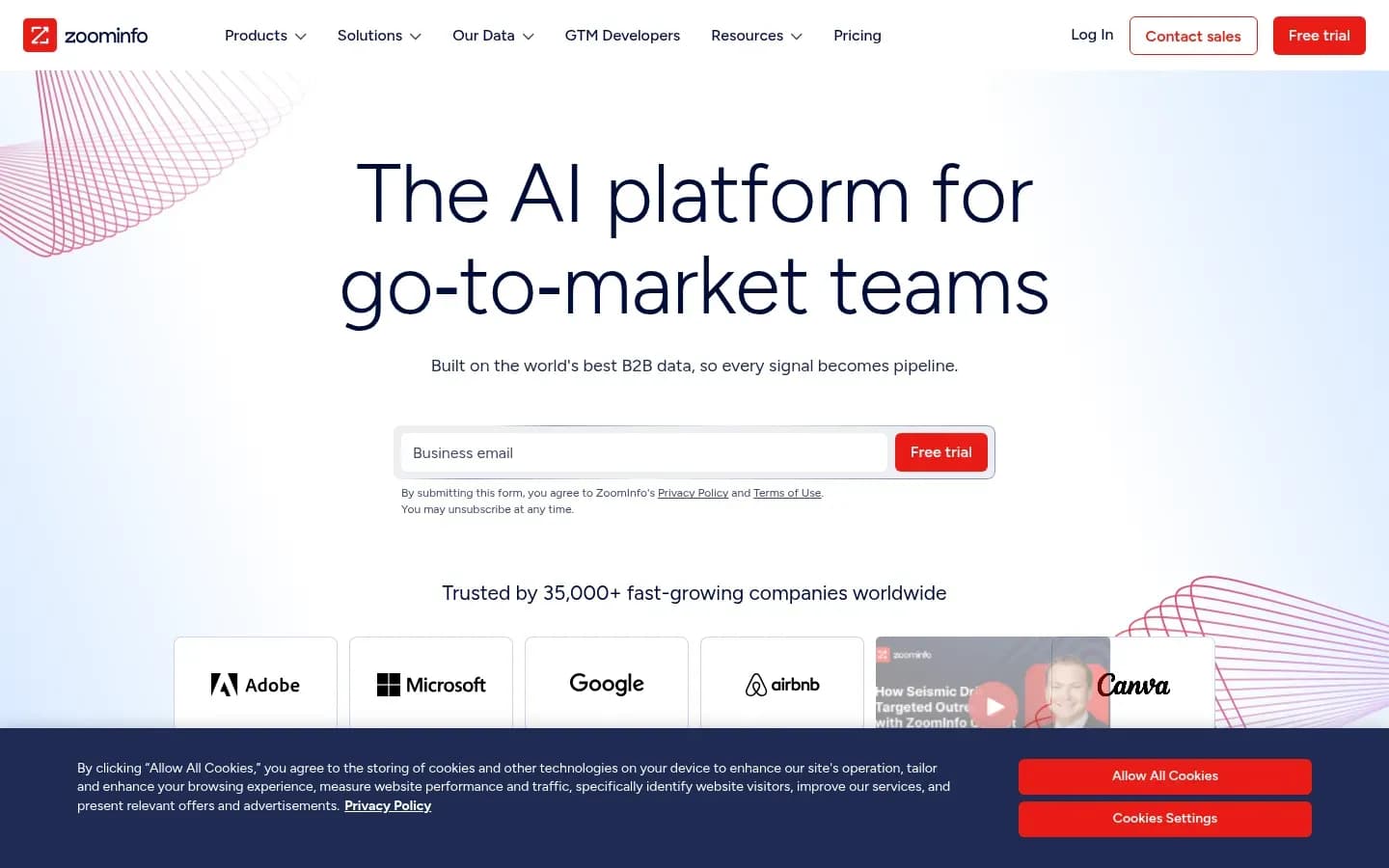
ZoomInfo advertises 420M+ global contacts, 120M+ direct dials and 145M+ companies, built partly from a contributory network in which more than 200,000 professionals share contact details in exchange for access to ZoomInfo Lite.
Verdict. ZoomInfo leads this ranking on buyer intent and data delivery. It advertises 420M+ contacts and pairs them with buyer intent scores and enterprise-wide data delivery, which suits large US teams more than small ones.
ZoomInfo
AI go-to-market platform with a B2B contact and company database for sales, marketing and RevOps teams.
ZoomInfo is an AI go-to-market platform built on a B2B contact and company database. Sales, marketing and RevOps teams use it to find accounts and contacts, read buyer intent and push records into their CRM. It is built for large teams that want one broad dataset across the US.
- Free trial
- Yes
- Public API
- Yes
- Compliance
- GDPR, ISO 27001, SOC 2
- Ratings
- G2 4.5/5 (9,178 reviews)
Data and coverage. ZoomInfo's sales product page states 420M+ contacts, 120M+ direct dials and 145M+ companies. The same page elsewhere gives over 70M phone numbers and 174M-plus verified email addresses, without explaining the gap between the two phone figures. Treat ZoomInfo's record counts as the vendor's own measures, not a like-for-like benchmark against other databases.
Freshness and verification. ZoomInfo sources data through three routes, by its own description:
- a contributory network of more than 200,000 ZoomInfo Lite users who share business contact information;
- automated machine learning that views public information on over 28 million sites and domains every day;
- an in-house research team that works on the database.
ZoomInfo describes its updates as continuous and automated rather than tied to a fixed refresh cycle.
Standout features. Buyer intent combines website visitor tracking with intent scores built from content consumption, technology signals and behavioural patterns. Records export to a CRM in one click, data updates run automatically, and an enterprise data delivery option feeds records across business systems and workflows.
Compliance posture. ZoomInfo's Trust Center states that ZoomInfo is a data broker under Texas law. Individuals can verify, claim, update or remove their profile through its Privacy Center. Its security certifications appear in the tool card.
Real cost drivers. G2 places ZoomInfo SalesOS's perceived cost at its highest tier. G2 reviewers report about one month to implement, about 14 months to return on investment and an average discount of about 15%, so budget for setup time and negotiate.
Pricing. ZoomInfo's plans appear in the table below.
ZoomInfo Sales pricing
| Plan | Price | Billing | Notes |
|---|---|---|---|
| Copilot Advanced | Custom pricing | ||
| Copilot Enterprise | Custom pricing | ||
| ZoomInfo Professional | Custom pricing |
ZoomInfo Marketing pricing
| Plan | Price | Billing | Notes |
|---|---|---|---|
| ABM Enterprise | Custom pricing | ||
| ABM Lite | Custom pricing | ||
| Marketing Demand | Custom pricing |
Best for
- Enterprise US sales and RevOps teams that need intent signals and data across many systems
Not for
- Small teams that only need a few hundred verified emails a month
Limitations. Freshness is ZoomInfo's most common complaint on G2. Inaccurate data, outdated data and outdated contacts are the top cons in its G2 reviews, each with around 200 mentions, even though data accuracy is also one of its top pros. Buyers should expect to clean and re-verify part of any export.
Cognism
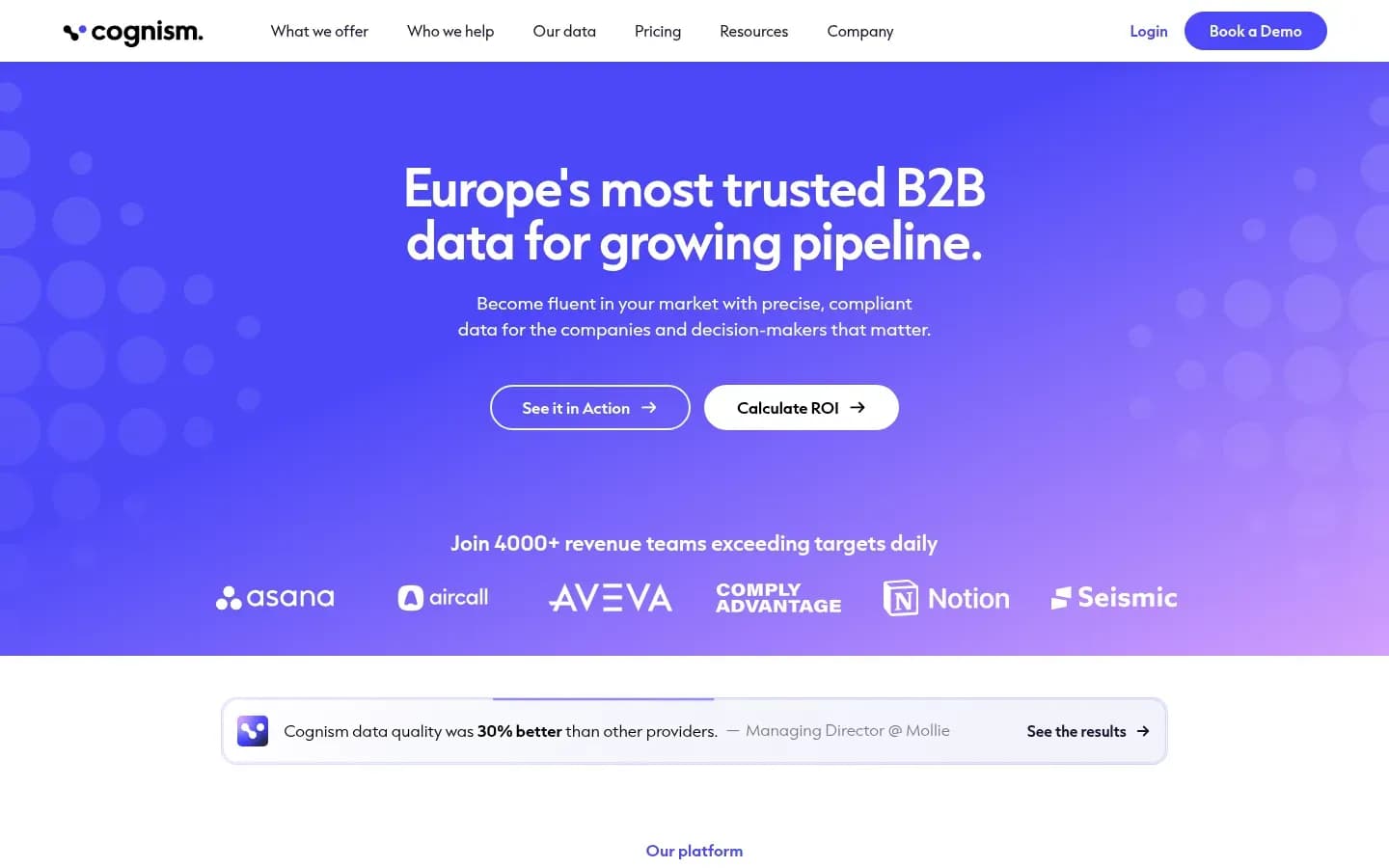
Cognism refreshes its Director-level and above contacts on a 30-day basis and screens its phone data against Do-Not-Call registries in 12 countries, including the UK's TPS and CTPS, and positions itself as built for growth in Europe.
Verdict. Cognism earns its place on European outreach. Its stated refresh cycle, verified mobiles and multi-country DNC screening make it the natural shortlist pick for teams calling prospects in the UK and EU.
Cognism
B2B sales intelligence platform with contact and company data, including phone-verified mobiles, strong in European markets.
Cognism is a B2B sales intelligence platform with contact and company data, including phone-verified mobile numbers. It positions itself as built for growth in Europe and covers Director-level and above contacts in Europe and the US. Sales teams that prospect by phone into European markets get the most from it.
- Public API
- Yes
- Compliance
- GDPR, ISO 27001, SOC 2
- Ratings
- G2 4.5/5 (1,372 reviews)
Data and coverage. Cognism describes its coverage by seniority and region, Director level and above in Europe and the US. It names its data sources as press releases, company websites, news articles, earnings releases, public registries and validated third-party sources.
Freshness and verification. Cognism states that its Director-level and above data is continually refreshed on a 30-day basis. Each contact is verified with manual and automated processes. Its phone-verified mobile numbers go through additional layers of verification checks, which, by Cognism's own claim, give up to 3x higher connect rates.
Standout features.
- Signals for intent, hiring, job joins and funding announcements, so reps can time outreach.
- Exports to Salesforce, HubSpot, Pipedrive and other CRMs.
Compliance posture. Cognism relies on legitimate interest under GDPR Article 6(1)(f) as its lawful basis. It states that it notifies business contacts of their inclusion in its database within GDPR timeframes and honours opt-outs. It screens its phone database against DNC registries in the UK (TPS and CTPS), the US, Australia, New Zealand, Germany, France, Ireland, Spain, Portugal, Croatia, Sweden and Belgium. It is registered as a data broker with the California Attorney General.
Pricing. Cognism's plans appear in the table below.
Cognism Sales prospecting pricing
| Plan | Price | Billing | Notes |
|---|---|---|---|
| Pro | Custom pricing | per seat | |
| Standard | Custom pricing | per seat |
Best for
- Teams selling into the UK and EU that call mobiles and need DNC screening
Not for
- Teams that need a large dataset of junior and mid-level contacts
Limitations. Data quality still leads Cognism's G2 complaints. Inaccurate data, incorrect numbers and outdated contacts are its top cons on G2, followed by incorrect and missing information. The 30-day refresh covers Director level and above, so contacts below that seniority sit outside the stated cycle.
Apollo
Apollo pairs a database of 240M+ contacts and 30M+ accounts with sequencing, a dialer and deliverability tools, and its credits are spent separately on email access, mobile numbers, exports and enrichment, so the real cost tracks how many records a team reveals and moves out.
Verdict. Apollo earns its place as the all-in-one option. A lean team can find contacts, write sequences, call and protect deliverability without stitching several tools together.
Apollo
AI sales platform combining a B2B contact and company database with outreach and engagement tools for sales teams.
Apollo is an AI sales platform that combines a B2B contact and company database with outreach and engagement tools. Sales teams use it to build lists, run sequences and make calls from one workspace. It suits outbound teams that want data and execution in the same tool.
- Free plan
- Yes
- Compliance
- ISO 27001, SOC 2
- Ratings
- G2 4.7/5 (9,843 reviews)
Data and coverage. Apollo states 240M+ contacts and 30M+ accounts. Its data layer combines a customer's own data, Apollo's proprietary data and third-party signals, with waterfall enrichment to fill gaps.
Standout features.
- AI agents that research accounts, build lists, write outreach and follow up.
- A Parallel Dialer for call-led prospecting.
- Deliverability tools: domain warming, inbox rotation and reputation monitoring.
- 200+ integrations with CRMs and other sales tools.
Compliance posture. Apollo's security certifications appear in its tool card.
Real cost drivers. Apollo's documentation lists what consumes credits:
- accessing or enriching email addresses;
- accessing phone numbers;
- exporting or pushing records outside Apollo, on certain plans or legacy configurations;
- enrichment and AI-powered web research.
Email and mobile data use separate credit balances, so a call-heavy team can run out of mobile credits while email credits remain. Calls that do not connect use zero credits.
Pricing. Apollo's plans appear in the table below.
Apollo pricing
| Plan | Price | Billing | Notes |
|---|---|---|---|
| Free | $0 | per month | per seat |
| Basic |
|
| per seat |
| Professional |
|
| per seat |
| Organization |
|
| per seat |
Best for
- Lean outbound teams that want data, sequences and a dialer in one workspace
Not for
- Teams that already run a separate sequencer and only need a data feed
Limitations. Apollo's breadth brings complexity. Missing features, inaccurate data and a learning curve are the top cons in its G2 reviews, followed by limited features and data inaccuracy, even though ease of use leads its pros. Budget onboarding time and verify exported emails before large sends.
SalesIntel
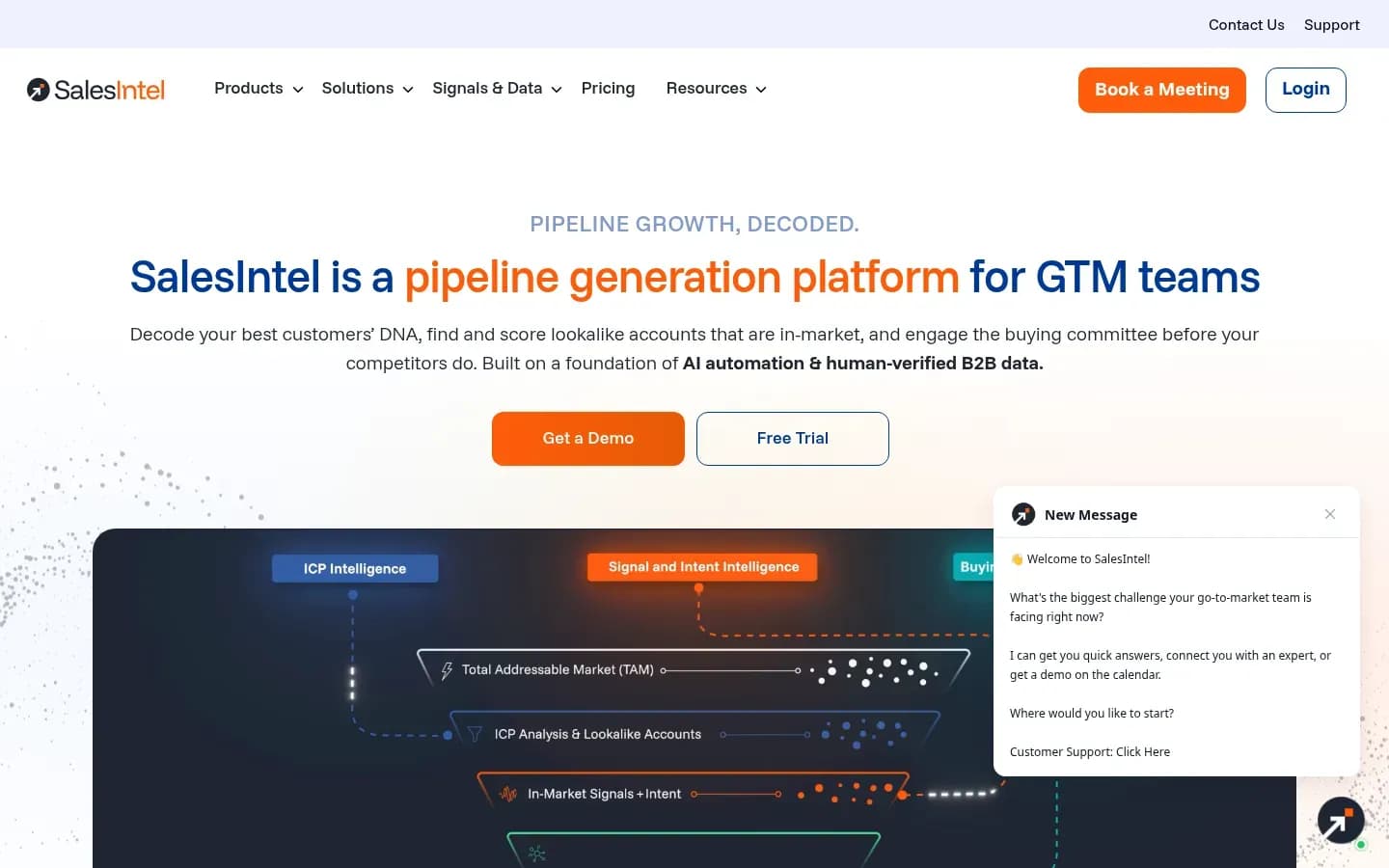
SalesIntel re-verifies its contacts with a mix of AI and human researchers on a rolling 90-day cycle and states 95% accuracy for those AI+human-verified records, which gives buyers a stated freshness window to hold the vendor to.
Verdict. SalesIntel earns its place on verification transparency. It tells buyers how often records are re-checked and by whom, and its unlimited-data positioning removes per-record anxiety for heavy users.
SalesIntel
B2B contact data and pipeline generation platform with human-verified data for sales, marketing and RevOps teams.
SalesIntel is a B2B contact data and pipeline generation platform built on human-verified data. Sales, marketing and RevOps teams use it to build lists, enrich records and act on intent. It suits US mid-market teams that want a stated re-verification cycle.
- Public API
- Yes
- Ratings
- G2 4.3/5 (540 reviews)
Data and coverage. SalesIntel states 200M+ verified B2B contacts, 54M+ verified mobile numbers and direct dials, firmographics on 30M+ companies and 42,000+ technologies tracked.
Freshness and verification. SalesIntel says its contacts are AI+human-verified on a rolling 90-day cycle to minimise data decay. It guarantees 95% accuracy on AI+human-verified contacts, a vendor claim that applies to that verified subset rather than every record.
Standout features.
- Research on Demand: users can request data that is missing, inaccurate or unavailable in the platform.
- Bombora intent data across 60,000+ intent topics.
- Native Salesforce and HubSpot integrations, connections to Outreach, Salesloft and Marketo, and 50+ CRM and marketing automation integrations.
Real cost drivers. SalesIntel positions its pricing as "One fee, unlimited data", so cost tracks seats and contract terms more than the number of records a team pulls.
Pricing. SalesIntel's plans appear in the table below.
Best for
- US mid-market teams that want a stated re-verification window and unlimited-data pricing
Not for
- Teams prospecting mainly into Europe that need multi-country DNC screening
Limitations. Human verification does not remove decay complaints. Inaccurate data and outdated data lead SalesIntel's G2 cons, with outdated contacts and outdated information close behind, even though human-verified contact data is one of its top praise themes. Reviewers also mention learning difficulties and filtering issues.
UpLead
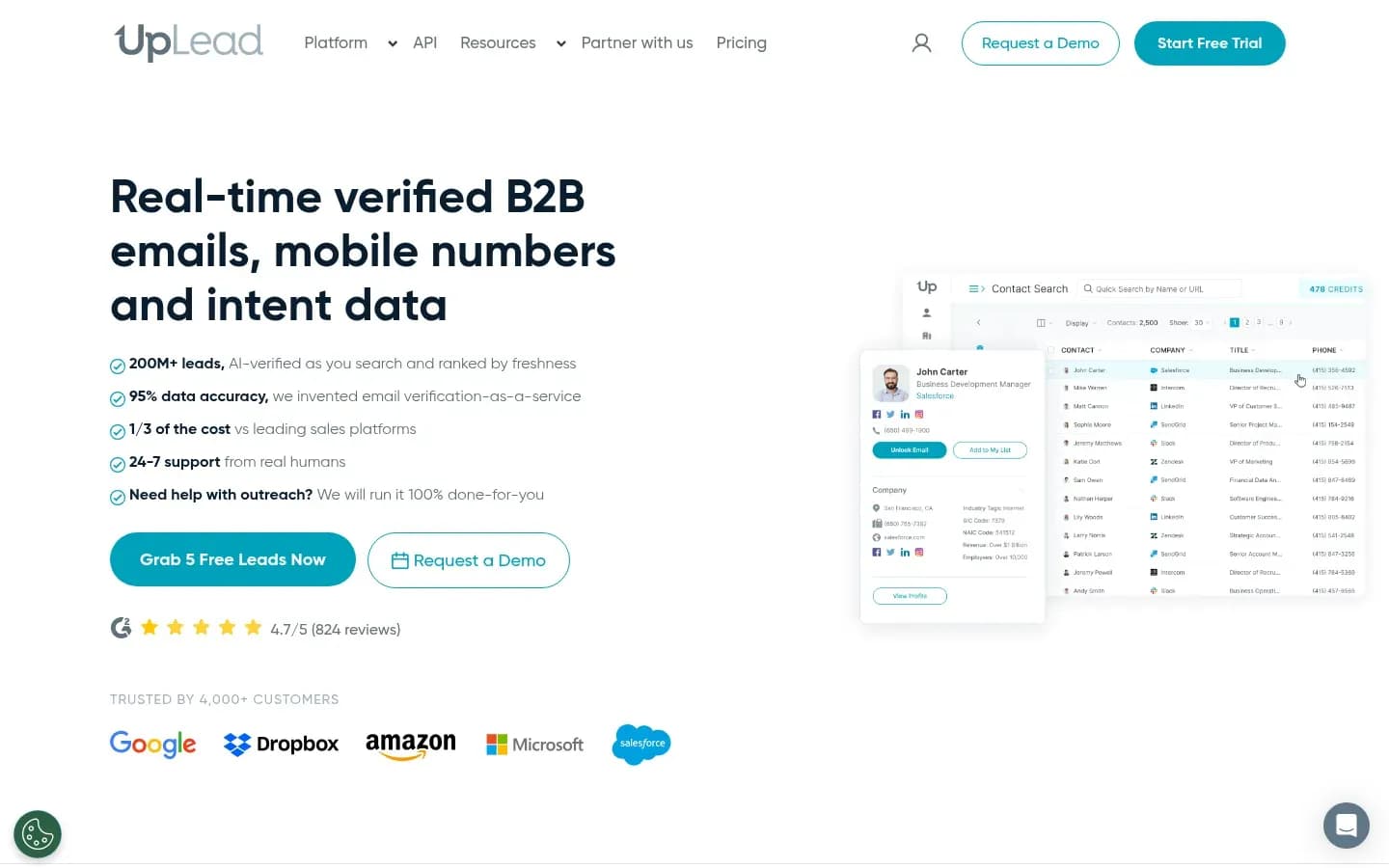
UpLead verifies each email in real time when a user downloads or exports it, labels it Valid, Invalid or Accept All, and refunds credits for bounces, so its accuracy promise applies at the moment of export rather than across the whole database.
Verdict. UpLead earns its place on verification at the point of use. Small teams pay for emails that were checked seconds before they reached the CRM, and bounces come back as refunds.
UpLead
B2B contact database with verified emails, mobile numbers and intent data for sales and marketing teams.
UpLead is a B2B contact database with verified emails, mobile numbers and intent data for sales and marketing teams. Its focus is email verification at the moment of download. It suits small, email-led teams that buy contacts in focused batches.
- Free plan
- No
- Free trial
- 7 days
- Public API
- Yes
- Ratings
- G2 4.7/5 (831 reviews)
Data and coverage. UpLead states 200M+ B2B contacts with email addresses, 19M+ global company profiles and 27K technologies tracked.
Freshness and verification. At download, UpLead performs real-time email verification with AI risk scoring and labels each email Valid, Invalid or Accept All. A Valid email is, by UpLead's own claim, 97%+ verified at the moment of download or export. UpLead backs this with a 95%+ accuracy guarantee and refunds for bounces and poor data. The 97% applies at export, not months later, so an exported list decays like any other.
Standout features. UpLead builds its data by analysing public documents and licensing data from third parties, then validates it with AI anomaly detection. It adds mobile and direct-dial numbers, technographics, intent data and data enrichment.
Real cost drivers. Bounce refunds lower the cost of bad data, because a failed email returns its credit. On G2, reviewers flag high upfront cost, automatic subscriptions and complicated pricing as a recurring concern, so check renewal terms before buying.
Pricing. UpLead's plans appear in the table below.
UpLead pricing
| Plan | Price | Billing | Notes |
|---|---|---|---|
| Essentials (annual billing) | $74 | per month, billed annually | per user |
| Essentials | $99 | per month | per user |
| Plus (annual billing) | $149 | per month, billed annually | per user |
| Plus | $199 | per month | per user |
| Professional | Custom pricing | per seat |
Best for
- Small teams buying verified emails in focused batches with bounce refunds
Not for
- Teams that reuse large exported lists for months without re-verifying them
Limitations. Missing contacts and outdated contacts are UpLead's top cons on G2, followed by filtering issues and missing emails. Its review base on G2 is far smaller than ZoomInfo's or Apollo's, so its patterns rest on fewer reviewers.
How Accurate Are B2B Contact Databases?
B2B contact data goes stale because people change jobs: the median US wage and salary worker had been with their current employer for 4.1 years in January 2026, and workers aged 25 to 34 for just 3.0 years, so any database is only as accurate as its last refresh.
The same Bureau of Labor Statistics release puts the highest median tenure, 4.9 years, in management, professional and related occupations. Workers aged 25 to 34 sit 1.1 years below the 4.1-year median.
No vendor escapes decay. Inaccurate data, outdated data and outdated contacts are the top complaint themes in ZoomInfo's G2 reviews, and the same pattern appears among the top cons on G2 for Cognism, Apollo, SalesIntel and UpLead. Data accuracy also sits among the top G2 pros for ZoomInfo, Cognism, SalesIntel and UpLead, so the same database draws both praise and complaints for its data.
What differs is the freshness promise each vendor states:
Stated freshness and the records it covers
| Vendor | Stated freshness | What it covers |
|---|---|---|
| Cognism | Refreshed on a 30-day basis | Director level and above |
| SalesIntel | Re-verified on a rolling 90-day cycle | AI+human-verified contacts |
| UpLead | Verified in real time at download | Each exported email |
| ZoomInfo | Automated machine-learning updates | Public data from 28M+ sites daily |
These promises measure different things. Cognism's cycle covers a seniority band. SalesIntel's 95% accuracy guarantee covers its AI+human-verified contacts. UpLead's 97%+ describes an email at the moment of export. None of them describes the whole database months after purchase.
The practical answer is to treat any stated accuracy as a starting point, then measure it on your own target accounts and re-verify before each large send.
How to Choose a B2B Contact Database
Choose a B2B contact database by its coverage of your own target accounts, its stated refresh cycle and the moment it verifies emails, not by its total record count, because ZoomInfo, Cognism, Apollo, SalesIntel and UpLead each measure size and accuracy their own way.
Start from list building for your ideal customer profile: the regions, industries, seniority levels and roles you really sell to. Then work through the checks below in order.
- Coverage for your ICP's region, seniority and roles, not total records: ZoomInfo publishes two different phone figures, and Cognism describes coverage by seniority and region
- The stated refresh cycle and what it covers: Cognism's 30 days applies to Director level and above, SalesIntel's 90 days to AI+human-verified contacts
- When and how emails are verified, and how accept-all emails are labelled: UpLead verifies at download and flags Accept All separately
- Phone data type and DNC screening if you call: Cognism screens against registries in 12 countries, including TPS and CTPS
- Export and credit rules: Apollo charges credits for reveals, exports and enrichment, with separate email and mobile balances
- Integrations with your CRM and sequencer: Salesforce and HubSpot are common to Cognism and SalesIntel, and Apollo lists 200+ integrations
- Compliance posture and data broker registration: Cognism is registered with the California Attorney General, and ZoomInfo states it is a data broker under Texas law
Weight the checks by how your team sells:
- Call-led teams: weight phone coverage and mobile verification first, then DNC screening.
- Email-led teams: weight verification at export and accept-all handling first, then credit rules.
- Teams prospecting into the UK and EU: weight European DNC screening and notice handling first, then refresh cycle.
- Teams that need execution too: weigh whether a built-in sequencer and dialer replaces tools you already pay for.
A database that passes these checks on paper still needs to pass them on your accounts, which is what the test in the next section is for.
How to Test a B2B Contact Database Before You Buy
The fairest way to compare B2B contact databases is to request the same 50 to 100 target accounts from each shortlisted vendor and compare role match, email status and mobile coverage side by side, because each vendor's accuracy figure applies to its own subset or moment, such as UpLead's 97%+ at the moment of export.
Run the test on accounts you would really contact, across your key regions and roles. A generic sample flatters every vendor.
- Pick 50 to 100 accounts you would really contact, spread across your key regions and roles
- Request the same accounts and roles from each shortlisted vendor's trial or sample
- Compare the match rate for the named roles you need, not total contacts returned
- Record each email's status: valid, invalid or accept-all
- Compare mobile and direct-dial match rates if your team calls
- Check a sample of emails with an independent verification tool and call a sample of numbers
- Note how many records the vendor shows as recently updated
- Ask each vendor in writing what its accuracy figure measures and when
That last question exposes the differences between the figures. Cognism's 30-day refresh applies to Director level and above. SalesIntel's 95% guarantee applies to AI+human-verified contacts. UpLead's 97%+ applies to a Valid email at download. A vendor that cannot say what its figure measures gives you nothing to hold it to.
Track credit spend during the test as well. At Apollo, email reveals, phone reveals, exports and enrichment draw on credits, with separate email and mobile balances, while calls that do not connect use zero credits. A trial that burns through mobile credits on 100 accounts predicts what a full quarter will cost.
UpLead refunds credits for bounced emails, so count the refunds during the test: they show the bounce rate on your own segment.
Score each vendor on the same sheet, then trial the one or two that matched your named roles best before signing a longer contract.
What Does a B2B Contact Database Cost to Run?
The running cost of a B2B contact database depends less on its list price than on how it meters use: Apollo spends separate credits on emails, mobile numbers, exports and enrichment, SalesIntel sells one fee for unlimited data, and UpLead refunds credits for emails that bounce.
Each tool's plans sit in its pricing table above. The cost drivers below decide what a realistic setup really costs.
What drives running cost
| Vendor | Main cost driver | What to watch |
|---|---|---|
| Apollo | Credits per reveal, export and enrichment | Separate email and mobile balances |
| SalesIntel | One fee for unlimited data | Seats and contract terms |
| UpLead | Credits per download | Bounce refunds, automatic subscriptions |
| ZoomInfo | Top-tier contract cost | Implementation time, negotiated discount |
Credits. Credit models charge for actions, not for access. At Apollo, a team spends credits to see an email, to reveal a phone number, to export or push records outside Apollo on some plans, and on enrichment credits and AI research. Because email and mobile use separate balances, a call-heavy team needs to size its mobile credits on their own.
Unlimited data. SalesIntel's "One fee, unlimited data" pitch moves the cost to the contract. Heavy users avoid per-record metering, so the questions become seat count and contract length.
Refunds and renewals. UpLead refunds credits for bounces and poor data, which lowers the cost of bad records. On G2, UpLead reviewers raise high upfront cost, automatic subscriptions and complicated pricing as a recurring concern.
Implementation and negotiation. G2 places ZoomInfo's perceived cost at its highest tier, with reviewers reporting about one month to implement, about 14 months to return on investment and an average discount of about 15%. That discount suggests list price is a starting point for negotiation.
Is Using a B2B Contact Database Legal Under GDPR, PECR and CAN-SPAM?
Buying B2B contact data is legal in the US, UK and EU, but the sender still carries duties: the FTC says CAN-SPAM makes no exception for business-to-business email, the UK requires live B2B calls to be screened against TPS and CTPS, and GDPR Article 14 requires notice to people whose data was not collected from them.
EU GDPR. When personal data comes from a database rather than from the person, GDPR Article 14 requires notice within a reasonable period and at the latest within one month. If you use the data to contact the person, notice is due at the latest at the first communication. If the data is passed to another recipient, it is due when first disclosed.
UK PECR and UK GDPR. The ICO says you do not need consent under PECR to send B2B marketing emails to corporate subscribers, but you must screen live B2B calls against both the TPS and CTPS registers. The UK GDPR still applies whenever you process personal data. The consent exception does not cover sole traders and some partnerships, so check how a prospect's business is constituted.
US CAN-SPAM. The FTC's compliance guide requires opt-out requests to be honoured within 10 business days, and each separate email in violation is subject to penalties of up to $53,088. Build both rules into your cold email programme before the first send.
California. From August 1, 2026, registered data brokers must access California's Delete Request and Opt-out Platform (DROP) at least once every 45 days and process consumer deletion requests, subject to limited exceptions. Data brokers must also register annually and pay a fee. Ask any vendor whether it is registered and how it handles DROP deletions.
Vendor duties versus yours. A vendor's posture covers the vendor's own processing. Cognism, for example, relies on legitimate interest, notifies contacts within GDPR timeframes, screens phone data against DNC registries in 12 countries and is registered as a data broker with the California Attorney General. That does not make your outreach compliant: your notices, opt-outs and call screening remain your responsibility.
This section is general information, not legal advice.
Which B2B Contact Database Should You Choose?
If you sell into the UK and EU and rely on calling mobiles, choose Cognism; if you need intent signals and data delivery across a large US team, choose ZoomInfo; and if you are a small team buying verified emails, UpLead's verification at export and bounce refunds fit best.
Match the pick to your situation:
Pick by situation
| Situation | Pick | Why |
|---|---|---|
| Enterprise US team needing intent | ZoomInfo | Buyer intent, enterprise data delivery |
| Selling into the UK and EU by phone | Cognism | 30-day Director+ refresh, DNC screening in 12 countries |
| Lean team wanting data plus execution | Apollo | Database, sequences and Parallel Dialer together |
| Team wanting a stated re-verification window | SalesIntel | 90-day AI+human cycle, Research on Demand |
| Small team buying verified emails | UpLead | Verification at export, bounce refunds |
Shortlist two at most, then run the account test before signing.
Frequently Asked Questions
What is a B2B contact database?
A B2B contact database is a searchable set of business contacts and company records, with emails, phone numbers, job titles and firmographics, that sales and marketing teams use to build prospect lists and enrich their CRM. Its value depends on coverage of your market and how recently each record was verified.
What is the difference between a B2B contact database and a CRM?
A B2B contact database supplies records you do not have yet, so your team can find new prospects. A CRM stores your own relationships: the accounts, contacts, deals and activity your team already works. Most teams export contacts from the database into the CRM, then manage outreach and pipeline there.
Should you use more than one B2B data provider?
Use more than one when a single provider leaves gaps in a region, seniority band or contact type such as mobiles. Waterfall enrichment queries several sources in sequence until a field is filled. Apollo builds waterfall enrichment into its data layer, alongside a customer's own data, its proprietary data and third-party signals. Test each added source on your own accounts.
Is LinkedIn Sales Navigator a B2B contact database?
Not in the sense used here. LinkedIn Sales Navigator is a LinkedIn search tool for finding and following people and accounts, rather than an exportable contact database of emails and phone numbers. A team that needs emails or phone numbers for outreach outside LinkedIn needs a contact database such as the five compared here.
Which B2B contact database is best for Europe?
For outreach into Europe, Cognism is the pick among the five here. It positions itself as built for growth in Europe, refreshes Director-level and above contacts on a 30-day basis and screens phone data against DNC registries in 12 countries, including the UK's TPS and CTPS. Cognism also states that it notifies contacts within GDPR timeframes.
Sources
Sources
- Employee Tenure News Release · bls.gov
- ZoomInfo SalesOS Reviews: Pros and Cons | G2 · g2.com
- CAN-SPAM Act: A Compliance Guide for Business · ftc.gov
- Art. 14 GDPR – Information to be provided where personal data have not been obtained from the data subject · gdpr-info.eu
- Business-to-business marketing | ICO · ico.org.uk
- Delete Request and Opt-Out Platform (DROP) · cppa.ca.gov