A small team buying its first AI visibility tracker pays for prompts, engines and check frequency, not for a logo on a pricing page. The short answer below ranks five self-serve tools, and the order rewards a short prompt list checked daily on ChatGPT, AI Overviews, Perplexity and Copilot.
The ranking rewards a short prompt list checked daily on the four engines OtterlyAI includes. OtterlyAI leads because every plan checks ChatGPT, AI Overviews, Perplexity and Copilot daily with no add-on, while LLMrefs refreshes weekly and Rankscale's credits suit weekly schedules. At larger workloads the order changes. Rework's three-tool comparison at 50 daily prompts with Gemini puts Rankscale's entry credit plan below Peec AI and OtterlyAI. The order applies to one brand in one main market, so price the engines your buyers use before choosing.
How We Chose These AI Visibility Tools
A small-budget AI visibility tool has to pass one test before price matters, which is whether a team can size its workload as prompts times engines times days and buy that workload on a self-serve plan, the framing Rankability's pricing study uses to compare whole subscriptions. If you are new to the topic, start with what AI search visibility measures and why mentions and citations differ.
Ten tools recur across the published rankings for this topic. Five pass the inclusion bar:
- A self-serve plan a small team can buy without a sales call
- Monthly or flexible billing
- Scheduled tracking of custom prompts or keywords on at least three AI engines
- A published unit, such as prompts, responses or credits, that a buyer can size
The five are then compared on the same criteria:
- The cost of a realistic small workload, counted as prompts times engines times check frequency
- Which engines are included and which are sold as add-ons
- How often each prompt is checked
- What pauses or burns the allowance
- What the plan includes beyond tracking
No tool here is scored on answer accuracy. AI answers also vary from run to run, so every tracker reports a sample of answers rather than a fixed truth.
Several well-known names miss the bar for small budgets. Sonary reports that Profound discontinued its self-serve Starter and Growth plans, and the others either cap the entry tier tightly or sell AI tracking inside a larger suite. Teams with enterprise budgets can compare the larger AI visibility platforms instead.
Considered, Not Included
| Tool | Reason |
|---|---|
| Profound | No self-serve plan, quote only |
| Semrush AI Visibility Toolkit | Entry tier tracks 25 prompts on two engines, more prompts cost extra |
| SE Ranking | AI tracking is an add-on to an SEO subscription |
| Surfer AI Tracker | Entry plan tracks ChatGPT only, refreshed weekly |
| HubSpot AEO | Prompts loaded by hand, bundled with Marketing Hub |
Best AI Visibility Tools For Small Budgets Comparison
The five tools below bill on different units, prompts at OtterlyAI and Peec AI, prompts and responses at Promptwatch, keywords at LLMrefs and credits at Rankscale, so the sticker price only compares once each is converted to the same prompts, engines and check frequency.
The table lists them in ranked order. Plan prices sit in each tool's pricing table further down.
| Tool | Pricing model | Free trial | Billing unit | Engines included | Check frequency | Best for |
|---|---|---|---|---|---|---|
| OtterlyAI | Paid | Yes | Prompts | 4 fixed, add-ons extra | Daily, fixed | Short daily prompt lists |
| LLMrefs | Paid | 7 days | Keywords | 11, all included | Weekly minimum | Broad engine coverage |
| Rankscale | Paid | Credits | 11, credit-priced | Scheduled per term | Wide engine mix, weekly | |
| Peec AI | Paid | Yes | Prompts | 3 chosen, add-ons extra | Daily | Daily stakeholder reporting |
| Promptwatch | Paid | 7 days | Responses | 7 named | Daily, adjustable | Tracking plus content drafting |
Read the Engines Included column before the price. A plan that supports Claude or Gemini does not always include them, and that gap is where most small budgets stretch.
OtterlyAI
OtterlyAI is the low-cost way to track a short prompt list every day, because every plan checks ChatGPT, Google AI Overviews, Perplexity and Microsoft Copilot daily, and the cost only climbs when a team adds Gemini, AI Mode or Claude as paid add-ons.
OtterlyAI
AI search monitoring platform that tracks brand mentions and website citations across ChatGPT, Perplexity, Google AI Overviews and other AI engines, for marketing teams and agencies.
OtterlyAI is an AI search monitoring tool that tracks brand mentions and website citations in AI answers. Plans are sized by search prompts, and every plan includes unlimited team members and unlimited brand reports. It suits marketers who want a simple daily feed rather than a research platform.
- Free trial
- Yes
- Platforms
- Web
- Public API
- Yes
- Compliance
- GDPR, ISO 27001, SOC 2
- Ratings
- G2 4.7/5 (54 reviews)
What it tracks: Every plan covers a fixed set of four engines, ChatGPT, Google AI Overviews, Perplexity and Microsoft Copilot. Claude, Google AI Mode and Gemini are extra add-ons. Plans are sized at 15 prompts on Lite, 100 on Standard, 400 on Premium and 1,000 or more on Enterprise.
Billing unit and spend driver: The unit is the prompt, and the spend driver is the engine list. Add-ons scale with the tier. On monthly billing, Gemini or AI Mode costs $9 a month each on Lite, $59 on Standard and $149 on Premium, while Claude costs $109 a month on Standard and $439 on Premium. Lite cannot buy extra prompts, so outgrowing 15 prompts means moving to Standard.
Check frequency: OtterlyAI checks every tracked prompt on every engine once a day, on a fixed cycle users cannot change. Its help centre recommends daily checks because AI answers are non-deterministic.
Pricing: OtterlyAI's plans and prices are below.
OtterlyAI pricing
| Plan | Price | Billing | Notes |
|---|---|---|---|
| Lite |
|
| |
| Standard |
|
| |
| Premium |
|
| |
| Enterprise | Custom pricing |
Best for
- A solo marketer or small team whose buyers use ChatGPT, AI Overviews, Perplexity and Copilot
- A pilot of 15 or fewer prompts that needs daily data
Not for
- Teams that need Claude or Gemini tracked on a small plan
- Teams that want to slow checks to weekly to save money
Limitation: Gemini, AI Mode and Claude cost extra on every tier, and Lite has a single workspace and no prompt top-up. G2 reviewers most often mention a learning curve at setup, with a few citing slow loading and layout issues.
Pros
- Four main engines checked daily on every plan
- Unlimited team members and brand reports
Cons
- Gemini, AI Mode and Claude are paid add-ons
- Lite holds 15 prompts with no top-up
LLMrefs
LLMrefs suits a small team that wants every major engine in one plan, since it includes eleven AI engines, from ChatGPT and Gemini to Claude, Grok and DeepSeek, without add-on fees and refreshes each tracked keyword at least weekly.
LLMrefs
AI search analytics platform that tracks how brands appear in ChatGPT, Google AI Overviews, Perplexity and Gemini, for brands, agencies and SEO teams.
LLMrefs is an AI search analytics tool that tracks how brands appear in AI answers. It works from keywords rather than single prompts and generates the related fan-out prompts automatically. It sells one All in One plan for marketing teams.
- Free plan
- Yes
- Free trial
- 7 days
- Public API
- Yes
What it tracks: LLMrefs covers ChatGPT, ChatGPT Search, Google AI Overview, Google AI Mode, Gemini, Perplexity, Claude, Grok, Microsoft Copilot, Meta AI and DeepSeek. The plan tracks 500 prompts with geo-targeting in 50+ countries and 20+ languages, unlimited team members, projects and domains, monthly AI prompt volume estimates and CSV export.
Billing unit and spend driver: The unit is the keyword, with prompts generated from it. With a single plan and every engine included, the spend driver is simply whether the keyword and prompt allowance fits the brand's list.
Check frequency: Every keyword updates at least once a week, with weekly reports.
Pricing: The LLMrefs plan is below.
LLMrefs pricing
| Plan | Price | Billing | Notes |
|---|---|---|---|
| All in One | $79 | per month |
Best for
- Teams that want Claude, Gemini, Grok and Meta AI included without add-ons
- Small teams that can work with weekly data
Not for
- Teams that need daily trend lines
- Teams that want the tool to suggest or write content
Limitation: An Analyze AI review, written by a competing vendor, finds that keyword framing mirrors SEO rather than the full questions AI users type, that the LLMrefs Score is hard to act on without knowing its weighting, and that the product is a read-only dashboard with no content tools. A Rankability review notes users want more prescriptive guidance and see occasional report delays.
Pros
- Eleven engines included with no add-on fees
- Unlimited team members, projects and domains
Cons
- Keyword framing gives less control over exact prompt wording
- Monitoring only, with no content features
Rankscale
Rankscale charges in credits rather than prompts, and the engine mix sets the bill, since a Claude check costs 2 credits against 0.25 for ChatGPT, Perplexity, Gemini or AI Mode, so a weekly schedule on cheaper engines keeps a small plan going far longer.
Rankscale
AI visibility platform that tracks brand mentions, rankings, citations and sentiment across AI engines, for agencies and enterprise SEO teams.
Rankscale is an AI visibility platform that tracks brand mentions, rankings, citations and sentiment across AI engines. It adds competitor benchmarking, page audits and prompt research. Its plans are credit-based and it markets to agencies and enterprise SEO teams as well as marketing teams.
- Public API
- Yes
What it tracks: Rankscale names Google AI Overviews, Google AI Mode, ChatGPT, Perplexity, Meta, Gemini, Claude, Copilot, DeepSeek, Grok and Mistral, and states every engine sits on one platform with no upsell. Features include citation and source analysis, sentiment and competitor benchmarking.
Billing unit and spend driver: Monthly credit use equals search terms times AI engines times executions per month. Per Rework's reading of the rates, a DeepSeek check costs 1 credit, and a Claude check costs eight times a ChatGPT check. Prompt Research costs 50 credits a run, and page audits beyond the monthly allowance and the LLMs.txt generator also draw credits. Credits reset monthly, and only some plans roll unused credits over, up to a cap.
Check frequency: Rankscale advertises eight monitoring schedules, set per search term. Its help centre advises moving high-frequency terms from daily to weekly to cut usage.
Pricing: Rankscale's plans are below.
Rankscale pricing
| Plan | Price | Billing | Notes |
|---|---|---|---|
| Essentials | $17 | per month, billed annually | |
| Pro |
|
| |
| Pro+ |
|
| |
| Growth |
|
| |
| Enterprise |
|
| |
| Custom Plan | Custom pricing |
Best for
- Teams tracking a wide engine mix on a weekly schedule
- Buyers who want page audits and prompt research in the same tool
Not for
- Teams that need Claude checked daily on a small plan
- Buyers who want a fixed, predictable monthly allowance
Limitation: Credit burn is harder to forecast than a prompt cap. Per Rework, the Essentials tier lacks API access and CSV or Sheets export, and Pro has no REST API. At daily cadence with Claude, Rework found Rankscale the costliest of the three tools it compared, while a weekly cadence kept it on the entry plan.
Pros
- Eleven named engines on one platform
- Weekly schedules stretch a small credit budget
Cons
- Claude checks and daily schedules burn credits fast
- Entry tier lacks export and REST API
Peec AI
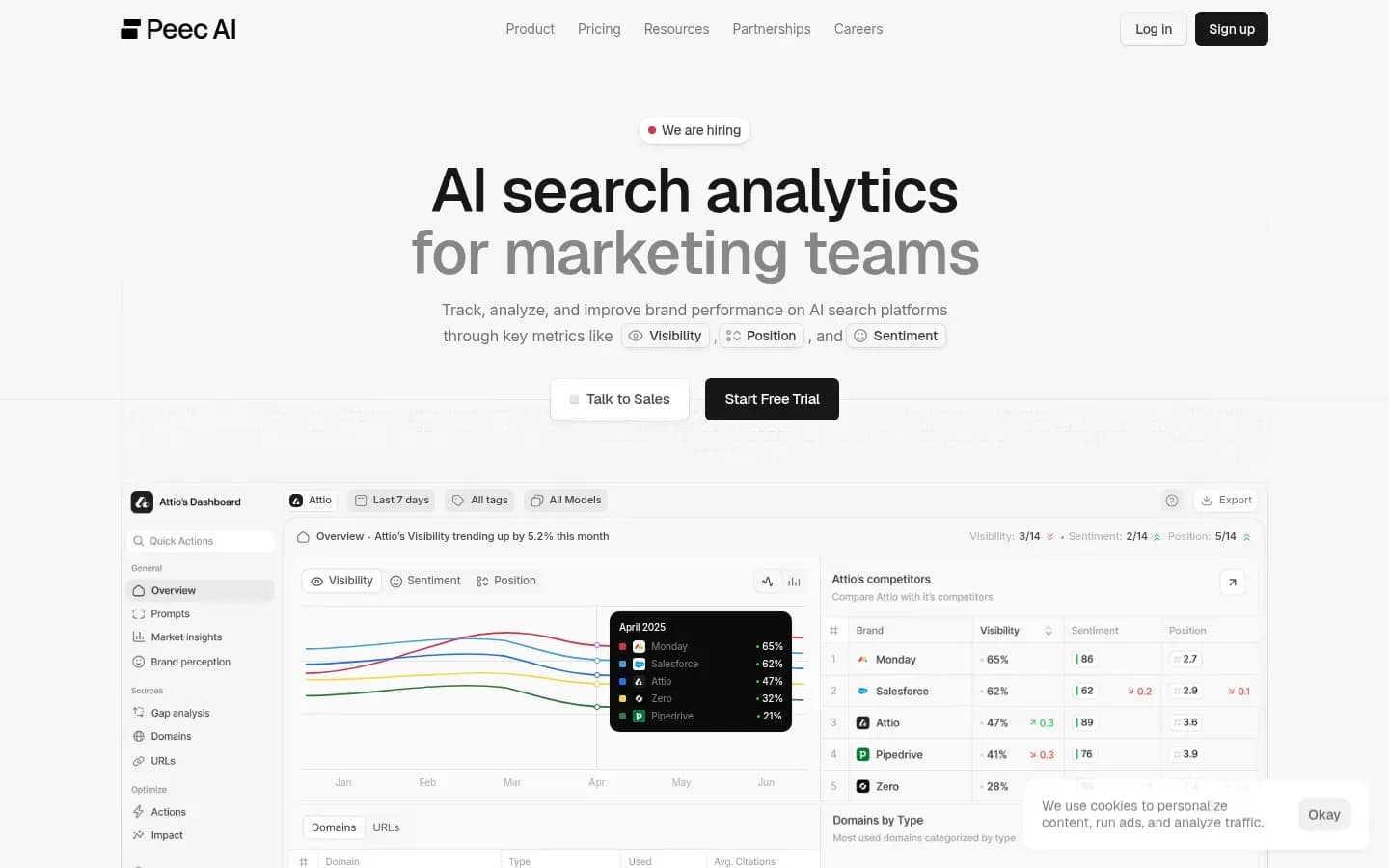
Peec AI gives a small team daily tracking on three models it chooses, with unlimited users on every self-serve plan, but each further model is a paid add-on and Claude sits among the upgrade models rather than the default pool.
Peec AI
AI search analytics platform for marketing teams and agencies that tracks brand visibility, position and sentiment in AI search tools.
Peec AI is an AI search analytics platform that tracks brand visibility, position and sentiment in AI search tools. Plans are sized by prompts and projects, and reporting is built for marketing teams that share results with stakeholders.
- Free plan
- No
- Free trial
- Yes
- Platforms
- API
- Public API
- Yes
- Ratings
- G2 4.7/5 (21 reviews)
What it tracks: The default model pool is ChatGPT, Google AI Overviews, Google AI Mode, Microsoft Copilot, Perplexity and Gemini, with Claude Sonnet and Claude Haiku as upgrade models. Starter holds 50 prompts and 1 project, Pro 150 prompts and 2 projects, and Advanced 350 prompts and 5 projects, which works out at 4,500, 13,500 and 31,500 AI answers a month. Data leaves through exports and a Looker Studio connector.
Billing unit and spend driver: The unit is the active prompt. Archived prompts keep their history without counting, and suggested prompts count only once accepted. The spend driver is models and countries. One extra model costs $35 a month on Starter, $85 on Pro and $165 on Advanced, and Starter allows one country per project against three on Pro and Advanced.
Check frequency: Every self-serve plan tracks daily.
Pricing: Peec AI's plans and prices are below.
Peec AI pricing
| Plan | Price | Billing | Notes |
|---|---|---|---|
| Starter |
|
| |
| Pro |
|
| |
| Advanced |
|
| |
| Enterprise | Custom pricing |
Best for
- A marketing team that has outgrown a pilot and reports to stakeholders
- Teams that want daily data on three engines they choose
Not for
- Teams whose buyers rely on Claude
- Brands that need several countries on the entry plan
Limitation: Self-serve plans track three models, and the entry plan covers a single country per project. For a deeper look at the model trade-off, see how Peec AI compares with Profound on engine coverage.
Pros
- Daily tracking and unlimited users on every self-serve plan
- Exports and a Looker Studio connector for reporting
Cons
- Three models unless you pay per extra model
- One country per project on Starter
Promptwatch
Promptwatch meters responses rather than prompts, counting every prompt on every model at every run, so a team that tracks fewer models or checks less often stretches the same plan, and monitoring pauses once the monthly response limit is used.
Promptwatch
AI search visibility platform that tracks how brands appear in AI answers and helps create content designed to be cited, for marketers, SEO teams and agencies.
Promptwatch is an AI search visibility platform that tracks how brands appear in AI answers and helps create content designed to be cited. It pairs monitoring with a content agent and AI crawler analytics, and it sells separate brand and agency plans.
- Free trial
- 7 days
- Platforms
- Chrome extension
- Public API
- Yes
- Ratings
- G2 4.6/5 (21 reviews)
What it tracks: Promptwatch covers ChatGPT, Gemini, Claude, Perplexity, DeepSeek, Google AI Overviews and Grok, with prompts set by country, language and city. Its content agent maps pages against AI answers, writes and refreshes pages from citation gaps and publishes to WordPress, Webflow or Framer. Access also runs through an MCP server.
Billing unit and spend driver: Responses equal prompts times models times runs. Fifty prompts on four models tracked daily come to about 6,000 responses a month, which is the Essential allowance. Essential holds 50 prompts and 6,000 responses, Professional 150 prompts and 18,000 responses, and Business 350 prompts and 42,000 responses. Add-ons raise agent credits and AEO articles, not responses.
Check frequency: The three fixed plans track daily. Teams can cut usage by tracking every two days, weekly or monthly, or by removing models.
Pricing: Promptwatch's plans and prices are below.
Promptwatch pricing
| Plan | Price | Billing | Notes |
|---|---|---|---|
| Essential | $95 | per month | |
| Professional | $245 | per month | |
| Business | $579 | per month |
Best for
- A lean team with no writer capacity that wants pages drafted and refreshed
- Teams that need city-level prompts
Not for
- Teams that want monitoring only, without content tools
- Teams that cannot risk gaps in a trend line
Limitation: Promptwatch bundles monitoring and content tooling in one response-metered subscription, and its entry plan, Essential, holds 50 prompts and 6,000 responses, enough for four models checked daily and no more. When the response limit is reached, monitoring pauses until usage resets or the plan is raised, which leaves a gap in the trend line.
Pros
- Monitoring and content production in one subscription
- Cadence and model count can be cut to save responses
Cons
- Monitoring pauses at the response limit
- Essential's responses run out past four daily models
How Much Do AI Visibility Tools Cost?
Rankability's pricing study puts plans that track 100 prompts daily on three AI engines from about $97 to just under $200 a month across the market, and for a small pilot it advises starting with a defined prompt set on a small fixed-price plan, so the first budget decision is how many prompts the team really needs.
Rankability publishes its study as a vendor that sells a competing tracker and includes itself, so treat the range as an industry guide rather than a quote. Its sizing method holds for any tool. Multiply prompts by engines by days, so 100 prompts on three engines checked daily for 30 days is 9,000 checks a month, then compare whole subscriptions at that number.
The study names five pricing traps:
- Recurring prompts are not the same as AI answers.
- Supported engines are not necessarily included engines.
- Weekly tracking is not daily tracking.
- Annual equivalents and promotions are not regular monthly prices.
- Unlimited clients does not mean unlimited monitoring.
For a small team, two of these matter most. Many pricing pages lead with the annual-billing figure expressed per month, so compare the monthly-billing column when you plan to pay month to month. And an engine named on a features page may be a paid add-on, as it is for Gemini and Claude on OtterlyAI and for any fourth model on Peec AI.
The pricing tables in each tool section above show the exact plans, including the annual-billing rates where a vendor publishes them.
AI Visibility Pricing Comparison At The Same Workload
At the same workload of about 50 prompts checked daily on ChatGPT, Gemini and Perplexity, Rework found Rankscale's entry credit plan cost least, Peec AI with a model add-on came next and Otterly with its Gemini add-on cost most, and adding Claude reshuffles that order.
Rework is an independent publisher, and its credit estimates are its own. The point of the exercise is the method. Each vendor bills on a different unit, so the only fair comparison fixes the workload first and then asks what each plan needs to cover it.
What 50 Daily Prompts on Three Engines Takes
| Tool | Billing Unit | What Covers The Workload | What Pushes It Up |
|---|---|---|---|
| OtterlyAI | Prompts | Standard, plus the Gemini add-on | Claude add-on, $109 a month on Standard |
| LLMrefs | Keywords | The single plan, weekly refresh | Outgrowing the keyword allowance |
| Rankscale | Credits | 4,500 checks at 0.25 credits each | Claude at 2 credits, daily schedules |
| Peec AI | Prompts | Starter's 50 prompts and three models | $35 a month per extra model on Starter |
| Promptwatch | Responses | Essential's 6,000 responses | A fourth model reaches the limit |
The arithmetic behind the table is short. Fifty prompts on three engines for 30 days is 4,500 checks. On Rankscale at 0.25 credits a check, that is about 1,125 credits a month. On Promptwatch it is 4,500 responses, inside Essential's 6,000, while a fourth model daily uses the whole allowance. On OtterlyAI, the 50 prompts outgrow Lite's 15, so the workload needs Standard, and Gemini is an add-on on top.
Adding Claude changes the order. Per Rework, Claude pushes Rankscale to weekly checks or a higher tier, raises OtterlyAI further through its Claude add-on, and is not sold self-serve on Peec AI. LLMrefs includes Claude in its plan, but its published refresh is weekly, so it does not promise a daily workload.
What Hidden Costs Push The Bill Up?
The bill for a small AI visibility setup rises through engines more than prompts, because supported engines are not necessarily included engines, as Rankability's study puts it. OtterlyAI charges for Gemini, AI Mode and Claude, Peec AI charges for any fourth model, and Rankscale's credit use rises with Claude.
The cost drivers differ by billing unit:
- Engine add-ons: OtterlyAI sells Gemini, AI Mode and Claude as add-ons that scale with the tier. Peec AI charges per extra model on every plan.
- Credit burn: Rankscale burns credits faster on Claude and on daily schedules, and Prompt Research takes 50 credits a run.
- Response limits: Promptwatch pauses monitoring once the monthly response limit is used.
- Prompt caps: OtterlyAI Lite holds 15 prompts and cannot buy more.
- Countries: Peec AI allows one country per project on Starter, so a second market means Pro.
The pattern is that the entry price buys a narrow setup. A small team rarely overspends on prompts. It overspends when the engine list grows, when it keeps daily checks on engines that cost more per run, or when it moves up a tier for one extra country.
How Many Prompts Should A Small Team Track?
A small team gets more from 25 to 50 well-chosen buying prompts tracked over weeks than from hundreds tracked once, because SparkToro found AI tools almost never return the same brand list twice, so the signal is how often a brand appears across many runs.
SparkToro's study, published in 2026, had 600 volunteers run 12 prompts through ChatGPT, Claude and Google's AI, 2,961 runs in total. ChatGPT or Google's AI had less than a 1-in-100 chance of returning the same brand list twice in 100 runs. Appearance was steadier than position, with City of Hope appearing in 69 of 71 ChatGPT answers but leading in only 25.
That changes how a small list should be built. One daily run per prompt is a sample, not a measurement, so a short list run many times beats a long list run rarely. Track the share of runs in which your brand appears, not its rank in one answer.
The decision rule is simple. Start from the questions a prospect asks before buying, group them by intent, and cap the list at what the entry plan holds. Peec AI helps here, since archived prompts keep their history without counting toward the limit. For the full method, see how to build an AI search prompt tracking list.
- List the questions prospects ask before they buy
- Group them by intent, such as comparison, pricing and problem
- Keep 25 to 50 prompts that a buyer would really type
- Add competitor and category prompts, not only brand prompts
- Cap the list at what the entry plan holds
- Review the list monthly and archive prompts that never move
Is Daily Or Weekly Tracking Enough?
Weekly tracking is enough for a small team that needs a broad engine mix on a fixed budget, because Rework estimates a weekly schedule stretches a fixed credit budget roughly seven times further than daily checks on the same prompts. The trade-off is a thinner sample, since each prompt runs about a seventh as often.
Daily tracking earns its cost on a short list where trend lines matter. It also comes with the plan on some tools. OtterlyAI checks daily on a fixed cycle, and Peec AI tracks daily on every self-serve plan, so on those tools a smaller list is the way to save, not a slower cadence.
Weekly tracking suits broad engine coverage billed on credits or keywords. LLMrefs refreshes every keyword at least weekly across all eleven engines. Rankscale lets a team set the schedule per search term, and its help centre advises moving high-frequency terms to weekly to cut credit use.
The trade-off is sample size. SparkToro recommends running a prompt many times and averaging the results, and OtterlyAI's help centre recommends daily checks to build enough data to see patterns. Fewer runs means a thinner sample per prompt, so weekly tracking is a budget and breadth choice, not a more accurate one.
Decision rule: Track daily when the list is short enough for the plan to hold and the plan fixes daily anyway, as on OtterlyAI and Peec AI. Track weekly when budget or a wide engine mix on a credit or keyword plan rules out daily checks, and read trends over more weeks to make up for the thinner sample. Whichever cadence you choose, learn to measure AI visibility without double-counting before reporting the numbers.
Which AI Visibility Tool Should You Choose On A Small Budget?
Choose by the engines your buyers use and how often you need data, not by the lowest sticker price, since Pew found Google users clicked a regular result on 8% of visits when an AI summary appeared, against 15% without one. For most small teams, that means OtterlyAI or LLMrefs.
That 2025 finding is why AI visibility is worth a small budget at all. When fewer searchers click through, being named inside the answer matters more. The choice then comes down to situation:
- A solo marketer piloting 15 or fewer prompts on the main engines: Choose OtterlyAI.
- A team that needs Claude, Gemini, Grok and Meta AI included and can accept weekly data: Choose LLMrefs.
- A team with a wide engine mix that will schedule weekly: Choose Rankscale.
- A team that needs daily data on three chosen models with stakeholder reporting: Choose Peec AI.
- A team without writing capacity that wants content drafted from citation gaps: Choose Promptwatch.
Agencies tracking several client brands have different needs, covered in the guide to AI visibility tools for agencies.
Frequently Asked Questions
Is there a free AI visibility tool?
Free trials and free accounts exist among AI visibility tools, and the comparison table above shows each tool's trial status. A free option is useful for testing the interface and a few prompts. For steady tracking of a buying-prompt list, a small paid plan usually gives more reliable data, because trends need many runs.
Can I check AI visibility manually in ChatGPT?
Checking prompts by hand in ChatGPT costs nothing and works for a quick look, but AI answers change between runs, so a handful of manual checks is a sample rather than a trend a team can report on. SparkToro found the same brand list almost never repeats, which is why trackers run prompts on a schedule.
Do AI visibility tools show traffic from AI search?
Not directly. These tools measure mentions, citations and sentiment inside AI answers, not clicks. An Analyze AI review notes LLMrefs does not tie mentions to clicks or conversions. Pew found users clicked a link inside a Google AI summary on about 1% of visits, so measure AI referral traffic in your web analytics tool.
Can I use more than one AI visibility tool?
Yes, but compare them with care. Each tool bills and counts on its own unit, whether prompts, keywords, credits or responses, and Rework's analysis shows those units change which tool costs least. Running two trackers on the same prompt list works best when you report each tool's trend separately rather than adding their numbers.
Sources
Sources
- Cheaper Profound Alternatives: AI Visibility Tools Small Teams Can Afford in 2026 · sonary.com
- NEW Research: AIs are highly inconsistent when recommending brands or products; marketers should take care when tracking AI visibility · sparktoro.com
- Peec AI vs Otterly vs Rankscale: Which AI Visibility Tracker Costs Less at Real Usage · resources.rework.com
- help.otterly.ai
- docs.peec.ai
- Do people click on links in Google AI summaries? · pewresearch.org
- Otterly vs Rankscale vs Trakkr: Three Published Price Ladders Compared at Equal Volume · resources.rework.com
- rankability.com
- How Much Should You Pay for AI Search Visibility Tracking Tools? · rankability.com
- otterly.ai