A startup buying its first B2B database needs a different shortlist from an enterprise sales team. What matters is how many people a self-serve plan lets in, whether a monthly option exists, and what the credit meter charges for and lets expire.
These picks apply to startups with one to ten sellers buying self-serve, without an enterprise data budget. Accuracy varies by region and ICP, so test a sample of your own target accounts in each free plan or trial before paying.
How We Picked These B2B Databases
This list ranks B2B databases by how easily a startup of one to ten sellers can start, stay flexible and control spend, judged from each vendor's published terms and recurring reviewer patterns rather than database size.
Many of the pages ranking for this search are written by data vendors that place their own product first. This one ranks by startup fit instead. For the wider category, including enterprise tools, see the hub on B2B contact databases or our broader ranking of B2B contact databases.
Eligibility: A tool made the list only if a startup of one to ten sellers can buy it without a sales call or an enterprise contract. It also needed a monthly or no-commitment option, email data plus at least one other data type, and published terms for the facts this post compares.
Criteria: Each tool is compared on the same five points.
- Small-team access: Seats per plan, and whether a free plan or trial lets you test first.
- Minimum commitment: Whether you can start month to month, and which features need annual terms.
- Credit meter: What each email, phone number or export costs in credits, and what expires.
- Onboarding effort: How much work stands between signing up and a first clean export.
- Reviewer patterns: The praise and complaints that recur across G2 reviews for each tool.
Limits: Lusha, UpLead and Lead411 publish their own data accuracy figures, and Snov.io publishes one for its email verifier. None of those figures is independent. This post therefore compares terms and meters, not accuracy, and treats every accuracy percentage as the vendor's own claim. The only reliable accuracy test is a sample of your own target accounts.
Databases Considered But Not Included
ZoomInfo, Cognism, Hunter, RocketReach and Clay appear on most startup database lists but fall outside this one, mainly because they are sold on annual quotes, cover only email, or orchestrate other providers' data.
They are all credible tools for the right team. The reasons below are about fit for a small, self-serve startup, not about data quality.
Tools considered and why they are not on this list
| Tool | Why it is not on this list |
|---|---|
| ZoomInfo | Enterprise annual contracts sold through a sales team |
| Cognism | Quote-only annual contracts aimed at EMEA sales teams |
| Hunter | An email finder rather than a full database with phone data |
| RocketReach | Per-lookup contact search with no outreach workflow, overlapping Lusha and UpLead |
| Clay | An enrichment layer that pulls from other providers rather than its own database |
Best B2B Databases For Startups
For most early-stage teams, Apollo is the first B2B database to try because it pairs its contact data with built-in email sequencing under one shared credit pool, while UpLead, Snov.io, Lusha and Lead411 each win a narrower situation.
The table compares the five on the terms that decide a startup purchase. Pricing model, free plan and trial come from each brand record. The typed columns show who each tool suits, how its meter works and whether you can pay month to month.
| Tool | Pricing model | Free plan | Free trial | Best for | Credit meter | Monthly option |
|---|---|---|---|---|---|---|
| Apollo | Freemium | Yes | Founder-led all-in-one prospecting | Shared credits, expire each cycle | Yes | |
| UpLead | Paid | No | 7 days | Verified emails, one seller | Credits, bounces refunded | Yes, no contract |
| Snov.io | Freemium | Email-first outreach on budget | Credits expire after 30 days | Yes | ||
| Lusha | Freemium | Yes | EMEA data, phone reveals | Phone costs 5 credits | Yes, credits roll over | |
| Lead411 | Paid | No | 7 days | Direct dials and intent | Exports, unused roll over | Yes, no commitment |
The ranking puts the broadest startup fit first. Apollo leads because one account covers list building and email sequencing. UpLead follows for teams that want clean emails and nothing else.
Snov.io ranks third, above two dedicated contact databases, because the ranking scores startup fit rather than database depth. For an email-first startup, its finder, verifier, warm-up and sending replace a database plus a separate sequencing tool in one bill. Snov.io is an outreach platform with a finder, though, so a team that needs phone data or a large contact database should look to Lusha or Lead411, which serve a specific region or channel well.
- ApolloBest for founder-led teams wanting data and sequencing in one tool
- UpLeadBest for one seller who needs verified emails, month to month
- Snov.ioBest for email-first outreach with finder, verifier and warm-up
- LushaBest for linkedIn-led prospecting into Europe and APAC
- Lead411Best for cold-calling teams that need direct dials
Apollo
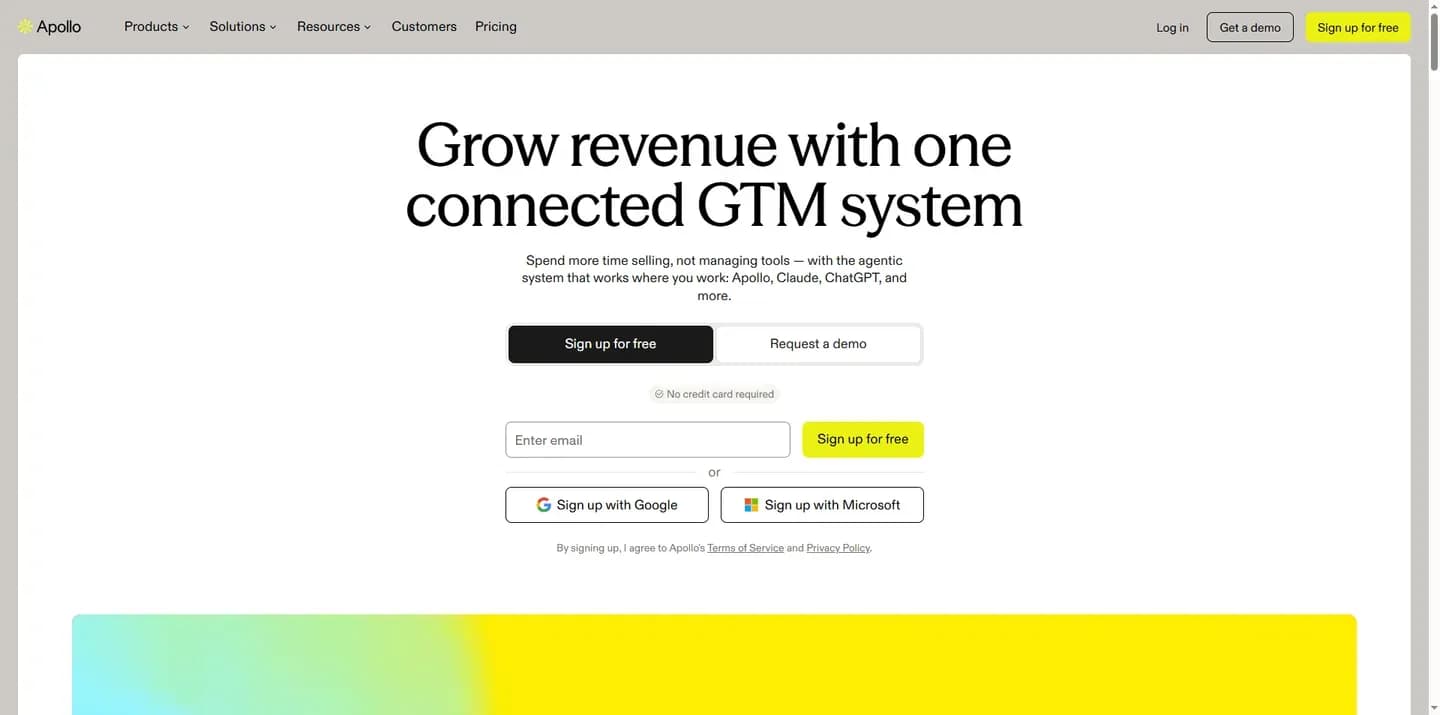
Apollo is the default pick for founder-led startups because it combines a contact database with email sequencing, but its credits expire at the end of every billing cycle, so unused allowance is lost spend.
Apollo
AI sales platform combining a B2B contact and company database with outreach and engagement tools for sales teams.
Apollo is a sales platform that pairs a B2B contact and company database with email sequencing and engagement tools. G2 reviewers repeatedly praise its large database, its advanced filters and having prospecting and outreach in one place. Many describe it as cost-effective for startups and small agencies. Apollo acquired the revenue intelligence company Pocus in 2026 and kept its own name.
- Free plan
- Yes
- Compliance
- GDPR, ISO 27001, SOC 2
- Ratings
- G2 4.7/5 (9,843 reviews) · Capterra 4.5/5 (398 reviews)
Startup access: Apollo credits sit in one pool shared across the team, and an admin can set a credit limit for each person. A founder can give a first sales hire a budget without buying a separate data account. Apollo also offers a one-time trial of a paid plan that includes 100 credits, enough to test a sample of target accounts before paying.
Cost meter: Apollo charges at most 1 credit per contact for an email, and only for emails it can verify. Each verified phone number costs the same number of credits whatever its type. Exporting company data can also use credits. Credits expire at the end of each billing cycle and do not roll over.
Pricing: A realistic Apollo bill is the seat price for each seller plus any add-on credit packs. Add-on credits renew automatically every billing cycle, a mid-cycle purchase is charged in full rather than prorated, and unused credits are non-refundable. Buy add-ons only when a campaign needs them.
Apollo pricing
| Plan | Price | Billing | Notes |
|---|---|---|---|
| Free | $0 | per month | per seat |
| Basic |
|
| per seat |
| Professional |
|
| per seat |
| Organization |
|
| per seat |
Best fit: A founder or first sales hire who wants to build lists and run email sequences from one tool, prospecting mainly into US accounts, with a team small enough that one shared credit pool is easy to manage.
Limitations: G2 reviewers often report outdated contact records and weaker accuracy outside the US. They also say the credit system pushes spend up as usage grows, that useful features sit in higher tiers and that the breadth of the product brings a learning curve. A team selling mainly into Europe should test Apollo against Lusha on the same sample.
UpLead
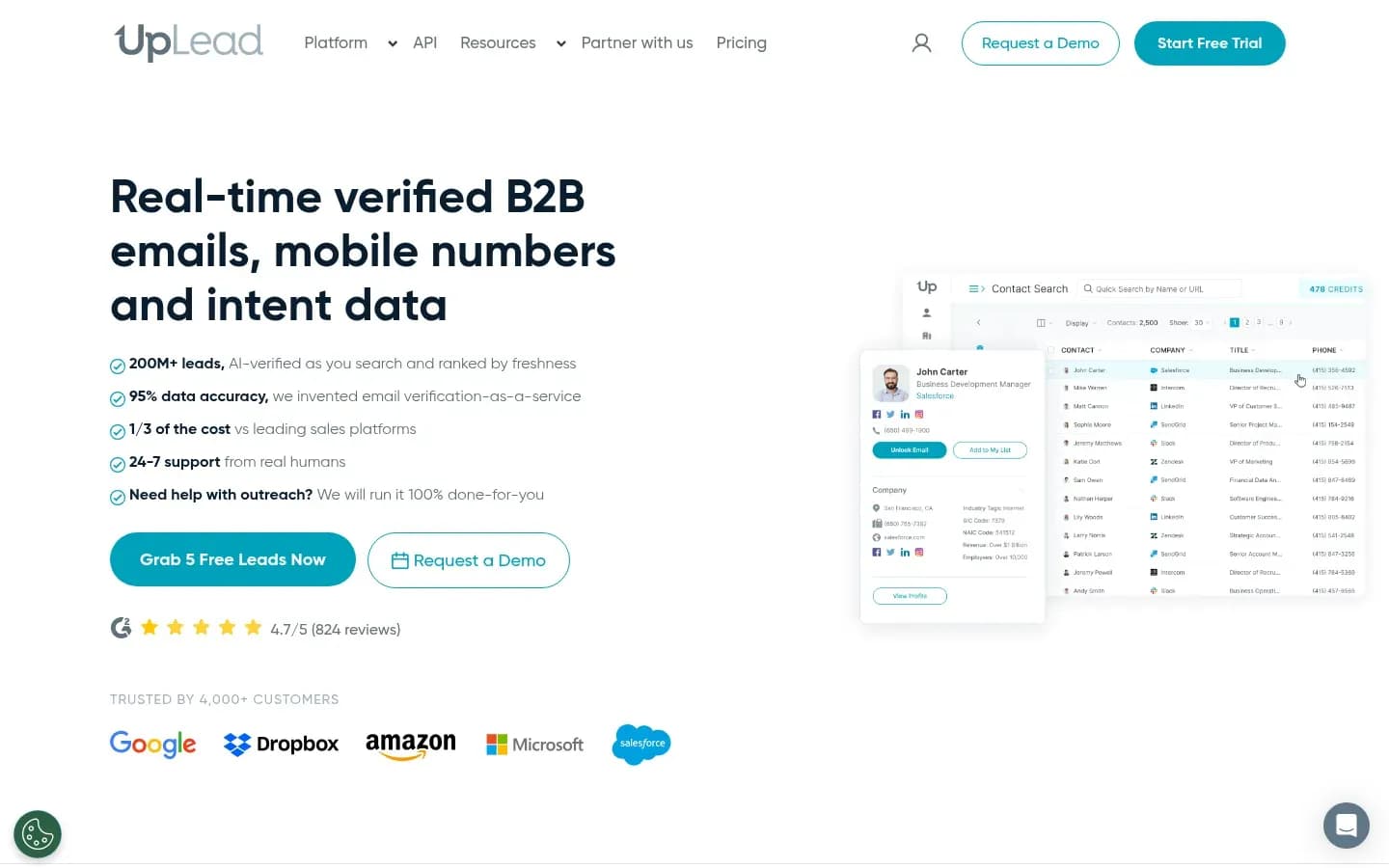
UpLead suits a startup with one seller who needs verified emails on a month-to-month plan, since its self-serve plans carry no contract but include a single user seat.
UpLead
B2B contact database with verified emails, mobile numbers and intent data for sales and marketing teams.
UpLead is a B2B contact database built around verified emails. UpLead says it holds 200M+ contacts, verifies each email in real time at export and backs its data with a 95%+ accuracy guarantee, refunding credits for bounces. Search runs on 50+ filters, including 16K+ technology data points for technographic targeting and intent filters.
- Free plan
- No
- Free trial
- 7 days
- Platforms
- API, Chrome extension
- Public API
- Yes
- Ratings
- G2 4.7/5 (831 reviews) · Capterra 4.6/5 (76 reviews)
Startup access: UpLead's monthly plans have no contract or long-term commitment, and you can upgrade or downgrade at any time. The Essentials and Plus plans each include 1 user seat. The Professional plan, which covers larger teams, is sold on annual billing only.
Cost meter: UpLead charges credits per contact. Extra credits cost $0.60 each on Essentials and $0.50 each on Plus. Because UpLead refunds credits for emails that bounce, a bad record costs less here than on a meter that charges for every reveal.
Pricing: A realistic UpLead bill for a solo seller is one self-serve plan plus extra credits in heavy months. A second seller changes the calculation, because the self-serve plans stop at one seat and the multi-seat plan is annual.
UpLead pricing
| Plan | Price | Billing | Notes |
|---|---|---|---|
| Essentials (annual billing) | $74 | per month, billed annually | per user |
| Essentials | $99 | per month | per user |
| Plus (annual billing) | $149 | per month, billed annually | per user |
| Plus | $199 | per month | per user |
| Professional | Custom pricing | per seat |
Best fit: A solo founder or one seller who wants clean, verified emails to load into an existing sequencing tool, and who values bounce refunds over built-in outreach.
Limitations: The single seat on Essentials and Plus is the main startup constraint. G2 reviewers also mention a small trial allowance, cost for some users and occasional missing or outdated contacts and coverage gaps. UpLead has no email sequencing of its own, so outreach needs a second tool.
Integrations: UpLead connects to Salesforce, HubSpot, Zoho, Pipedrive, Microsoft Dynamics 365 and Close on the CRM side, and to Outreach, SalesLoft, Reply.io, Woodpecker and lemlist for outreach, with Zapier for the rest.
Snov.io
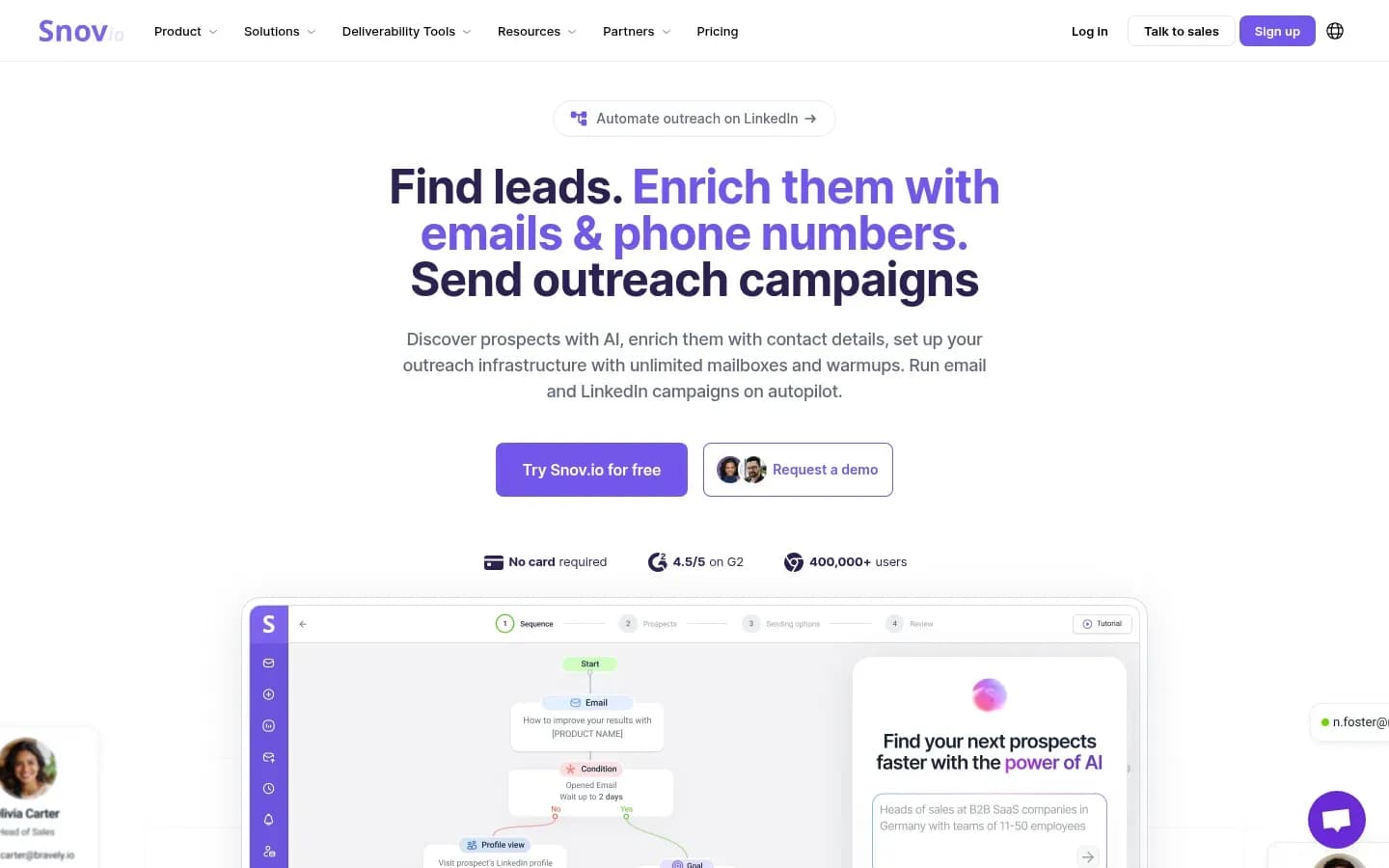
Snov.io is a low-friction choice for an email-first startup that wants to find, verify and send from one account, though it is an outreach tool with a finder rather than a deep phone database.
Snov.io
Outreach automation and lead generation platform for sales teams and marketers, combining email finding and verification, warmup, and cold email and LinkedIn campaigns.
Snov.io combines an email finder, an email verifier, email and LinkedIn drip campaigns, automated inbox warm-up and a built-in CRM. Snov.io says its verifier is 98% accurate. It does not publish a database size, so it belongs on this list as an email-first outreach platform rather than as a like-for-like contact database.
- Platforms
- Chrome extension
- Public API
- Yes
- Compliance
- GDPR
Startup access: Snov.io bills monthly, every 3 months at 5% off or annually at 25% off, and you can cancel, upgrade or downgrade at any time.
Cost meter: Each prospect found and each email verification costs 1 credit. Sending runs on a second meter, recipients, and a recipient is charged at first contact, with follow-ups in the same period free. Unused credits expire after 30 days and roll over only on an annual plan or with renewal enabled.
Pricing: A realistic Snov.io bill has up to four parts. The plan covers credits and recipients, phone enrichment tokens are a separate meter at $0.02 per token, valid for 90 days, and LinkedIn automation is a separate product billed per account slot.
Snov.io Sales Suite pricing
| Plan | Price | Billing | Notes |
|---|---|---|---|
| Starter (annual billing) | $29.25 | per month, billed annually | |
| Starter | $39 | per month | |
| Pro S (annual billing) | $74.25 | per month, billed annually | |
| Pro S | $99 | per month | |
| Pro M | $189 | per month | |
| Pro L | $369 | per month | |
| Ultra | $738 | per month |
Snov.io LinkedIn Automation pricing
| Plan | Price | Billing | Notes |
|---|---|---|---|
| LinkedIn account slot (annual billing) | $62 | per month, billed annually | |
| LinkedIn account slot | $69 | per month |
Best fit: An email-first founder who wants finding, verifying, warm-up and sending in one bill, and who does not need a large phone dataset.
Limitations: Snov.io is not a deep phone database and publishes no database size. G2 reviewers say the credit model feels limiting for small teams and that higher tiers are expensive at low volume. They also report occasional email accuracy problems and basic reporting.
Integrations: Snov.io states 5,000+ integrations and an MCP connection.
Lusha
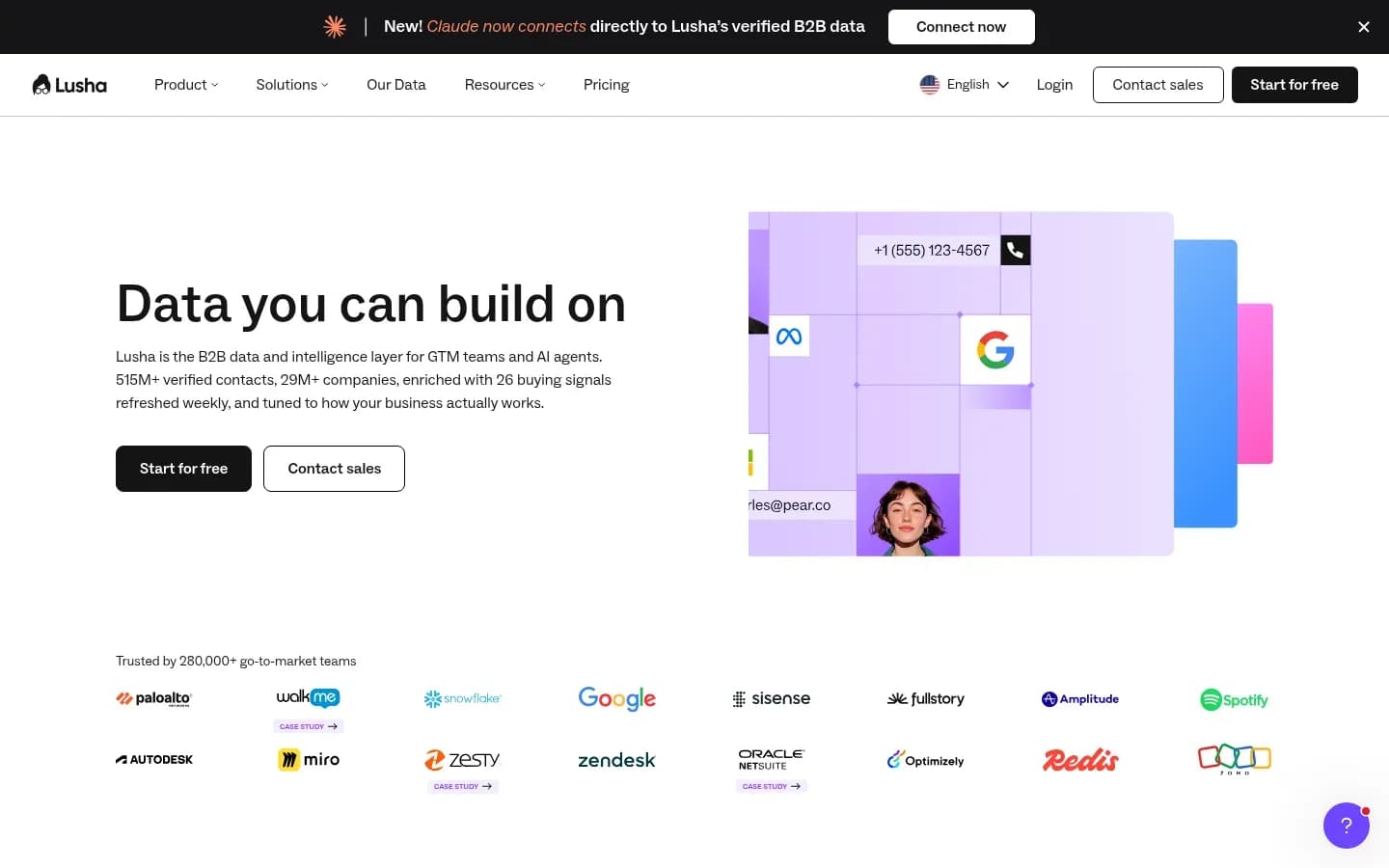
Lusha fits a startup that prospects contact by contact from LinkedIn and sells into Europe, but a phone reveal costs five times the credits of an email, which shapes the real cost.
Lusha
B2B contact and company data platform for sales, marketing and recruiting teams, with a Chrome extension and API.
Lusha is a B2B contact and company data platform. Lusha says it holds 515M+ contacts and 29M+ companies, about 132 million of them US contacts, and refreshes contact fields weekly. It adds buying signals such as job changes, funding rounds and hiring surges, and reveals contact details while you browse professional network profiles.
- Free plan
- Yes
- Platforms
- API, Chrome extension, Web
- Public API
- Yes
- Compliance
- GDPR, ISO 27001, SOC 2
- Ratings
- G2 4.3/5 (1,667 reviews)
Lusha's accuracy figures, 98% for email and 85% US and 86% global for phone, are the vendor's own claims, not independent findings.
Startup access: On Lusha's monthly paid plans, unused credits roll over up to 2x the monthly allowance. On annual plans, unused credits do not carry forward to renewal. A shared team credit pool is available only on the Premium and Scale plans.
Cost meter: Revealing an email costs 1 credit and revealing a phone number costs 5 credits. A phone-heavy motion therefore burns through an allowance five times faster than an email-only one. Free-plan credits reset each cycle and do not carry over.
Pricing: A realistic Lusha bill depends on the mix of emails and phones you reveal. Plan the allowance from that mix, not from the headline credit count, and prefer monthly billing while rollover matters to you.
Free option: Free plan. Plans and prices on Lusha’s site →
Best fit: A startup selling into EMEA or APAC that prospects one contact at a time from LinkedIn and mostly needs emails, with phone numbers for a short list of priority accounts.
Limitations: G2 reviewers praise Lusha's EMEA and APAC data but report weaker US coverage. They also mention inaccurate or outdated details, credit limits that feel restrictive at high volume and costs that rise over time.
Integrations: Lusha connects to Salesforce, HubSpot, Pipedrive and Zoho, and to Clay, Make, n8n and Zapier for workflows.
Lead411
Lead411 is the pick for a startup that sells by phone, since its no-commitment entry plan includes unlimited direct-dial views and rolls unused exports over while you stay subscribed.
Lead411
Sales intelligence platform with verified emails, direct-dial mobile numbers and trigger data for outbound sales teams.
Lead411 is a sales intelligence platform for outbound teams. Lead411 says its mobile direct phones are double-verified and claims 96%+ email deliverability. It offers extensions for prospecting from LinkedIn and from Gmail, and trigger data for timing outreach.
- Free plan
- No
- Free trial
- 7 days
- Platforms
- API, Chrome extension
- Ratings
- G2 4.5/5 (482 reviews)
Startup access: Lead411 marks its entry plan as "No Commitment". That plan includes 200 exports a month and unlimited email and direct-dial views, so a seller can look up numbers freely and spend exports only on the contacts worth keeping. Lead411 offers discounted rates for multiple seats.
Cost meter: Lead411 meters exports rather than reveals. Unused exports roll over while you stay subscribed. Extra exports cost $0.50 each on the no-commitment plan and less on higher tiers. Bombora intent data is available only on Lead411's annual subscriptions, where the first tier with intent includes 10,000 exports a year.
Pricing: A realistic Lead411 bill for a startup is the no-commitment plan plus extra exports in busy months. Adding Bombora intent later means moving to an annual subscription.
Lead411 pricing
| Plan | Price | Billing | Notes |
|---|---|---|---|
| Spark | $49 | per month | |
| Ignite | $150 | per month | |
| Pilot Light | $0 |
Best fit: A startup whose outbound motion is cold calling, which wants direct dials now and intent data once the team commits to annual terms.
Limitations: G2 reviewers report coverage gaps in niche markets and regions and want more direct and mobile numbers with clearer phone-type labels. They also describe an interface that could be simpler and clunky CRM exports. Reviewers do praise helpful support and simpler workflows than larger databases.
Integrations: Lead411 plans include free integration with 25 CRMs.
How To Choose A B2B Database For A Startup
Choose a startup B2B database by your ICP's region, whether you need phone numbers, how many people will prospect and what happens to unused credits, then confirm accuracy on a sample of your own target accounts. Those five checks separate the tools on this list faster than any feature grid.
Work through them in order, because each one removes options.
- Decide whether you need email only or email plus phone, since phone reveals cost 5 credits on Lusha and Lead411 is built for direct dials
- Match coverage to your ICP region, since G2 reviewers flag weaker non-US accuracy for Apollo and weaker US coverage for Lusha
- Count your sellers before buying, since UpLead Essentials and Plus include 1 user seat
- Check what expires, since Apollo credits expire each billing cycle and Snov.io credits after 30 days unless annual
- Run a matched sample of your own ICP accounts in each free plan or trial and compare bounce rates
- Treat the accuracy figures Lusha, UpLead, Lead411 and Snov.io publish as vendor claims
Start with the channel: If your motion is email, the meter that matters is the cost per verified email and what bounces cost you. UpLead refunds credits for bounces, and Apollo charges only for emails it can verify. If your motion is the phone, Lead411's unlimited direct-dial views on its no-commitment plan change the economics.
Then the region: Reviewer patterns point in opposite directions for the two broadest tools. Apollo reviewers report weaker accuracy outside the US, and Lusha reviewers praise its EMEA and APAC data but report weaker US coverage. A startup selling into Germany and one selling into Texas should not buy the same database by default.
Then the team: One seller fits any plan here. A second seller rules out UpLead's self-serve plans, and on Lusha a shared credit pool needs Premium or Scale. Apollo shares credits across the team with per-person limits.
Finally, the sample: Lusha, UpLead, Lead411 and Snov.io's verifier each come with the vendor's own accuracy figure, so those claims cannot separate them. Pull the same 50 to 100 target accounts in each tool you shortlist, verify the emails, and compare who found the buyers you need. Our guide on how to evaluate B2B database coverage before buying sets out that test step by step.
How Much Does A B2B Database Cost A Startup
What a startup actually pays for a B2B database depends less on the plan price than on the meter, because Apollo credits expire every billing cycle, Lusha charges five credits per phone number and Snov.io bills recipients and credits separately. Two tools on the same plan price can produce very different monthly bills.
Each tool's plans sit in the pricing tables in its section. This section covers what the plan price leaves out.
What each startup database meters, and the cost that surprises
| Tool | You pay on | Rule to know | Cost that surprises |
|---|---|---|---|
| Apollo | Credits per verified email or phone | Credits expire each billing cycle | Add-on credits renew, unprorated |
| UpLead | Credits per contact | Bounced emails refunded as credits | $0.60 or $0.50 per extra credit |
| Snov.io | Credits plus recipients | Credits expire after 30 days | Phone tokens at $0.02 each |
| Lusha | 1 credit per email, 5 per phone | Monthly plans roll over up to 2x | Phone reveals drain the allowance |
| Lead411 | Exports | Unused exports roll over | $0.50 per extra export |
Expiring credits: The plan price overstates value in a slow month. Apollo credits expire at the end of each billing cycle, and Snov.io credits expire after 30 days unless you are on an annual plan or have renewal enabled. If a campaign slips a month, the unused allowance is gone. Lusha's monthly plans and Lead411 handle this better, since unused credits or exports roll over.
Phone data: Each meter treats phone numbers its own way. Lusha charges 5 credits for a phone reveal against 1 for an email. Snov.io bills phone enrichment on a separate token meter at $0.02 per token, valid for 90 days. Apollo charges the same credits for each verified phone number whatever its type. Lead411 includes unlimited direct-dial views on its no-commitment plan and meters exports instead.
Add-ons that keep billing: Apollo add-on credits renew automatically each billing cycle, and a mid-cycle purchase is charged in full rather than prorated. Snov.io sells LinkedIn automation as a separate product per account slot. Lead411 charges $0.50 per extra export on its no-commitment plan and less on higher tiers.
Seats: UpLead's Essentials and Plus include 1 user seat. A second seller means a second plan or the annual Professional plan. Apollo shares one credit pool across the team, and an admin can set a credit limit for each person.
A simple way to budget is to estimate the contacts and phone numbers your next campaign needs, convert them to credits on each meter, and compare that figure rather than the headline plan.
Do Startups Need A Long-Term Contract For B2B Data
None of these five databases requires a startup to sign an annual contract to start, but UpLead's Professional plan and Lead411's Bombora intent data are sold only on annual terms. A startup can begin month to month on any of them and decide on annual billing once usage settles.
The catch is that "no contract" entry plans can gate the features a growing team wants.
- UpLead: Monthly plans carry no contract, but the multi-seat Professional plan is annual-only.
- Lead411: The entry plan is marked "No Commitment", but Bombora intent data needs an annual subscription.
- Snov.io: You can cancel any time, but credits roll over only on an annual plan or with renewal enabled.
- Lusha: Monthly plans roll unused credits over up to 2x, while annual plans do not carry credits forward to renewal.
- Apollo: Credits expire each billing cycle on any term, so annual billing does not protect unused allowance.
Lusha shows that annual is not always better for a startup. Its monthly plans keep unused credits for longer than its annual plans do at renewal, so the flexibility of monthly billing has a direct cash value.
For a startup, the bigger risk is paying a year ahead for an ICP that is still changing. A first market test often reshapes the target list within a quarter.
How Long Does It Take To Set Up A B2B Database
Setup time for a startup B2B database runs from under a day on Lead411, by G2 reviewers' accounts, to a learning curve on Apollo, with Lusha praised by reviewers for quick setup. Snov.io adds inbox warm-up before its first send, so plan for that step when choosing it.
The gap comes from how much each product covers. Apollo combines a database with email sequencing, so there is more to learn before a first campaign. Snov.io adds a step the pure databases do not, because inbox warm-up runs before sending.
The core steps below apply whichever tool you pick.
- Write your ICP as account filters, person filters and exclusions
- Connect your CRM so exports land as records rather than spreadsheets
- Import a suppression list of customers, open deals and past opt-outs
- Run a small export of 50 to 100 contacts first
- Verify the export and check bounces before the first full campaign
The filter step takes the most thought. Our playbook on how to turn an ICP into prospecting filters shows how to write account filters, person filters and exclusion rules that each tool can apply.
Which B2B Database Should A Startup Choose
If you are a founder running both prospecting and email yourself, start with Apollo; if you sell by phone, choose Lead411; if your buyers are mostly in Europe, choose Lusha. UpLead and Snov.io cover the remaining cases, one seller who needs verified emails and an email-first team that wants one bill.
Before buying anything, check what you already hold. If your CRM already holds most of your target accounts, it is usually better to enrich the CRM records you already hold than to buy a new list.
Founder doing email and sequencing in one tool on a tight budget: Apollo.
Best for
- Founders building lists and running email sequences from one account
Not for
- Teams selling mainly outside the US
One seller wanting verified emails and no contract: UpLead.
Best for
- A solo seller who wants verified emails with bounce refunds
Not for
- Teams of two or more on self-serve plans
Email-first outreach with finder, verifier and warm-up in one bill: Snov.io.
Best for
- Email-first founders who want finding, verifying and sending together
Not for
- Teams that need deep phone data
Selling into Europe or APAC, contact by contact from LinkedIn: Lusha.
Best for
- Startups prospecting EMEA and APAC accounts one contact at a time
Not for
- Phone-heavy motions on a small credit allowance
Cold-calling motion needing direct dials: Lead411.
Best for
- Cold-calling teams that want unlimited direct-dial views
Not for
- Teams that need intent data without an annual commitment
When two situations apply, pick by the channel that books most of your meetings. A founder who emails US accounts and calls only a few priority accounts will get more from Apollo than from Lead411.
Is Buying B2B Contact Data Legal For Cold Email
The FTC states that CAN-SPAM makes no exception for business-to-business email, so every cold email a startup sends to a bought B2B list still needs an opt-out honored within 10 business days and a valid physical postal address. The duties sit with the sender, not with the database vendor.
The FTC's compliance guide sets out the rules that matter most for a startup sending to a bought list.
- No B2B exemption: Business email follows the same rules as consumer email.
- Opt-outs: Honor every opt-out request within 10 business days.
- Postal address: Include a valid physical postal address in every message.
- Penalties: Each separate email in violation can draw a penalty of up to $53,088.
Rules outside the US differ, so a startup prospecting into Europe should check the local rules before the first campaign. This section is general information, not legal advice.
Frequently Asked Questions
Is there a free B2B database for startups?
The comparison table above shows which of these five tools has a free plan or a free trial. Use any no-cost tier to test a sample of your ICP before paying, not to run campaigns.
Do startups need phone numbers or just emails?
Most startups need emails first and phone numbers only for priority accounts or a calling motion. Lusha charges 5 credits per phone reveal against 1 per email, and Snov.io bills phone enrichment on a separate token meter. Buy phone data in volume only if the team actually calls.
How often should a startup refresh its contact data?
Re-verify a startup contact list before each campaign rather than once a year. US workers stayed a median 4.1 years with their employer in January 2026, so half had been in their current job for less time than that. Workers aged 25 to 34 had a median of 3.0 years. See how fast B2B contact data decays for the field-by-field evidence.
Should a startup use one B2B database or two?
Start with one database and add a second only when a measured gap appears. A common gap is region, since reviewers report weaker non-US accuracy for Apollo and weaker US coverage for Lusha. Another is channel, where an email-first tool leaves the team short of direct dials for calling.
Our Verdict
Sources
Sources
- Employee Tenure News Release · bls.gov
- uplead.com
- apollo.io
- The Email List Decay Report for 2026 · zerobounce.net
- CAN-SPAM Act: A Compliance Guide for Business · ftc.gov
- knowledge.apollo.io