Claude now sends measurable referral traffic, and it picks sources differently from ChatGPT. That makes "does this tool track Claude, and on which plan?" the first question to ask of any AI visibility tracker.
This shortlist applies when you need Claude-specific mention and citation data for a B2B brand, not a general multi-engine dashboard. Claude answers vary from run to run and change when Claude searches, so any tool's number is a rate across repeated runs, not a fixed rank.
Why Track Claude Separately From ChatGPT?
Claude cites a different web than ChatGPT. In one practitioner analysis, Claude used web search in 36.6% of prompts and shared only 8% of its citations with ChatGPT, against about 90% search use for ChatGPT. A ChatGPT score therefore says little about how Claude presents your brand.
The figures come from Jonathan Clark of Moving Traffic Media, who presented them at a Zero Click by Profound session. He gave no sample size, so treat them as directional. The same analysis found Claude's citations overlapped 64% with Google rankings.
The practical consequence is simple. A brand can earn ChatGPT citations from pages Claude never surfaces, and the reverse. Each engine needs its own tracking if Claude matters to your buyers.
Claude is still a small traffic source, but it is growing fast. In SE Ranking's own Google Analytics dataset, Claude's share of website traffic rose from 0.0029% in January to 0.0141% in April 2026, a 386% increase. SE Ranking sells AI visibility tools and did not state its sample size.
Over the full 16 months of that dataset, ChatGPT generated 78.23% of AI-referred traffic and Claude 1.40%. So the case for tracking Claude now is its growth rate and its different source set, not today's volume. Teams that wait for the volume to arrive will have no baseline to compare against.
If you are new to the wider discipline, our hub on AI search visibility covers how mentions, citations and referrals are measured across engines.
How We Chose These Claude Visibility Tracking Tools
Five tools made this shortlist because each tracks Claude answers for brand mentions and cited sources, and each vendor documents on its own pages which plan or add-on includes Claude. Tools whose Claude placement is known only from a competitor's review or ranking are listed separately with the reason.
Inclusion bar: The tool tracks Claude answers (not only ChatGPT), shows mentions and cited sources, and its vendor states how Claude is sold, by plan or add-on.
The criteria, in order of weight:
- Claude access by plan, because a tracker that keeps Claude on a higher tier ranks lower for most buyers.
- How Claude answers are collected, through the app interface, a browser front end or the API, with or without web search.
- Refresh cadence and repeat runs.
- Evidence shown, such as answer text, citations and sentiment.
- What drives the bill.
Collection methods and plan limits below are as each vendor describes them, and review patterns are attributed to the platform that published them. Refresh cadence sets how many samples a month you collect per prompt.
Most pages ranking for this topic are vendor lists that rank their own product first. Superlines' Claude list is one example. This list includes no Growth Tribune product, and the order follows Claude fit for an in-house B2B team.
Considered, Not Included
| Tool | Why not included |
|---|---|
| Peec AI | Enterprise-only Claude, per a rival's ranking |
| Semrush | Enterprise-only Claude, per a rival's ranking |
| Otterly.AI | Claude add-on, per a rival's review |
| Superlines | Claude fit claimed only in its own ranking |
| AIclicks | API-only Claude collection, per a rival's ranking |
The Enterprise-only Claude placement for Peec AI and Semrush and AIclicks' API-only collection come from Superlines' own ranking, and Otterly.AI's Claude add-on from Trakkr's coverage review. Both publishers sell competing trackers.
Best Claude Visibility Tracking Tools
For Claude specifically, Promptwatch and Rankscale lead because both include Claude on every plan, while Profound sells Claude inside custom Enterprise contracts and Scrunch offers it only as an Enterprise add-on.
| Tool | Free plan | Free trial | Claude access | Claude collection | Refresh | Best for |
|---|---|---|---|---|---|---|
| Promptwatch | 7 days | Every plan | App interface scraping | Daily | In-house SEO and content | |
| Rankscale | Every plan, per-model credits | API or web search | Bi-hourly to bi-monthly | Analysts and agencies | ||
| Profound | No | Enterprise plan only | Browser front end | Daily | Enterprise custom contracts | |
| LLMrefs | Yes | 7 days | Included on its plan | Aggregated per keyword | Weekly | Small teams, consultants |
| Scrunch | 7 days, no card needed | Enterprise add-on only | Browser automation or API | 72-hour default | Sitecore-led enterprises |
Read the Claude access column first. It decides the shortlist before price does, because a cheap plan without Claude tracks nothing you need.
The collection column decides what the number means. App and browser capture is closest to what a buyer sees, while API answers without search measure a different Claude. The refresh column sets how quickly a change in Claude's answers shows up in your data.
The order in this post is Promptwatch, Rankscale, Profound, LLMrefs and Scrunch. It ranks Claude fit for an in-house B2B team, meaning Claude on the entry plan, app-faithful collection and daily data, rather than overall platform size.
Promptwatch
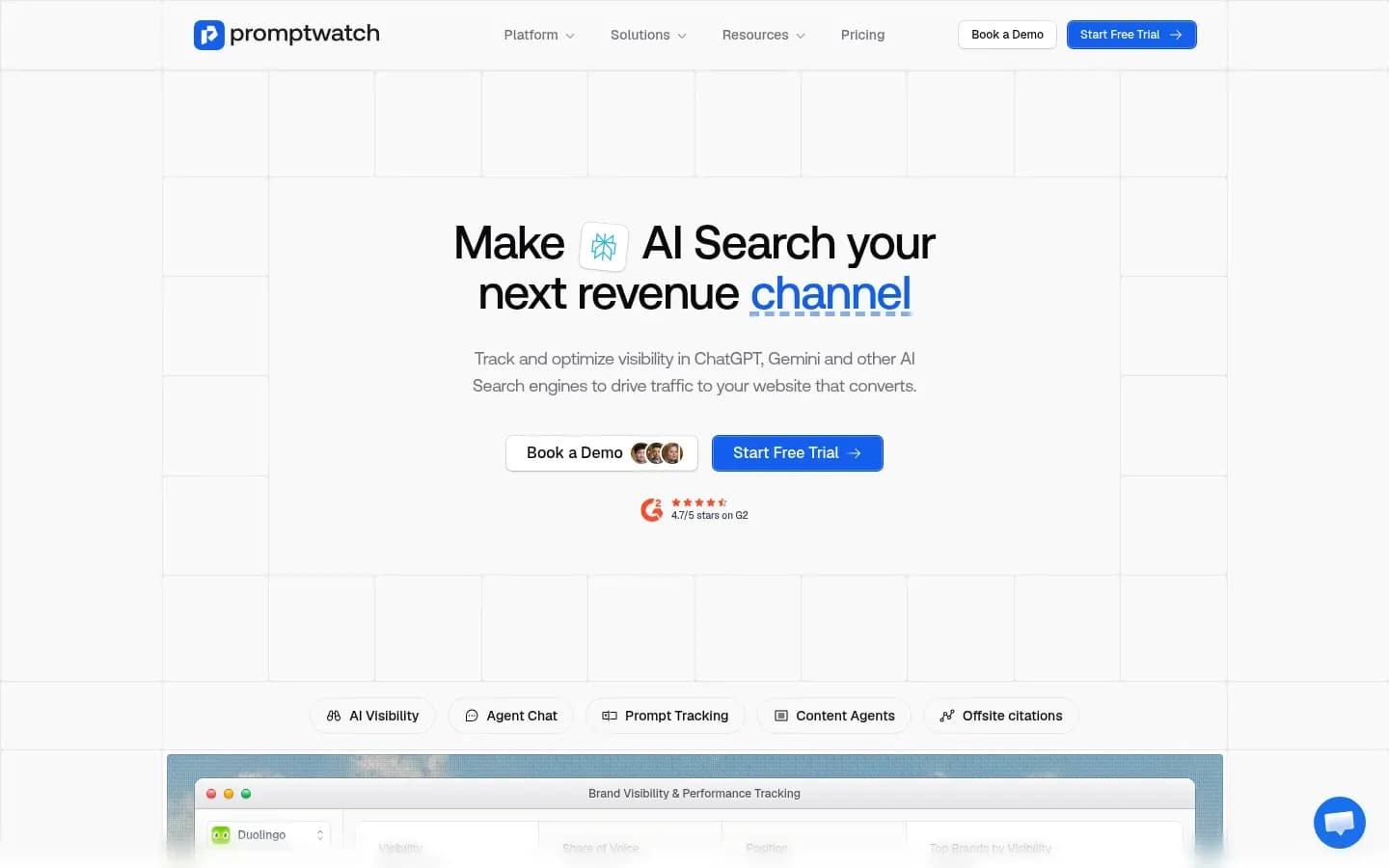
Verdict: Promptwatch is the most direct Claude tracker for in-house teams. It includes Claude on every plan, refreshes daily and, by its own account, collects answers by scraping the chat interfaces people actually use.
Promptwatch
AI search visibility platform that tracks how brands appear in AI answers and helps create content designed to be cited, for marketers, SEO teams and agencies.
Promptwatch is an AI search visibility platform that tracks how a brand appears in AI answers, Claude among them, and turns citation gaps into content. It serves in-house marketers, SEO teams and agencies.
- Free trial
- 7 days
- Platforms
- Chrome extension
- Public API
- Yes
- Compliance
- GDPR, ISO 27001
- Ratings
- G2 4.6/5 (22 reviews)
How it gets Claude answers: Promptwatch says it scrapes the user interfaces of the AI apps people use every day rather than querying their APIs. Interface capture reflects the answers users see, including any searching Claude chose to do.
Claude access by plan: All seven listed models, Claude among them, are on every plan, with daily tracking and unlimited seats. The Business plan adds tracking up to hourly.
Standout features:
- Buyer personas defined by role, goals and context, and locations in any country and language, with city-level tracking on the Business plan.
- Cited-page reporting that shows which pages AI answers cite.
- Agent analytics that show which AI crawlers hit which pages.
- A content agent that turns citation gaps into new pages and refreshes, and publishes to WordPress, Webflow or Framer.
Pricing:
Promptwatch pricing
| Plan | Price | Billing | Notes |
|---|---|---|---|
| Essential | $95 | per month | |
| Professional | $245 | per month | |
| Business | $579 | per month |
What drives the bill: Prompts and responses per plan. Essential covers 1 project, 50 prompts and 6,000 responses. Professional raises that to 2 projects, 150 prompts and 18,000 responses and adds content writing and MCP and API access. Business covers 5 projects, 350 prompts and 42,000 responses. On Essential, Agent Chat and MCP or API access are paid add-ons, so a team that wants Claude data in its own reporting should price the add-on in.
Best fit: In-house content and SEO teams that want Claude tracking and content actions in one tool.
Limitations: Searchable, which sells a competing tracker, notes in its review that Promptwatch tracks both the Claude chatbot and Claude Code with web search on, and does not separate answers with web search from answers without it. Teams that want to study Claude's recall without search need a second source.
Pros
- Claude on every plan with daily tracking
- Collects from the app interface, not the API
- Personas, plus city-level tracking on Business
- Content agent turns citation gaps into pages
Cons
- No split between web-search and no-search Claude answers
- API and MCP access cost extra on the entry plan
Rankscale
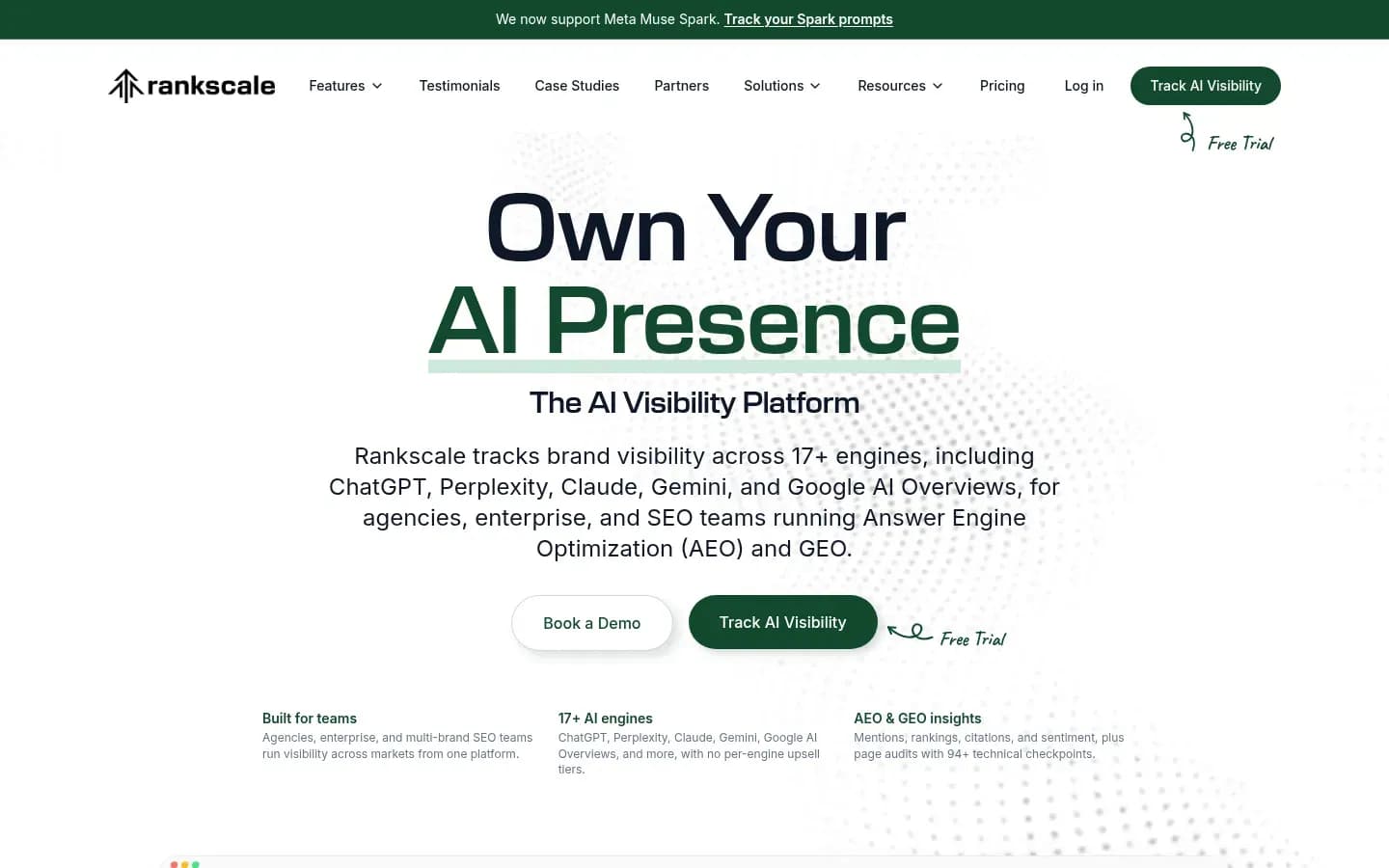
Verdict: Rankscale lets you choose API or web-search answers for each Claude model and prices each one separately, so a team can measure both versions of Claude on any plan.
Rankscale
AI visibility platform that tracks brand mentions, rankings, citations and sentiment across AI engines, for agencies and enterprise SEO teams.
Rankscale is an AI visibility platform from Vienna-based Rankscale GmbH that tracks brand mentions, rankings, citations and sentiment across AI engines. It suits agencies and SEO teams that want fine control over what they measure.
- Platforms
- Web
- Public API
- Yes
How it gets Claude answers: Each Claude model can run via the API or with web search, and you choose per model. Claude Sonnet 5.5, Claude Haiku 5.5 and Claude Haiku 4.5 are all available.
Claude access by plan: Claude is on every plan, with a credit cost per model. Every plan also includes unlimited prompts, all regions and languages and 17+ AI engines.
Standout features:
- Configurable update frequencies, from bi-hourly to bi-monthly.
- Citation counts for clickable source links to your domain.
- A Sources Box Analysis that reverse-analyzes the domains AI answers cite.
- Sentiment classification of each mention as positive, neutral or negative.
Pricing:
Rankscale pricing
| Plan | Price | Billing | Notes |
|---|---|---|---|
| Essentials | $17 | per month, billed annually | |
| Pro |
|
| |
| Pro+ |
|
| |
| Growth |
|
| |
| Enterprise |
|
| |
| Custom Plan | Custom pricing |
What drives the bill: Credits. A Claude Sonnet 5.5 answer costs 3 credits via the API or 4 with web search, a Claude Haiku 5.5 answer 1 or 3, and a Claude Haiku 4.5 answer 2 or 3. Choosing searched answers and Sonnet over Haiku burns credits faster. Extra brand dashboards are a paid add-on, and unused credits roll over, up to 2x on Pro and Pro+ and 3x on Growth and Enterprise.
Best fit: Analysts and agencies who want to compare Claude's API answers with its web-search answers, model by model.
Limitations: Across 33 reviews on OMR, several of them incentivised, the most-cited weakness is the user interface (10 mentions). Reviewers also say the dense data takes weeks to interpret and that client-ready reporting is limited. Reviewers praise its broad model coverage, per-engine prompt setup, competitor and sentiment depth and responsive support.
Pros
- Choose API or web-search answers per Claude model
- Unlimited prompts and 17+ engines on every plan
- Unused credits roll over
Cons
- Interface and dense data take time to learn
- Client-ready reporting is limited
- Searched Claude answers use more credits
Profound
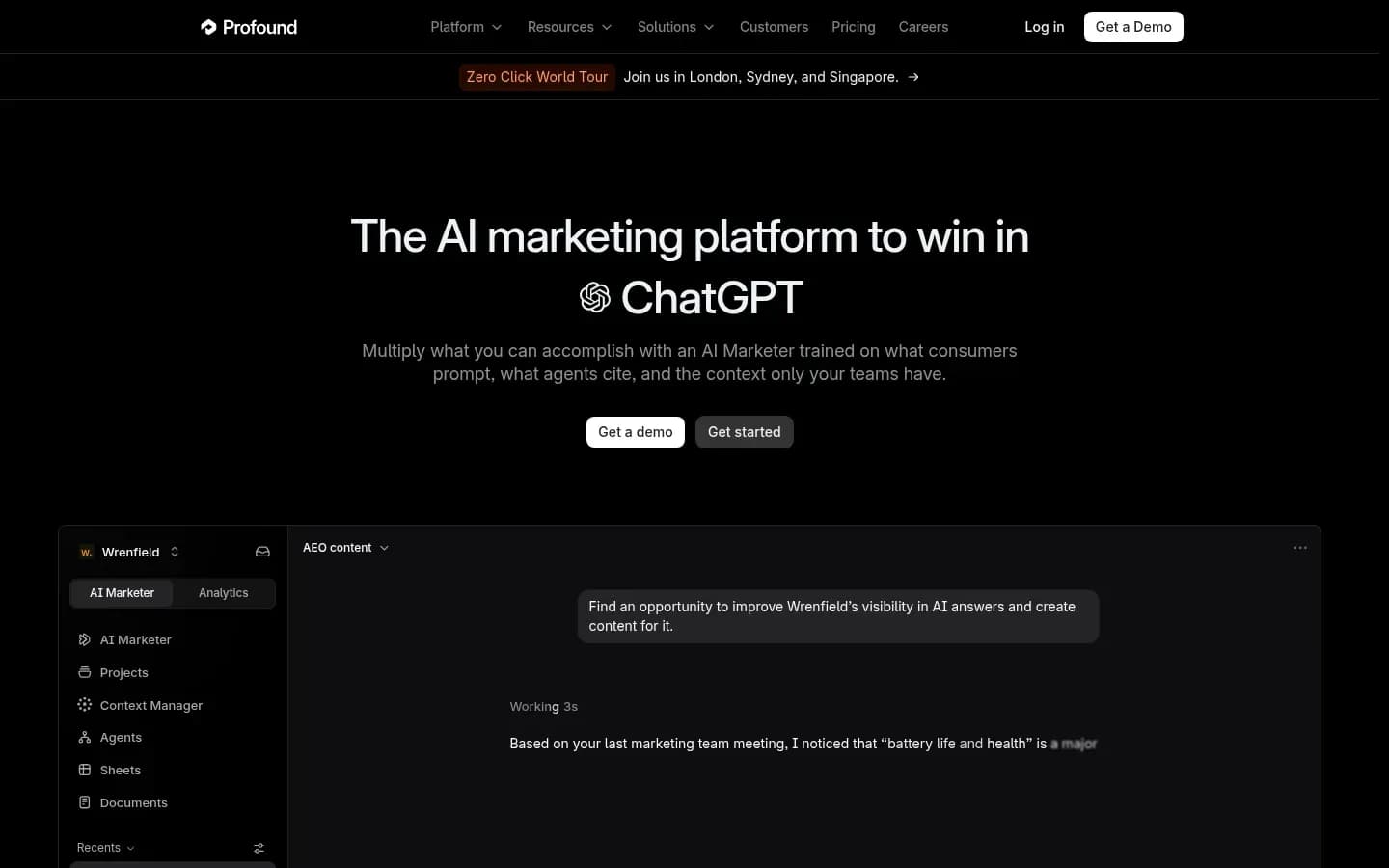
Verdict: Profound gives enterprise teams browser-captured Claude answers refreshed daily, but since its self-serve plans were retired, Claude tracking there comes only through a custom Enterprise contract.
Profound
AI marketing platform that shows marketing and AEO teams what customers ask AI tools and how their brand appears in the answers.
Profound is an AI marketing platform that shows marketing and AEO teams what customers ask AI tools and how their brand appears in the answers. It sells to enterprise brands on tailored packages.
- Free plan
- No
- Compliance
- SOC 2
- Ratings
- G2 4.5/5 (1,133 reviews)
How it gets Claude answers: Profound says it queries the front-end experiences normal users see and captures answers directly from the browser instead of the API. Every tracked prompt runs daily.
Claude access by plan: Claude comes through a custom Enterprise package, which includes up to 10 answer engines, Claude among them. Profound added Claude support in August 2025 and routes access through the customer's Profound representative. The former Starter and Growth plans are retired for new subscriptions.
Standout features:
- Visibility score and share of voice against competitors.
- Sentiment and citation-source reporting.
- Competitor rankings across engines.
- Unlimited seats and domains, AI Marketer credits and SSO/SAML on Enterprise.
Pricing:
Profound pricing
| Plan | Price | Billing | Notes |
|---|---|---|---|
| Agency Enterprise (agency tab) | Custom pricing | ||
| Agency Growth (agency tab) | Custom pricing | ||
| Enterprise | Custom pricing | ||
| Trial | Custom pricing |
What drives the bill: Prompts, credits and regions are all custom-quoted, so the size of your prompt tracking plan sets the contract. Expect to scope the prompt set before you get a number.
Best fit: Enterprise brands with a budget for a custom contract that want browser-captured Claude data. Teams weighing it against the other enterprise option can read our Profound vs Scrunch comparison.
Limitations: Recurring dislikes in Profound's G2 reviews are a price that feels high for smaller teams, a learning curve with unclear terminology, limited integrations with other data platforms, and limited report customisation and context for score changes.
Pros
- Browser-captured answers, close to what buyers see
- Every tracked prompt runs daily
- Share of voice, sentiment and citation sources
Cons
- Claude only through a custom Enterprise contract
- Learning curve and unclear terminology
- Limited integrations and report customisation
LLMrefs
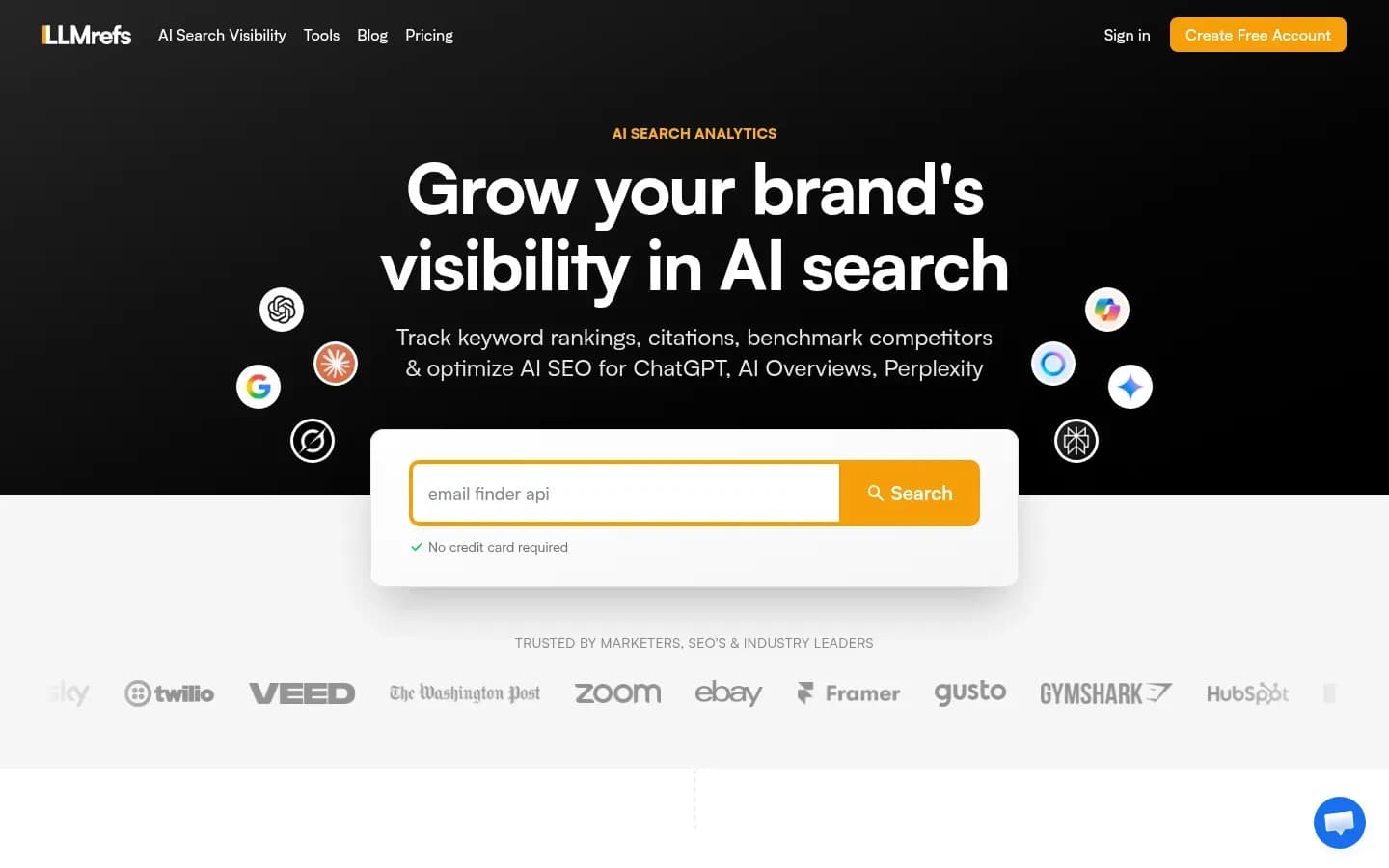
Verdict: LLMrefs is the simplest way to get Claude into a multi-engine report. Its plan covers Claude at no extra fee, turns keywords into tracked prompts and reports an aggregated score per keyword each week.
LLMrefs
AI search analytics platform that tracks how brands appear in ChatGPT, Google AI Overviews, Perplexity and Gemini, for brands, agencies and SEO teams.
LLMrefs is an AI search analytics platform that tracks how brands appear across AI engines, Claude included. It works at keyword level and suits brands, agencies and SEO teams that want a light, cross-engine view.
- Free plan
- Yes
- Free trial
- 7 days
- Public API
- Yes
How it gets Claude answers: LLMrefs generates prompts and fan-out prompts from your keywords, checks them continuously and updates every keyword at least once a week. Results are aggregated and weighted across every prompt for each keyword.
Claude access by plan: Claude is one of nine engines on the marketing-team plan, alongside ChatGPT, AI Overview, AI Mode, Gemini, Perplexity, Grok, Copilot and Meta, with no additional fees.
Standout features:
- Unlimited team members and unlimited projects.
- Geo-targeting in 50+ countries and 20+ languages.
- CSV export and monthly prompt volume estimates.
- Extra tools such as an AI crawlability checker and an LLMs.txt generator.
Pricing:
LLMrefs pricing
| Plan | Price | Billing | Notes |
|---|---|---|---|
| All in One | $79 | per month |
What drives the bill: The marketing-team plan caps tracking at 500 prompts, so the main sizing question is whether your keyword set fits under the cap.
Best fit: Small teams and consultants who want a low-cost, low-effort cross-engine view that includes Claude.
Limitations: Rankability, which sells a competing tracker, notes occasional delays in report generation and says LLMrefs monitors rather than giving prescriptive optimisation guidance. The weekly cadence and keyword-level aggregation also smooth over single-prompt swings in Claude's answers.
Pros
- Claude included with every other engine
- Unlimited seats and projects
- Keyword-based setup with automatic fan-out prompts
Cons
- Weekly, aggregated data hides single-prompt swings
- Monitoring rather than optimisation guidance
- Occasional report delays
Scrunch
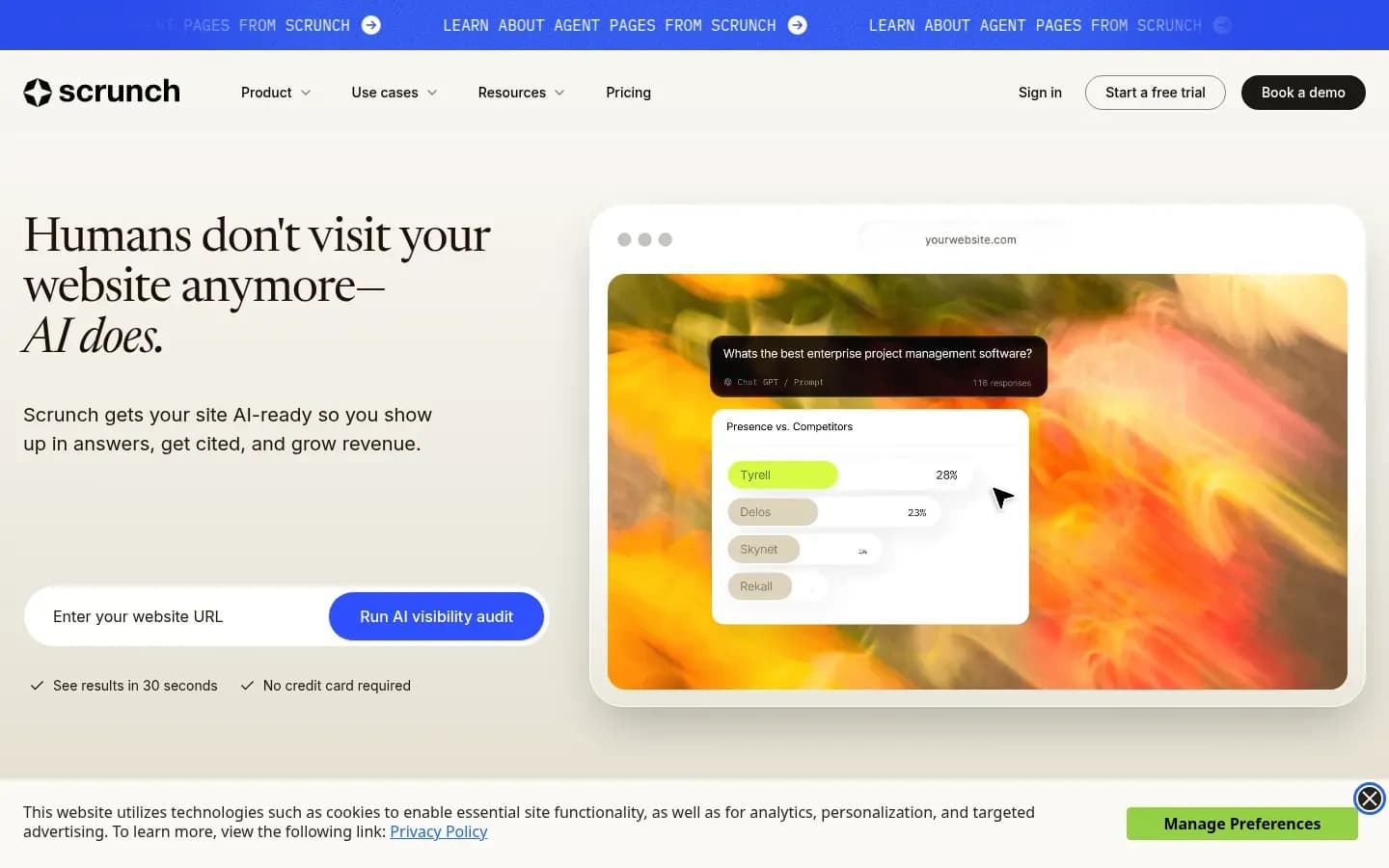
Verdict: Scrunch tracks Claude only as an add-on to its Enterprise plan, so a team on a lower Scrunch plan sees ChatGPT, Perplexity, Gemini and five other platforms but no Claude answers at all.
Scrunch
AI search visibility platform for marketing teams and agencies that tracks how a brand appears in AI answers and serves AI-optimized pages to AI agents.
Scrunch is an AI search visibility platform for marketing teams and agencies that tracks how a brand appears in AI answers and serves AI-optimized pages to AI agents.
- Free trial
- 7 days, no card needed
- Compliance
- SOC 2
- Ratings
- G2 4.6/5 (73 reviews)
Sitecore announced that it acquired Scrunch in June 2026, and Scrunch now connects directly to Sitecore workflows. The name is unchanged.
How it gets Claude answers: Scrunch collects with browser automation and official platform APIs, choosing the approach per platform. A newly tracked prompt is collected daily for its first 14 days, then on a default 72-hour refresh, with on-demand refresh available.
Claude access by plan: Scrunch's Core tier covers eight platforms (ChatGPT, Perplexity, Gemini, Google AIO, Google AI Mode, Microsoft Copilot, Grok and Meta AI), and no plan below Enterprise includes Claude. Claude is an add-on on the Enterprise plan, which is billed yearly.
Standout features:
- On-demand refresh on top of the default collection cycle.
- Enterprise features such as Data Studio and SSO through SAML or OIDC.
- Unlimited brands and seats on Enterprise, which suits groups with many sub-brands.
Pricing:
Scrunch pricing
| Plan | Price | Billing | Notes |
|---|---|---|---|
| Starter |
|
| |
| Growth |
|
| |
| Enterprise | Custom pricing |
What drives the bill: AI responses per month, brands and seats, plus the Claude add-on on Enterprise. The Core tier's limits are 15,000 AI responses a month, 1 brand, 5 seats, 5 competitors and 10 citation targets.
Best fit: Enterprise brands already on Sitecore or tracking many sub-brands, ready to buy the Claude add-on.
Limitations: Claude needs an Enterprise contract plus the add-on. After a prompt's first 14 days, the default refresh is every 72 hours, so a change in Claude's answers can take up to three days to show.
Pros
- Connects directly to Sitecore workflows
- Unlimited brands and seats on Enterprise
- On-demand refresh
Cons
- Claude only as an Enterprise add-on
- 72-hour default refresh after a prompt's first 14 days
How Do Claude Visibility Tracking Tools Collect Answers?
Claude decides for itself when to search. Anthropic's help center says Claude searches the web when it helps and attaches citations and source links to those answers, so a tracker that queries Claude's API without web search measures a different Claude than the one your buyers use.
Trackers reach Claude in one of three ways, and each gives a different number:
- App interface scraping. Promptwatch says it scrapes the chat interfaces people use. The answer includes whatever searching Claude chose to do, much like a real session.
- Browser front-end capture. Profound captures answers from the browser front end rather than the API. Scrunch mixes browser automation with official APIs, choosing per platform.
- API calls, with or without the web search tool. Rankscale lets you pick per Claude model, so you can collect both kinds of answer and compare them.
Anthropic's documentation explains why the route matters. When a question benefits from current information, Claude invokes a search tool. In the new Claude experience there is no web search toggle, while the older experience lets users switch it off. Answers that used search carry direct citations.
Searching is also less common than many teams assume. In Clark's analysis, Claude searched in only about a third of prompts. Most Claude answers to your tracked prompts may come from what the model already knows, with no citations at all.
Decision rule: If citations to your pages matter, pick a tool that captures searched answers from the app or browser. If brand recall matters, also track answers without search, for example with Rankscale's API option.
This difference in collection is one reason two tools can report very different numbers for the same brand. Our analysis of why AI visibility scores differ between platforms covers the other causes, from prompt sets to scoring formulas.
Which Plans Actually Include Claude Tracking?
Only three of the five tools here, Promptwatch, Rankscale and LLMrefs, put Claude on their entry plan, while Profound and Scrunch reserve it for Enterprise contracts. For most buyers, plan placement removes more options from the shortlist than price or features do.
Where Claude Sits in Each Price Grid
| Tool | Where Claude sits |
|---|---|
| Promptwatch | Every plan |
| Rankscale | Every plan, credit cost per model |
| LLMrefs | Included on its plan |
| Profound | Enterprise only |
| Scrunch | Enterprise add-on only |
| Otterly.AI | Paid add-on on public plans |
| Peec AI | Enterprise only |
| Semrush | Enterprise only |
The pattern across the market is that "tracks Claude" on a homepage often means "on a higher tier". Scrunch's entry plan covers eight platforms and leaves Claude out. Profound routes Claude through a representative on Enterprise. Otterly.AI's public plans cover four engines, with Claude a paid add-on on Lite, Standard and Premium, according to Trakkr's review.
So check the plan grid, not the feature page. The feature page lists every engine a vendor supports, while the plan grid shows which ones you get for what you are willing to pay.
Two follow-up checks are worth making on the plan you can buy. First, check which Claude it tracks. Rankscale names Claude Sonnet 5.5, Claude Haiku 5.5 and Claude Haiku 4.5, and Searchable's review says Promptwatch tracks the Claude chatbot and Claude Code. Second, check whether Claude answers count against the same allowance as other engines, since that sets how many Claude answers the plan really buys.
What Does Claude Visibility Tracking Cost To Run?
The bill for Claude tracking is set by the meter, not the list price. On Rankscale, a Claude Sonnet 5.5 answer with web search costs 4 credits against 3 via the API, so tracking searched answers uses a third more of the same plan. Each tool's pricing widget above shows its plans.
What Drives Spend on Each Tool
| Tool | Meter | Claude cost driver |
|---|---|---|
| Rankscale | Credits per answer | Web search and Sonnet cost more |
| Promptwatch | Prompts and responses | API and MCP extra on Essential |
| Scrunch | Responses per month | Claude add-on on Enterprise |
| Profound | Custom quote | Prompts, credits and regions |
| LLMrefs | Tracked prompts | 500-prompt cap |
Sizing rule: Prompts x runs per prompt x refreshes per month = answers per month. Compare that figure with the plan's answer or response allowance, per engine you track.
A worked example shows how fast the meter moves. Thirty prompts refreshed daily is about 900 Claude answers a month. Run each prompt three times per refresh to smooth out variance and it becomes about 2,700.
Now set that against the allowances. Rankscale Pro includes 1,200 credits. At 4 credits per searched Sonnet answer, that buys 300 Claude answers a month, while Haiku 5.5 via the API at 1 credit buys 1,200. Rankscale's headline of up to 4,800 answers on Pro is a ceiling that searched Sonnet answers come nowhere near.
Promptwatch Essential includes 6,000 responses across its models, and Scrunch's Core tier 15,000 AI responses a month, though the Core tier has no Claude. On Profound, the prompt plan and credits are scoped in the contract.
Three costs hide outside the meter:
- Rankscale's extra brand dashboards are a paid add-on, though unused credits roll over.
- Promptwatch's MCP and API access are add-ons on Essential, which matters if Claude data must flow into your own reporting.
- Scrunch's Claude add-on comes on top of a yearly Enterprise contract.
The skeptic's point holds. The meter, not the plan name, sets the real cost of tracking Claude with search on, so model your prompt count and runs before you compare plans.
How Many Prompt Runs Make Claude Visibility Data Reliable?
A single Claude answer is a sample, not a ranking. In SparkToro's study of nearly 3,000 runs across ChatGPT, Claude and Google's AI, the same brand list came back less than once in 100 tries, so visibility has to be measured as a mention rate across repeated runs.
The study, by Rand Fishkin of SparkToro and Patrick O'Donnell of Gumshoe.ai, had 600 volunteers run 12 identical prompts. The odds of the same list in the same order were closer to 1 in 1,000. Results were reported across all three engines together, not for Claude alone.
In practice, that changes what you track:
- Mention rate, not position. Count how often Claude names your brand across many prompts and runs. A rank from one answer will not repeat.
- Many prompts per topic. Promptwatch advises starting with 15 to 30 prompts per monitor or market.
- Repeat runs over time. Refresh cadence decides how many samples a month you collect per prompt.
Refresh Cadence by Tool
| Tool | Refresh |
|---|---|
| Promptwatch | Daily, up to hourly on Business |
| Profound | Daily for every tracked prompt |
| Rankscale | Configurable, bi-hourly to bi-monthly |
| Scrunch | Daily for 14 days, then 72 hours |
| LLMrefs | Weekly, aggregated per keyword |
Daily tools give about 30 samples per prompt a month. Rankscale lets you buy more samples for the prompts that matter and fewer for the rest. LLMrefs' weekly, keyword-level aggregation is already a rate, which suits trend reporting but hides swings in individual answers.
Read changes as changes in rate across a month of runs, not day-to-day moves. Our guide to AI visibility benchmarks by buyer intent shows how to set sample sizes and confidence intervals for each prompt group.
How To Choose A Claude Visibility Tracking Tool
Choose a Claude tracker in this order. Confirm Claude is on a plan you can buy, then check whether the tool captures the searched answers buyers see, and only then compare refresh rate, evidence and price. Plan placement and collection method rule out more tools than any feature list does.
Before you trial anything, build an AI search prompt tracking list, because every check below depends on how many prompts you need to run.
- Claude is on the plan you can afford, not only on Enterprise or as an add-on.
- Collection matches what you measure, app or browser for citations, API without search for recall.
- Refresh cadence gives enough repeat runs per prompt each month.
- Evidence shows the answer text, the cited pages and sentiment.
- Personas and locations cover every market you sell into.
- Export or API access gets Claude data into your reporting.
- The meter charges a known amount per Claude answer, with search on.
Claude on the plan: Promptwatch and Rankscale include it on every plan, and LLMrefs on its marketing-team plan. Profound and Scrunch need an Enterprise contract, and Scrunch also an add-on.
Collection: Promptwatch scrapes the app interface, Profound captures the browser front end, and Rankscale lets you pick API or web search per model. Pick the route that matches the question you need answered.
Refresh and repeat runs: Daily data gives about 30 samples per prompt a month. A 72-hour cycle gives about ten.
Evidence: Profound reports visibility score, share of voice, sentiment and citation sources. Promptwatch shows which pages AI answers cite.
Personas and locations: Promptwatch supports buyer personas on every plan and city-level tracking on its Business plan, which matters if Claude's answers differ by market or buyer role.
Export: Check how data leaves the tool. Promptwatch's MCP and API access are add-ons on Essential, while LLMrefs offers CSV export.
The meter: On Rankscale a searched Sonnet answer costs a third more than an API answer. On Scrunch, the Claude add-on comes on top of a yearly Enterprise contract.
Which Claude Visibility Tracking Tool Should You Choose?
If you need Claude data on a self-serve plan with daily refresh, choose Promptwatch. If you need to compare Claude with and without web search, choose Rankscale. If you buy on enterprise contracts, shortlist Profound and Scrunch, and let the rest of the stack decide between them.
In-house B2B content team that wants tracking plus content actions: Promptwatch. Claude is on every plan, answers come from the app interface, and the content agent turns citation gaps into pages. It does not suit teams that need searched and unsearched answers kept apart.
Analyst or agency that wants to compare API and web-search Claude per model: Rankscale. It lets you choose API or web-search answers per Claude model and prices each one separately. It does not suit teams that need polished client reports out of the box.
Enterprise with budget for a custom contract and browser-captured data: Profound. Every tracked prompt runs daily from the browser front end. It does not suit smaller teams, given its contract-only pricing.
Small team or consultant that wants a low-effort weekly view across engines: LLMrefs. Claude comes with every other engine at no extra fee. It does not suit teams that need to see single-prompt changes.
Enterprise on Sitecore or managing many sub-brands: Scrunch with the Claude add-on. It connects to Sitecore workflows and allows unlimited brands on Enterprise. It does not suit teams that need Claude below Enterprise.
Frequently Asked Questions
Is there a free Claude visibility tracker?
The simplest no-cost route is manual. Run your prompts in Claude yourself and log which brands and pages appear. That gives one sample per prompt, which the SparkToro study shows is not enough. For repeatable data, LLMrefs is the lowest-effort option, and the comparison table shows which tools offer a free plan or trial.
Does Claude cite sources in its answers?
Claude cites sources whenever it searches the web, and Anthropic's help center says those answers include direct citations and source links. Claude does not search for every prompt. In one practitioner analysis it searched in about a third of prompts, so many Claude answers carry no citations at all.
Can you track Claude answers without web search?
Yes, through the API. Rankscale lets you run each Claude model via the API or with web search and prices the two separately. In Claude's new app experience there is no web search toggle, so answers without search reflect what Claude recalls rather than what buyers see when it searches.
Does Claude use Brave Search?
It appears to. Jonathan Clark's analysis, reported by Search Engine Land, found Claude seems to use Brave's top results without re-ranking them, and its citations overlapped 64% with Google rankings. He gave no sample size, so treat it as directional, but ranking well in classic search still helps Claude visibility.
Sources
Sources
- Claude visibility may depend heavily on Brave Search rankings, new data suggests · searchengineland.com
- Claude Is The Fastest-Growing AI Traffic Source, Per New Data · searchenginejournal.com
- Enable and use web search | Claude Help Center · support.claude.com
- AI recommendation lists repeat less than 1% of the time: Study · searchengineland.com
- Sitecore acquires Scrunch to help brands influence discovery and buying decisions in the AI-search era · sitecore.com
- rankscale.ai
- omr.com
- rankscale.ai