A visitor identification tool only earns its place in a B2B SaaS stack when the match reaches a rep with the right context. Here is the short answer.
These picks apply to B2B SaaS teams whose site traffic includes pricing, demo or docs visits worth routing to a rep. RB2B and Albacross publish no method behind their match-rate claims, so treat accuracy figures as claims to test on your own accounts.
Visitor Identification Tools For B2B SaaS Compared
Of the five visitor identification tools compared here, Warmly, RB2B and Vector name individual visitors and push them to sales, while Leadfeeder and Albacross name the company behind a visit and pair it with the pages it read. The table puts them side by side on the four things that decide whether a match turns into a conversation.
| Tool | Pricing model | Free trial | Identification level | Page context | CRM routing | Follow-up built in |
|---|---|---|---|---|---|---|
| Warmly | Paid | Person and company | Visits, emails, meetings | Lead and rep routing | AI chat, email, ads | |
| RB2B | Freemium | 7 days, no card needed | Person (US), company (global) | High-intent page tracking | Slack, Teams, HubSpot, Salesforce | Via Instantly, HeyReach, Clay |
| Vector | Paid | Company, person if consented | Pages read per visitor | HubSpot, Salesforce, Slack | Sales alerts, contact ads | |
| Leadfeeder | Freemium | 14 days, no card needed | Company only | Pages engaged per company | Six CRMs plus Slack | Assign teammate, email alert |
| Albacross | Paid | 14 days, no card needed | Company only | Pages read per company | CRM, Slack, Teams sync | Display and LinkedIn ads |
The split matters more than any single feature. Warmly, RB2B and Vector are person-level tools built to put a named contact in front of a rep. Leadfeeder and Albacross are company-level tools built around EU data handling, so they tell you which account is reading your pricing page and leave the contact search to an enrichment step. If you are new to the category, the hub on visitor identification tools explains how company and person matches differ as evidence.
How We Chose These Tools
Each tool here had to show which product pages a visitor read, route that record into a CRM or Slack with an owner, and support a sales follow-up. A tool that only reports traffic, or that works inside a single CRM, did not clear that bar.
The criteria, in the order they were weighed:
- Identification level and coverage. Person-level or company-level, and in which countries each level works.
- Product-page context. Whether the record shows pricing, demo or docs visits, not just a company name.
- Account routing and CRM sync. Whether the match lands on the right CRM record and owner without creating duplicates.
- Sales follow-up. Whether chat, email, ads or alerts run inside the tool or through named integrations.
- What drives the real bill. The meter each vendor charges on, such as resolutions, site visitors or ad spend.
Accuracy is not scored, because the match-rate claims RB2B and Albacross make come without a published method. The section on accuracy below explains how to test it yourself.
The main tools left out, and why:
Considered, not included
| Tool | Why not included |
|---|---|
| HubSpot buyer intent | Runs on HubSpot tracking code and credits |
| 6sense | Account-based GTM platform, broader scope |
| Demandbase | ABM suite with ads and orchestration |
| Leadinfo | Company-only, overlaps Leadfeeder and Albacross |
| Snitcher | Company-level by default, overlaps Leadfeeder |
The order below puts the three person-level tools first and the two company-level tools after them. Within each group, tools built mainly around sales follow-up come before tools that tie identification to account-based advertising, which suits a narrower set of teams.
Warmly
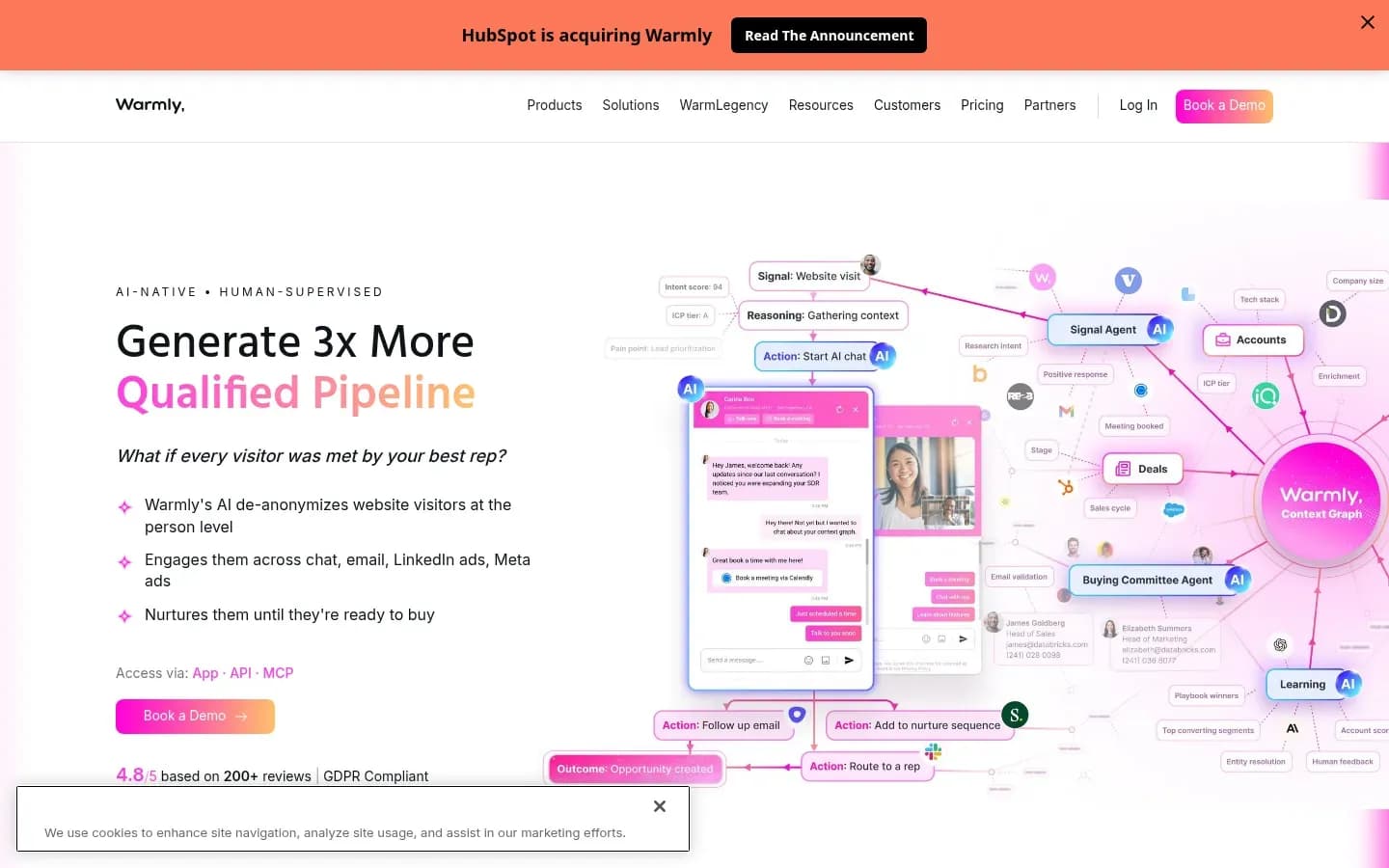
Warmly is the strongest pick for HubSpot-centred B2B SaaS teams that want visitor identification, chat, routing and agent-led follow-up in one product, and its existing contracts, pricing and integrations stay unchanged after it agreed to join HubSpot in June 2026.
Warmly
B2B go-to-market platform with AI agents that identify website visitors and engage them through chat, email and retargeting, for sales and marketing teams.
Warmly is a go-to-market platform whose AI agents identify website visitors and engage them through chat, email and retargeting. It serves sales and marketing teams that want one product to cover the steps from match to meeting.
- Platforms
- API
- Compliance
- GDPR, SOC 2
- Ratings
- G2 4.5/5 (250 reviews)
Verdict: Warmly ranks first because it is the only tool in this list that combines person-level identification, AI and human chat, lead and rep routing, and follow-up across email, ads and LinkedIn in a single product.
Identification: Warmly's Inbound Agent identifies website visitors at the person level. Its TAM Agent scores accounts across the total addressable market and maps buying committees, so a named visitor arrives with the rest of the account around them.
Product-page context: Warmly groups its signals into three layers. First-party signals cover web visitor behaviour, product usage, chat and CRM data. Second-party signals cover social activity, new hires and job changes. Third-party signals cover keyword research, competitor research and lookalikes.
Routing and CRM: The Inbound Agent lists lead routing and rep routing. Warmly integrates with HubSpot CRM, Salesforce, Pipedrive and Microsoft Dynamics 365, and sends notifications to Slack and Microsoft Teams.
Sales follow-up: Follow-up can happen inside Warmly or through the sales engagement tool a team already runs. The Inbound Agent runs an AI chatbot and live human chat with context from every site visit, email and meeting, plus intent-based popups, personalised microsites and retargeting across email and ads. Warmly also integrates with Outreach, Salesloft, Apollo and Instantly, and can push conversations into the Outreach activity feed. Warmly also lists LinkedIn and Google ads among its integrations.
Best fit: HubSpot-centred SaaS teams that want one vendor for identification, chat, routing and follow-up, and that have enough inbound traffic to justify a platform rather than a point tool.
Limitation: Warmly announced on 30 June 2026 that it had agreed to be acquired by HubSpot, and independent trade coverage lists the deal with the same date. Warmly says existing contracts, pricing, account teams, product experience and integrations remain unchanged. Its stated plan is to connect its context and agent capabilities across HubSpot's customer platform, which ties the long-term roadmap to HubSpot. That matters most for Salesforce shops, which should weigh how much of the future product will be built around a CRM they do not use.
Warmly AI Web-Deanonymization pricing
| Plan | Price | Billing | Notes |
|---|---|---|---|
| AI Web-Deanonymization |
|
|
Warmly Inbound Chat pricing
| Plan | Price | Billing | Notes |
|---|---|---|---|
| Inbound Chat |
|
|
Warmly AI Inbound Autopilot pricing
| Plan | Price | Billing | Notes |
|---|---|---|---|
| AI Inbound Autopilot |
|
|
RB2B
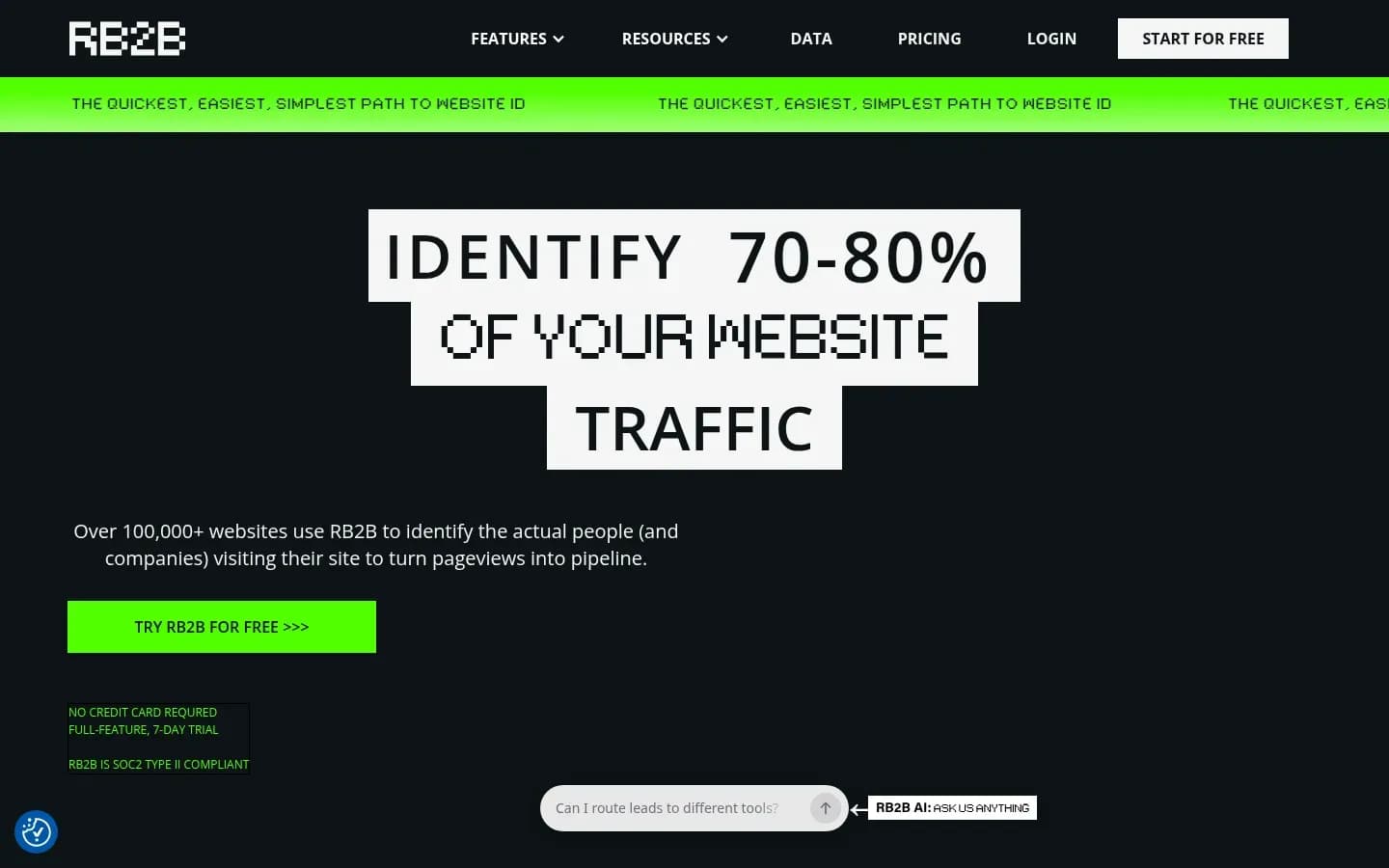
RB2B names individual US visitors with their LinkedIn profile and business email and pushes them to Slack, Teams or the CRM, but outside the US it identifies only the company.
RB2B
Website visitor identification tool that identifies visitors and sends their details to Slack, Teams and CRMs, for sales and marketing teams.
RB2B is a website visitor identification tool that identifies visitors and sends their details to Slack, Teams and CRMs. It suits sales and marketing teams that want named contacts delivered where reps already work.
- Free plan
- Yes
- Free trial
- 7 days, no card needed
- Platforms
- Web
- Compliance
- GDPR, SOC 2
- Ratings
- G2 4.5/5 (285 reviews) · Capterra 1/5 (1 reviews)
Verdict: RB2B pushes person-level IDs for US visitors to Slack or the CRM, which suits SaaS teams happy to run follow-up in another tool.
Identification: RB2B's person-level identification is US-only and draws on a US-only database. Company-level identification is global on every plan through its Demandbase partnership.
Product-page context: RB2B lists high-intent page tracking as a feature, alongside ICP lead filtering by company revenue, size, seniority, department and geography. Traffic exclusions let a team suppress pages that should never trigger an alert, such as careers or support pages.
Routing and CRM: RB2B sends names, LinkedIn profiles, business emails and company data to Slack, Teams, the CRM, Clay and more than 50 other apps. HubSpot and Salesforce have dedicated integrations.
Sales follow-up: Outreach does not run inside RB2B. It runs through integrations such as Instantly, HeyReach, Zapier and Clay, so the sequence lives in whichever tool the team already uses.
What drives the bill: RB2B bills by monthly resolutions, and overage is charged per resolution, at 45 cents on Starter and 25 cents on Pro and Pro+. Additional domains cost $99 per month each, up to five, on Pro and Pro+. Pro+ volumes above 12,500 monthly resolutions are priced with RB2B's team. Starter pushes LinkedIn URLs only, with no email addresses and no other integrations. Because every resolution counts, bot and non-ICP traffic consumes the meter unless suppression rules filter it out first. The post on RB2B's resolution meter and overage works through what a realistic month costs.
Best fit: US-heavy SaaS teams whose reps prospect named contacts from Slack and who already run outbound in Instantly, HeyReach or Clay.
Limitation: Visitors outside the US never get person-level data from RB2B, so a team with a large European audience sees companies only for that traffic.
RB2B pricing
| Plan | Price | Billing | Notes |
|---|---|---|---|
| Free | $0 | per month | |
| Starter | $79 | per month | |
| Pro | $149 | per month | |
| Pro+ | $199 | per month |
Vector
Vector fits B2B SaaS teams that pair visitor identification with account-based advertising, since one annual contract sized by monthly site visitors and ad spend covers identification, signals, ads and integrations with unlimited seats.
Vector
Account-based marketing platform that turns buyer signals and account scoring into contact-level ad audiences for B2B marketing teams.
Vector is an account-based marketing platform that turns buyer signals and account scoring into contact-level ad audiences. It serves B2B marketing teams that want identification and paid targeting from the same data.
- Public API
- Yes
- Compliance
- GDPR
Verdict: Vector is the pick when identification feeds advertising as much as it feeds sales, because the same match powers both alerts and contact-level audiences.
Identification: Vector matches every visit to a company. Where a consented match exists, it also identifies the person, with name, role and work email.
Product-page context: Vector ties each identified visitor to the pages they read, so a rep sees, for example, that a named visitor was on the pricing page.
Routing and CRM: Vector sends identified visitors to HubSpot, Salesforce and Slack through native integrations. In HubSpot it matches visitors to existing contacts through the HubSpot UTK cookie and syncs activity back to the matched record, which avoids duplicates.
Sales follow-up: Vector offers real-time sales alerts for reps and builds contact-level advertising audiences, so marketing can keep an identified account warm while sales reaches out.
What drives the bill: Vector sells one annual contract covering the whole platform with unlimited seats. Two numbers set the plan, monthly site visitors and monthly ad spend, with tiers running from up to 25,000 to up to 250,000 monthly site visitors. Credits cover identifying website visitors and custom AI research. Site traffic and ad spend set the real cost, not headcount.
Best fit: SaaS teams running ABM advertising alongside identification that want one contract and no per-seat limits for sales and marketing.
Limitation: Vector says contact-level matches are a smaller, higher-intent slice than company matches, and that results depend on the audience and where it browses from. It cannot assign a HubSpot UTK to a new contact created in HubSpot, so the duplicate protection works best on contacts already in the CRM.
Vector pricing
| Plan | Price | Billing | Notes |
|---|---|---|---|
| Starter | $36,000 | per year |
Leadfeeder
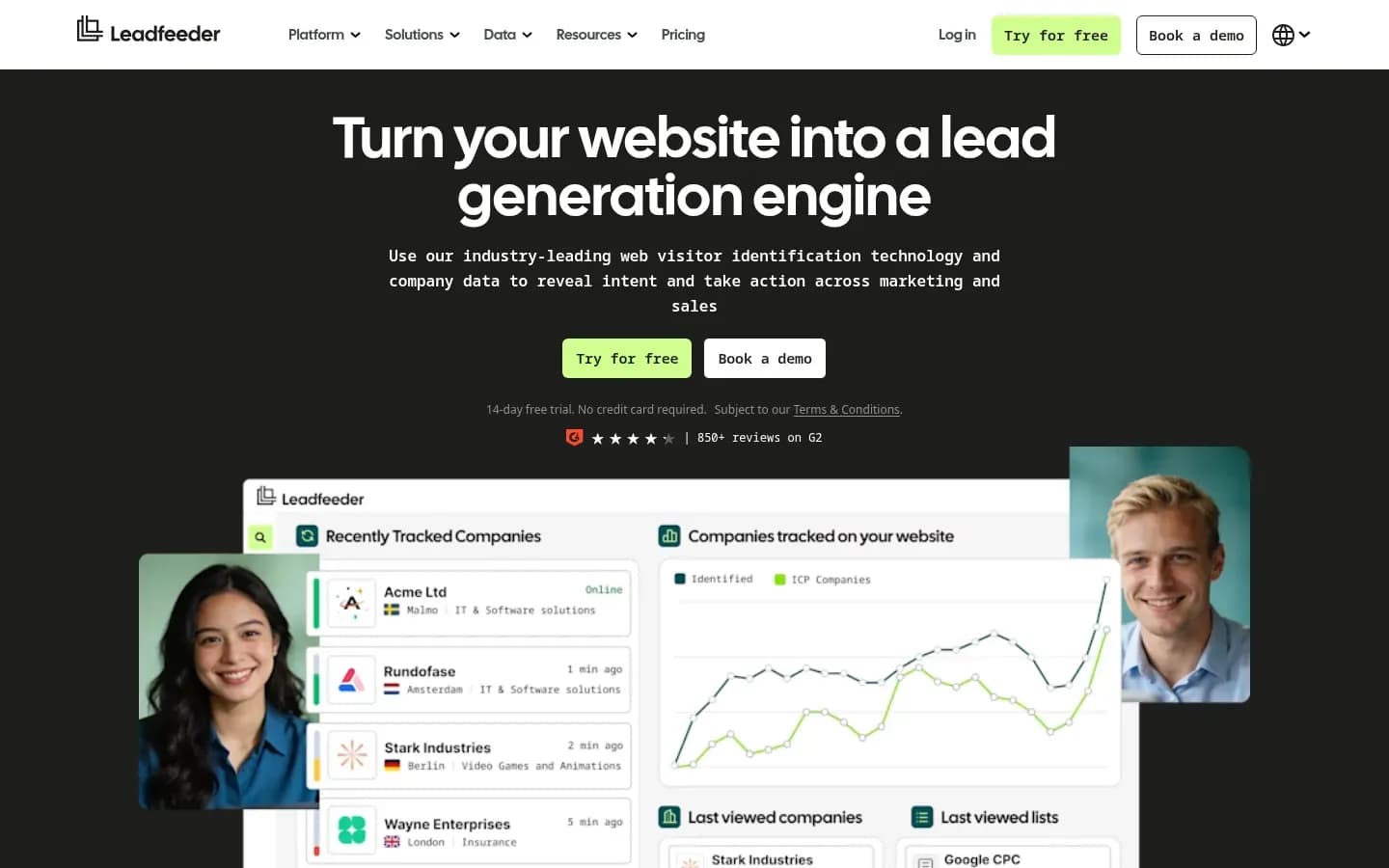
Leadfeeder, which absorbed the Dealfront brand in March 2026, identifies the companies behind visits, shows the pages each one engaged with and syncs them to six CRMs, with data hosted on AWS in Ireland.
Leadfeeder
Website visitor identification software that shows B2B marketing and sales teams which companies visit their site and syncs them to their CRM.
Leadfeeder (formerly Dealfront) is website visitor identification software that shows B2B marketing and sales teams which companies visit their site and syncs them to their CRM. Its visitor product is now called Web Visitors.
- Free plan
- Yes
- Free trial
- 14 days, no card needed
- Platforms
- API, Chrome extension, Web
- Public API
- Yes
- Compliance
- GDPR, ISO 27001
- Ratings
- G2 4.3/5 (861 reviews) · Capterra 4.2/5 (137 reviews)
Verdict: Leadfeeder suits teams that sell to accounts and want EU data handling, with company-level identification, assignment and CRM sync built in.
Identification: Leadfeeder identifies the companies behind anonymous visits. On 24 March 2026 Dealfront became Leadfeeder, the visitor product was renamed Web Visitors and Promote became Campaigns. The brand change did not alter contracts, pricing, features, data or integrations.
Product-page context: Leadfeeder shows which pages each company opens and engages with most, and Web Insights reports ICP fit and an intent score for each account.
Routing and CRM: Leadfeeder syncs company and contact data to Salesforce, HubSpot, Pipedrive, Microsoft Dynamics, Zoho and SuperOffice, and has a Slack integration.
Sales follow-up: A user assigns a company to a teammate from the company's details, and the assignee gets an email notification. Teams that prefer not to assign individuals use tags and a custom feed per tag, for example one feed per territory or segment.
What drives the bill: Page activity and CRM integrations sit on Leadfeeder's paid tiers. The entry tier shows only the last 7 days of leads, does not show what companies do on the site and includes no integrations, so a team that needs page context and CRM sync needs a paid plan.
Best fit: EU-heavy SaaS teams that sell to accounts, enrich contacts later and want data processed on a legitimate-interest basis and hosted on AWS in Ireland.
Limitation: Leadfeeder works at company level, so a rep still needs an enrichment step to find the right person at an account that visited the pricing page.
Leadfeeder pricing
| Plan | Price | Billing | Notes |
|---|---|---|---|
| Lite | €0 | per month | |
| Discover | €79 | per month, billed annually | |
| Activate | €369 | per month, billed annually | |
| Scale | €599 | per month, billed annually | |
| Enterprise | Custom pricing |
Albacross
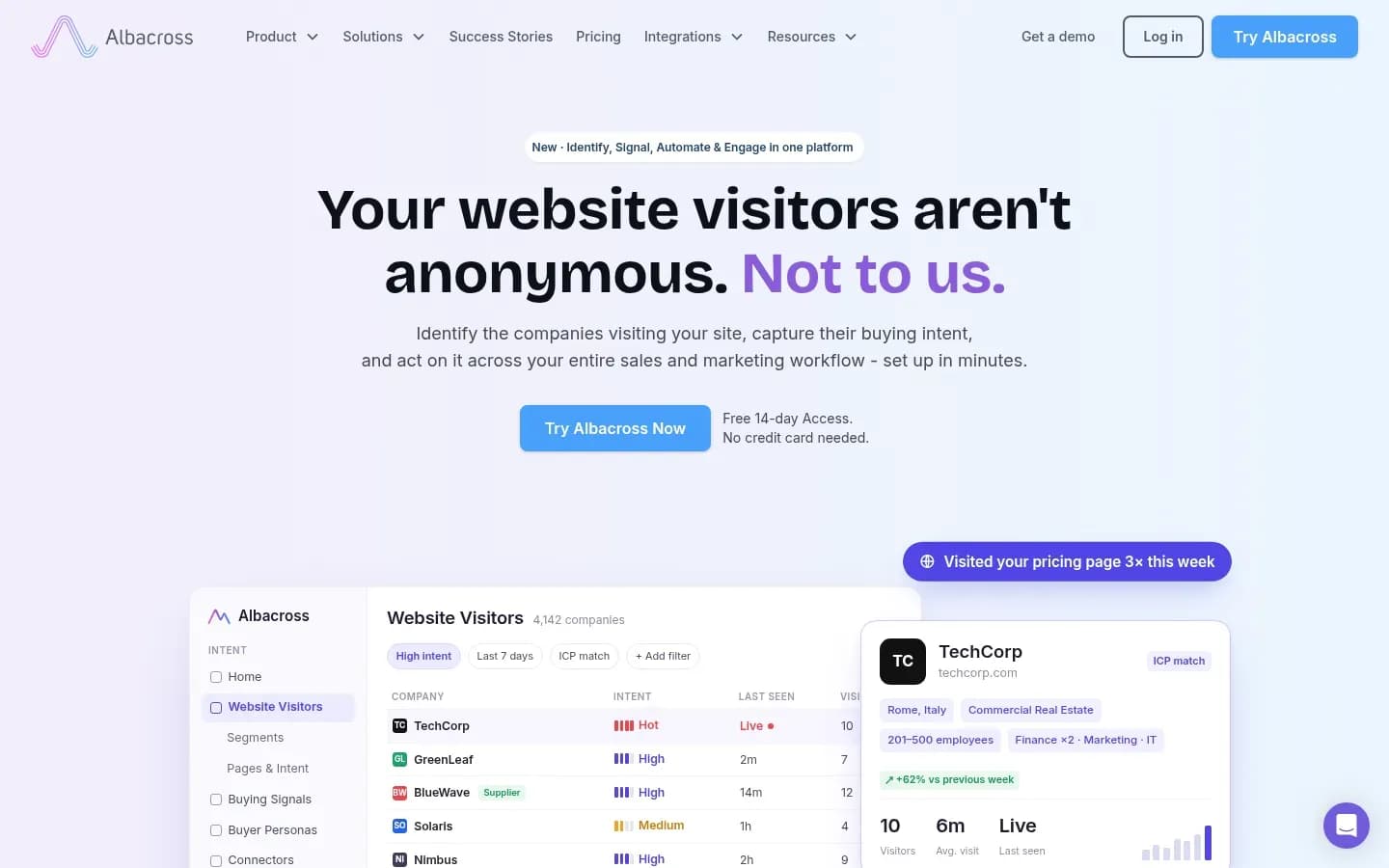
Albacross names the companies behind anonymous visits, scores each on fit and intent and syncs hot accounts to the CRM, Slack, Teams and LinkedIn ad audiences, but it does not identify individuals.
Albacross
B2B website visitor identification and buying-intent platform that shows sales and marketing teams which companies visit their site and syncs scored accounts to their CRM.
Albacross is a B2B website visitor identification and buying-intent platform that shows sales and marketing teams which companies visit their site. It syncs scored accounts to the CRM and runs ads to the same accounts.
- Free trial
- 14 days, no card needed
- Platforms
- Chrome extension
- Public API
- Yes
- Compliance
- GDPR
- Ratings
- G2 4.6/5 (129 reviews)
Verdict: Albacross suits account-based teams that want identification and ad targeting from one company-level tool.
Identification: Albacross turns anonymous traffic into named companies. It shows companies, not individuals.
Product-page context: Each identified company comes with the pages it read, and every account is scored on fit and intent.
Routing and CRM: Albacross syncs hot accounts to the CRM, Slack, Teams and ad audiences automatically. Its help centre documents integrations with HubSpot, Salesforce (including CRM Sync), Pipedrive, Attio, Slack, Microsoft Teams, LinkedIn, n8n, Zapier for Microsoft Dynamics 365, Google Sheets and webhooks. Customising Slack messages is labelled beta.
Sales follow-up: Albacross runs display and LinkedIn ads to target accounts, so follow-up can start with paid reach before a rep makes contact. Because the same hot accounts sync to Slack, Teams and the CRM, ads and sales alerts work from one account list.
Best fit: EU-heavy SaaS teams that want account targeting in ads from the same tool that identifies the account.
Limitation: Albacross identifies companies only, never individuals. It claims customer tests show its identification rate is 1.7x higher than most intent data platforms and calls its EU identification rates the highest, but it publishes no test method, so treat both as vendor claims.
Albacross pricing
| Plan | Price | Billing | Notes |
|---|---|---|---|
| Starter |
|
| |
| Professional |
|
| |
| Organisation | Custom pricing |
Company-Level Vs Person-Level Visitor Identification For B2B SaaS
Person-level visitor identification names the individual, but tools such as RB2B resolve people only for US traffic, so a B2B SaaS team with mostly European visitors gets more from company-level tools like Leadfeeder or Albacross.
The two levels answer different sales questions. Company-level data tells an account executive which target account is active and which pages it read. Person-level data tells an SDR who to email today. The guide to company-level and person-level identification covers the trade-offs in more depth.
Coverage is where the levels diverge most:
- RB2B resolves people for US visitors only, from a US-only database, and identifies companies globally.
- Vector identifies a person only where a consented match exists, and says contact matches are a smaller slice than company matches.
- Leadfeeder and Albacross identify companies, with the pages each one read.
- RB2B states its database is designed to exclude personal data of EU and UK residents.
Decision rule: Choose person-level identification when most pipeline traffic comes from the US and reps work named contacts. Choose company-level identification when traffic is international, or when the team sells to accounts and enriches contacts later.
A mixed audience does not force a single choice. A team with US and European traffic can run a person-level tool for its US pipeline and still get company matches for the rest, since RB2B's company-level identification is global. The cost is two data streams to route, so decide which record wins in the CRM before switching both on.
The level also changes what lands in the CRM. A person-level match arrives as a contact, which a rep can enrol in a sequence straight away, but which needs duplicate checks against existing contacts. A company-level match arrives as account activity, which suits territory-based routing to an account owner, but which needs a separate step to find the contact.
For account-based sellers, company-level data is often enough. The pages an account reads, its fit score and its intent score tell a rep whether to act, and an enrichment tool can then find the buying committee.
How Accurate Is Website Visitor Identification?
Visitor identification accuracy figures come from vendors, for example RB2B says it identifies 70-80% of website traffic and Albacross claims a 1.7x higher identification rate, neither with a published method. The reliable test is to check a tool's matches against accounts already in your CRM.
The claims vary in form, which makes them hard to compare:
- RB2B says it identifies 70-80% of website traffic, with person-level identification typically 30-40% and company-level identification another 30-40%. No method is published with the claim.
- Albacross says customer tests show its identification rate is 1.7x higher than most intent data platforms. No test method is published.
- Vector says results depend on the audience and where it browses from, and that contact-level matches are a smaller slice than company matches.
Decision rule: Test any tool on accounts you already know before buying. Install it during a trial period, then compare its matches against your CRM customers and open opportunities. If a known customer browses your docs and the tool names a different company, that tells you more than any published rate. The protocol for how to test matches on accounts you already know sets out the steps.
Three checks make the test fair:
- Use traffic from the countries you sell into, since person-level coverage differs by country.
- Count wrong matches as well as missed ones, because a wrong company routed to a rep wastes more time than no match.
- Compare matches on pricing and demo pages separately, since those are the visits reps act on.
How To Route Identified Visitors To Sales And Follow Up
Route identified visitors in four steps. Filter by ICP and suppress low-value pages, sync matches onto existing CRM records, assign an owner who gets a same-day notification, and pick a follow-up channel per segment. An identified account on a pricing page should reach its CRM owner with that page context the same day.
Speed matters because 94% of B2B buying groups rank their preferred vendors before first contact, according to 6sense's 2025 Buyer Experience Report, a global survey of more than 4,000 buyers across North America, EMEA and APAC. The same study found buyers purchased from that preliminary favourite 77% of the time. In our judgement, that makes routing speed and page context worth more than raw match volume.
A visit on its own is not buying intent, though. A candidate reading careers pages or a customer checking docs looks the same as a buyer until fit and page filters separate them. Work through these steps in order:
- Filter by ICP and suppress low-value pages, such as careers and support, before anything reaches a rep.
- Sync matches to the CRM onto existing records, so a visit adds activity instead of creating a duplicate.
- Assign an owner and send a notification the rep will see the same day.
- Choose the follow-up channel per segment, whether chat, email sequence, ads or a direct call.
Filtering. RB2B lists ICP lead filtering by revenue, size, seniority, department and geography, plus page suppression. Leadfeeder and Albacross score fit and intent per account, which does the same job at company level.
CRM sync without duplicates. Vector matches visitors to existing HubSpot contacts through the UTK cookie and syncs activity back to the matched record. Leadfeeder syncs company and contact data to six CRMs, including Salesforce, HubSpot and Pipedrive.
Owner assignment. Leadfeeder assigns a company to a teammate, who gets an email notification, or routes by tags and custom feeds. Warmly lists lead routing and rep routing with Slack and Teams notifications. RB2B pushes named visitors to Slack, Teams or the CRM, where the team's own routing rules take over. The playbook on how to route identified accounts to their owner covers ownership rules and follow-up SLAs.
Follow-up channel. Warmly runs AI and human chat, email and ad retargeting itself, and connects to Outreach, Salesloft, Apollo and Instantly. RB2B hands follow-up to Instantly, HeyReach, Zapier or Clay. Albacross runs display and LinkedIn ads to identified accounts. Vector builds contact-level ad audiences and sends real-time sales alerts.
Set a same-day rule for pricing and demo page visits from accounts that pass the ICP filter, and a weekly review for everything else. That keeps reps focused on the visits most likely to sit inside an active buying process.
What Does Visitor Identification Software Cost To Run?
Visitor identification tools bill on different meters, RB2B by monthly resolutions with overage per extra resolution and Vector by an annual contract sized to monthly site visitors and ad spend, so traffic volume sets the real cost more than seats. Estimate identified visitors per month before comparing any plan.
What sets the bill
| Tool | Billing meter | What raises the bill |
|---|---|---|
| RB2B | Monthly resolutions | Overage, extra domains, unfiltered traffic |
| Vector | Site visitors and ad spend | Higher traffic or ad budget |
| Leadfeeder | Paid tier for page activity | Page context and CRM sync |
RB2B. Every resolution counts against the monthly allowance. Overage costs 45 cents per resolution on Starter and 25 cents on Pro and Pro+. Extra domains cost $99 per month each, up to five, on Pro and Pro+. Starter pushes LinkedIn URLs only, with no emails and no other integrations, so a team that wants emails in its CRM needs a higher tier.
Vector. One annual contract covers the platform with unlimited seats. Monthly site visitors and monthly ad spend set the plan, so a traffic spike or a bigger ad budget moves the bill, while adding reps does not.
Leadfeeder. The entry tier shows only the last 7 days of leads, with no on-site activity and no integrations. Page context and CRM sync, the two things this post judges on, need a paid tier.
Warmly and Albacross plans appear in their pricing tables in the tool sections above.
Decision rule: Count your monthly identified visitors after suppression, not your total sessions, before comparing plans. Strip out bots, existing customers, job seekers and support traffic first. On a resolution meter, that filtering decides the bill. On a visitor-tier contract, it decides which tier you need. Then check whether the plan you can afford includes the integrations your routing depends on, since an entry tier without CRM sync leaves reps copying records by hand.
Is Website Visitor Identification Legal Under GDPR?
The UK regulator treats visitor identification tags as storage and access technologies, since PECR covers tracking pixels, scripts and tags and allows them only in particular circumstances or with valid consent. For UK traffic, that makes consent the starting point before any GDPR basis a vendor claims.
The ICO's guidance applies to any technology that stores or accesses information on a user's device, including fingerprinting as well as pixels, scripts and tags. A visitor identification tag sits squarely in that scope, whichever vendor supplies it.
Vendors take different positions on the data side:
- RB2B requires sites that enable its global company-level identification to use a consent management solution, and says its database is designed to exclude personal data of EU and UK residents.
- Leadfeeder processes personal data on the legitimate-interest basis of Art. 6(1)(f) GDPR after a balancing test with external counsel, and hosts its data on AWS in Ireland.
- Vector says its identification respects the site's consent banner.
Consent gating has a practical cost. A tool that honours the banner does not match visitors who decline, so a match-rate test should run on consented traffic only. For RB2B, the exclusion of EU and UK personal data means European visitors yield company matches at most, whatever the banner records.
Decision rule: Put the visitor identification tag behind your consent banner for UK traffic, and as general practice for EU traffic too, loading it only after consent. Check that the tool you choose honours the banner, and record which lawful basis you rely on for any personal data it returns.
This is general information, not legal advice.
Which Visitor Identification Tool Should A B2B SaaS Team Choose?
Choose Warmly if you run HubSpot and want chat, routing and follow-up in one tool, RB2B if most of your pipeline traffic is in the US and reps want named contacts in Slack, and Leadfeeder if most of your traffic is in Europe. Vector and Albacross fit teams that tie identification to account-based advertising.
Two mismatches cause most regret. A Salesforce shop choosing Warmly is betting on a roadmap now tied to HubSpot's platform. A team choosing RB2B's Starter tier for CRM routing finds it pushes LinkedIn URLs only, with no emails and no other integrations. The same check applies to Leadfeeder, whose entry tier shows no on-site activity and has no integrations.
Whichever tool fits, run it on known accounts first and set the routing rules before the tag goes live, so the first matches reach an owner rather than a shared channel.
Frequently Asked Questions
Person-level visitor identification from RB2B works only for US visitors, while RB2B's company-level identification is global on every plan.
Does visitor identification work for visitors outside the US?
Yes, at company level. RB2B's person-level identification covers US visitors only, while its company-level identification is global on every plan through its Demandbase partnership. RB2B also says its database is designed to exclude personal data of EU and UK residents, so outside the US expect account names rather than named people.
What happens to Warmly now that HubSpot is buying it?
Warmly announced on 30 June 2026 that it agreed to be acquired by HubSpot. Warmly says existing contracts, pricing, account teams, product experience and integrations remain unchanged. It plans to connect its context and agent capabilities across HubSpot's customer platform, which matters most for teams that run Salesforce rather than HubSpot.
Does a website visit mean buying intent?
Not on its own. Candidates, customers and early researchers visit too, so a visit signals intent only when page context and ICP fit back it up. That is why a visit is not always buying intent, while a pricing page visit from a target account deserves a same-day follow-up.
Is Leadfeeder the same as Dealfront?
Yes. On 24 March 2026 Dealfront became Leadfeeder. The visitor product is now called Web Visitors and Promote became Campaigns. Leadfeeder says the brand change did not alter contracts, pricing, features, data or integrations, so existing Dealfront customers keep the same product and terms under the Leadfeeder name.
Sources
Sources