A visitor identification tool names more companies in some markets than in others, and several vendors say so in their own documentation. Demandbase flags weaker data in India, the Middle East and APAC, Leadinfo says its rate is lower outside Europe, and Leadfeeder reports a lower rate on US and Canadian visits than in its core regions. This guide compares five tools on the three things that change by market, which are regional coverage, identification level and data handling.
These picks apply to B2B sites whose visitors come largely from Europe, the UK and North America and that need company-level identification. Vendors do not publish match rates country by country, so trial each shortlisted tool on your own traffic split by country.
How We Chose These Tools
Every tool on this list names the companies behind website visits and publishes a data processing or compliance statement. That bar matters because website visitor identification rests on matching IP addresses and other signals to companies, and that matching is uneven from one country to the next.
The ranking weighs five criteria:
- Regional coverage evidence. What each vendor publishes about where its data is strong or weak, labelled as a vendor claim.
- Identification level. Whether the tool names the company behind a visit or claims to name the person.
- Data handling. Where data is hosted when the vendor says so, the legal basis it relies on and whether it signs a data processing agreement.
- Cost meter. What actually sets the bill, such as identified companies, credits, seats, users or traffic volume.
- Independent review patterns. What users on G2, Capterra and Trustpilot repeatedly praise or complain about.
Vendors do not publish match rates country by country. Every regional figure in this guide is therefore a vendor claim and is labelled as one. The section on testing match rates by country shows how to check those claims on your own traffic before you sign.
Tools Considered But Not Included
RB2B, a person-level tool that appears on most competing lists, shows contact-level identification as US only on its pricing page, as Happierleads reports, so for European and UK visitors it can show a company name at best. The other five tools below were left out for fit rather than quality.
Tools considered but not included
| Tool | Why it is not on this list |
|---|---|
| RB2B | Person-level identification is US only |
| Warmly | Built around US person-level identification and AI chat |
| 6sense | Enterprise ABM suite that overlaps the Demandbase pick |
| ZoomInfo WebSights | Sold inside ZoomInfo's wider data platform |
| HubSpot Breeze Intelligence | Works only inside HubSpot |
| Snitcher | Publishes less on regional data and EU handling |
For teams weighing a US person-level tool against a European company-level one, the trade-offs between RB2B and Leadfeeder on identity level, geography and GDPR fit are set out in a separate comparison.
Best Visitor Identification Tools For International Traffic
For traffic split across Europe and North America, Leadfeeder is the strongest all-round pick, Leadinfo claims its deepest coverage in Benelux, DACH, the UK and the Nordics, and Demandbase suits enterprise ABM teams that can live with weaker APAC data. Albacross and Lead Forensics round out the list for European ad activation and trial-based pricing.
All five work at company level. The table below shows each vendor's own statement of where its data is strong, next to the pricing model, free plan and compliance fields from each brand record.
| Tool | Pricing model | Free plan | Compliance | Identification level | Regional evidence, vendor-stated |
|---|---|---|---|---|---|
| Leadfeeder | Freemium | Yes | GDPR, ISO 27001 | Company-level | Europe and North America |
| Leadinfo | Paid | GDPR, ISO 27001 | Company-level | Benelux, DACH, UK, Nordics | |
| Demandbase | Quote only | ISO 27001, SOC 2 | Company-level | Weaker India, Middle East, APAC | |
| Albacross | Paid | GDPR | Company-level | Used by European B2B teams | |
| Lead Forensics | Quote only | GDPR, ISO 27001 | Company-level | Shown by trial matches |
- LeadfeederBest for mixed Europe and North America traffic
- LeadinfoBest for benelux, DACH, UK and Nordic traffic
- DemandbaseBest for enterprise ABM across regions
- AlbacrossBest for european ad audience activation
- Lead ForensicsBest for quotes tied to trial matches
The order puts fit for traffic split between Europe and North America first, then how much each vendor documents about its regional data and data handling.
Leadfeeder
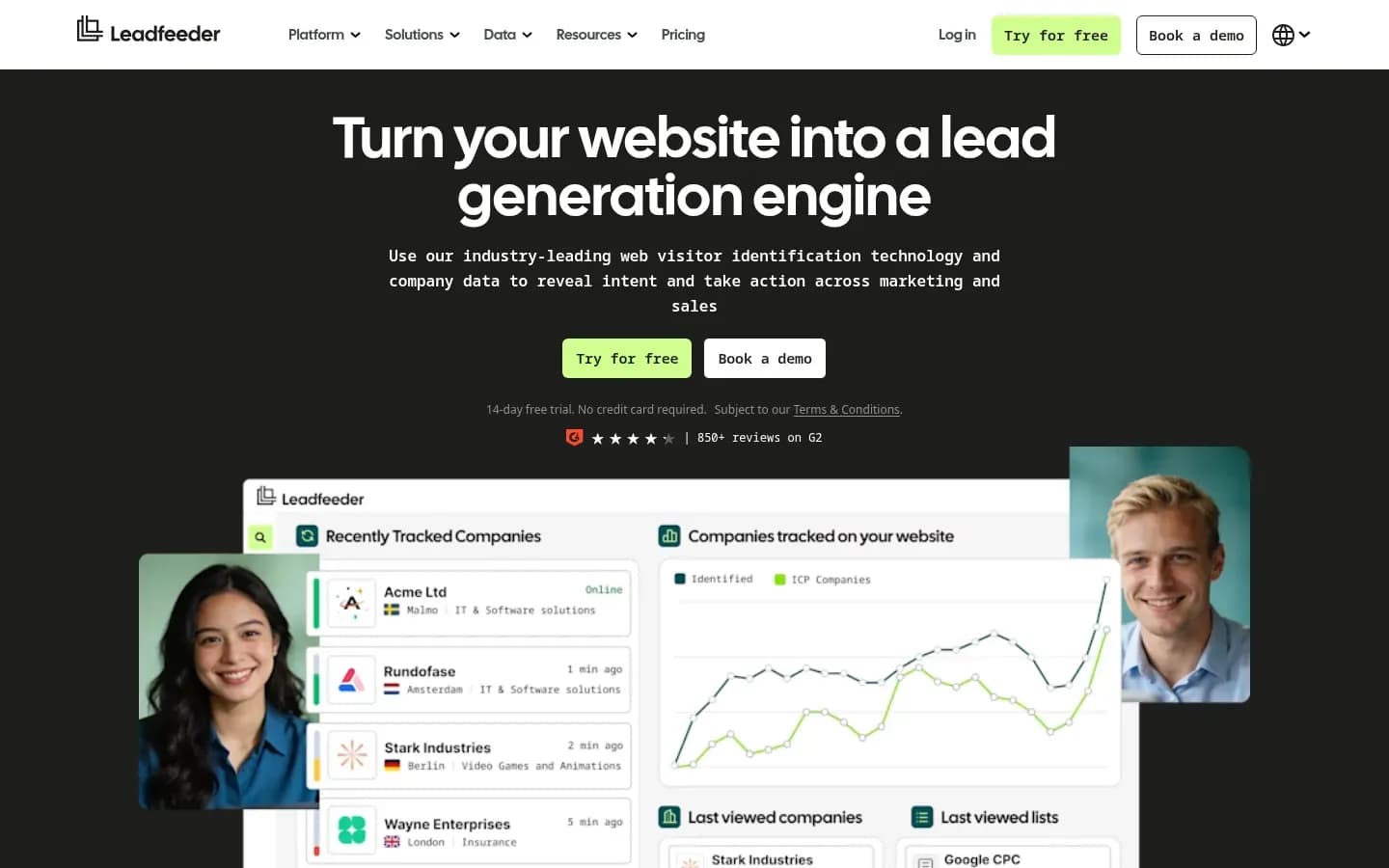
Leadfeeder, the brand Dealfront unified under in March 2026, is a company-level identification tool aimed at SMB and mid-market teams in Europe and North America, with its data hosted on Amazon Web Services in Ireland.
Leadfeeder
Website visitor identification software that shows B2B marketing and sales teams which companies visit their site and syncs them to their CRM.
Leadfeeder names the companies visiting a B2B website and adds contact data from its own database. It is built for SMB and mid-market sales and marketing teams that sell across Europe and North America.
- Free plan
- Yes
- Free trial
- 14 days, no card needed
- Platforms
- API, Chrome extension, Web
- Public API
- Yes
- Compliance
- GDPR, ISO 27001
- Ratings
- G2 4.3/5 (872 reviews) · Capterra 4.2/5 (137 reviews)
Verdict: The strongest all-round pick for traffic split between Europe and North America, with EU hosting and a self-serve plan ladder.
What it does: Leadfeeder matches website visits to companies and cites a database of more than 60 million companies and 400 million verified contacts, which is the vendor's own figure. Leadfeeder says the product is designed for SMB and mid-market teams "particularly across Europe and North America".
Regional coverage: Leadfeeder self-reports that in August 2026 it identified 38.0% of visits across its five core regions and 30.8% of visits from the US and Canada. These are Leadfeeder's own figures, not an independent measurement, but they show the vendor admitting a gap in North America.
Data handling: Leadfeeder states that its servers and data are hosted and processed on Amazon Web Services in Ireland. It processes personal data on legitimate interest under Article 6(1)(f) GDPR and signs a data processing agreement with customers. Transfers involving its US entity use Standard Contractual Clauses.
Identification level: Company-level. Contact details for people at the matched companies come from monthly credits on the Activate and Scale plans.
Pricing: The Leadfeeder plan ladder is shown below.
Leadfeeder pricing
| Plan | Price | Billing | Notes |
|---|---|---|---|
| Lite | €0 | per month | |
| Discover | €79 | per month, billed annually | |
| Activate | €369 | per month, billed annually | |
| Scale | €599 | per month, billed annually | |
| Enterprise | Custom pricing |
Real cost: Paid plans are tiered by the number of identified companies per month, and Activate and Scale also by monthly credits for contact data. Every plan includes unlimited users and unlimited tracked domains with no seat fees. The bill therefore grows with the companies your traffic produces and the contacts you pull, not with team size. Scale is billed annually only.
Best fit: SMB and mid-market teams with mixed European and North American traffic that want self-serve plans and EU-hosted data.
Limitations: Leadfeeder's own numbers show lower identification on US and Canadian visits than in its core regions. The Lite plan shows only the last 100 identified companies and 7 days of visitor history, with a ceiling of 50,000 unique visitors.
Why it's on the list: It ranks first because its vendor material names both Europe and North America as target markets, it states its hosting location and legal basis plainly, and its pricing scales with identified companies rather than seats.
Leadinfo
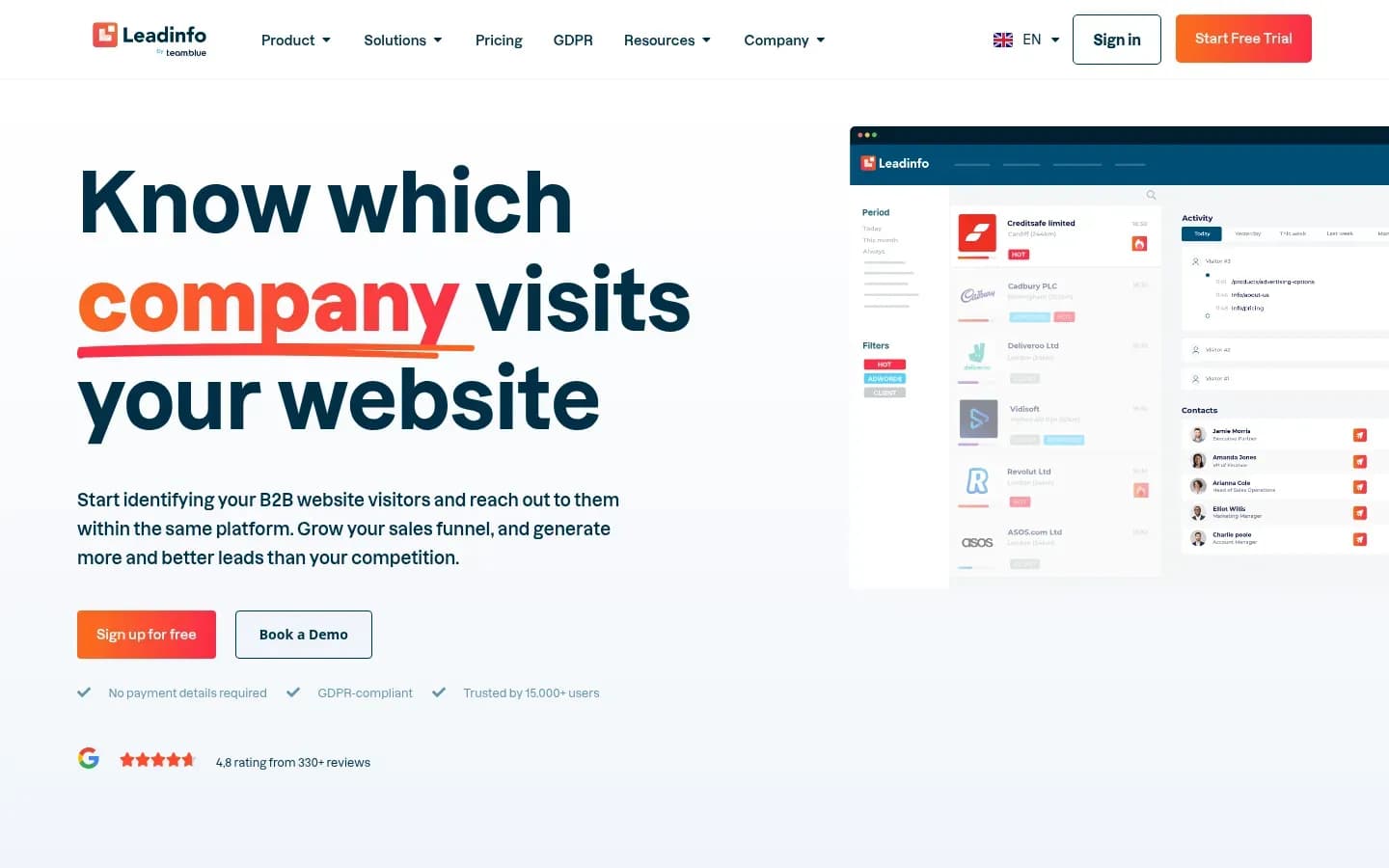
Leadinfo claims 220 million European business profiles with its deepest coverage in Benelux, DACH, the UK and the Nordics, hosts all data in Ireland and Frankfurt, and added North American customers by acquiring Canada-based Visitor Queue in January 2026.
Leadinfo
B2B website visitor identification software that links visits to company data so sales and marketing teams can generate leads.
Leadinfo links website visits to company data so B2B sales and marketing teams can see and follow up on the businesses showing interest. Its data is strongest in northern and western Europe.
- Free trial
- 14 days, no card needed
- Compliance
- GDPR, ISO 27001
- Ratings
- G2 4.3/5 (836 reviews)
Verdict: A strong fit for Benelux, DACH, UK and Nordic traffic, where Leadinfo claims its deepest coverage, with EU-only hosting and a newer North American footprint.
What it does: Leadinfo identifies the companies behind visits from their IP addresses and enriches them from a database it says holds 220 million European business profiles, a vendor claim.
Regional coverage: Leadinfo claims an identification rate of 35-40% in Europe and says that for visitors outside Europe the identification rate is lower. The Visitor Queue deal brought its more than 9,000 European clients together with Visitor Queue's North American customer base, and Leadinfo's CEO framed it as building "a truly global visitor intelligence platform".
Data handling: Leadinfo hosts all data in the EU, in Ireland and Frankfurt, which suits teams whose legal or procurement policy requires EU-only hosting.
Identification level: Company-level. Leadinfo names the causes of misses as VPNs that mask the real IP, home workers on consumer internet, and consumer ISPs that assign dynamic IPs.
Pricing: The Leadinfo plan ladder is shown below.
Leadinfo pricing
| Plan | Price | Billing | Notes |
|---|---|---|---|
| Starter |
|
| |
| Scale |
|
| |
| Pro |
|
|
Real cost: Starter, Scale and Pro are priced by identified-company ranges. Starter includes 3 user seats and 3 automations, Scale 10 seats and 10 automations, and Pro unlimited users and automations, with the top range set by contacting sales. Add-ons raise the bill, with Autopilot and Leadbot Business charged per seat and Liquid content from EUR 39 per month. Screen recording is included from Scale. Prices can be shown in EUR, GBP, USD and DKK.
Best fit: Teams whose traffic is concentrated in Benelux, DACH, the UK or the Nordics and that need data kept inside the EU.
Limitations: Leadinfo's G2 reviews most often complain about data accuracy, notably for smaller companies, plus filtering, segmentation and price. About six in ten region-tagged reviews come from Europe, so review evidence for non-European traffic is thin.
Why it's on the list: It ranks second because Leadinfo claims its deepest coverage in Benelux, DACH, the UK and the Nordics and keeps hosting inside the EU. Its North American reach came with the Visitor Queue deal, while Leadfeeder names North America as a target market in its own material.
Demandbase
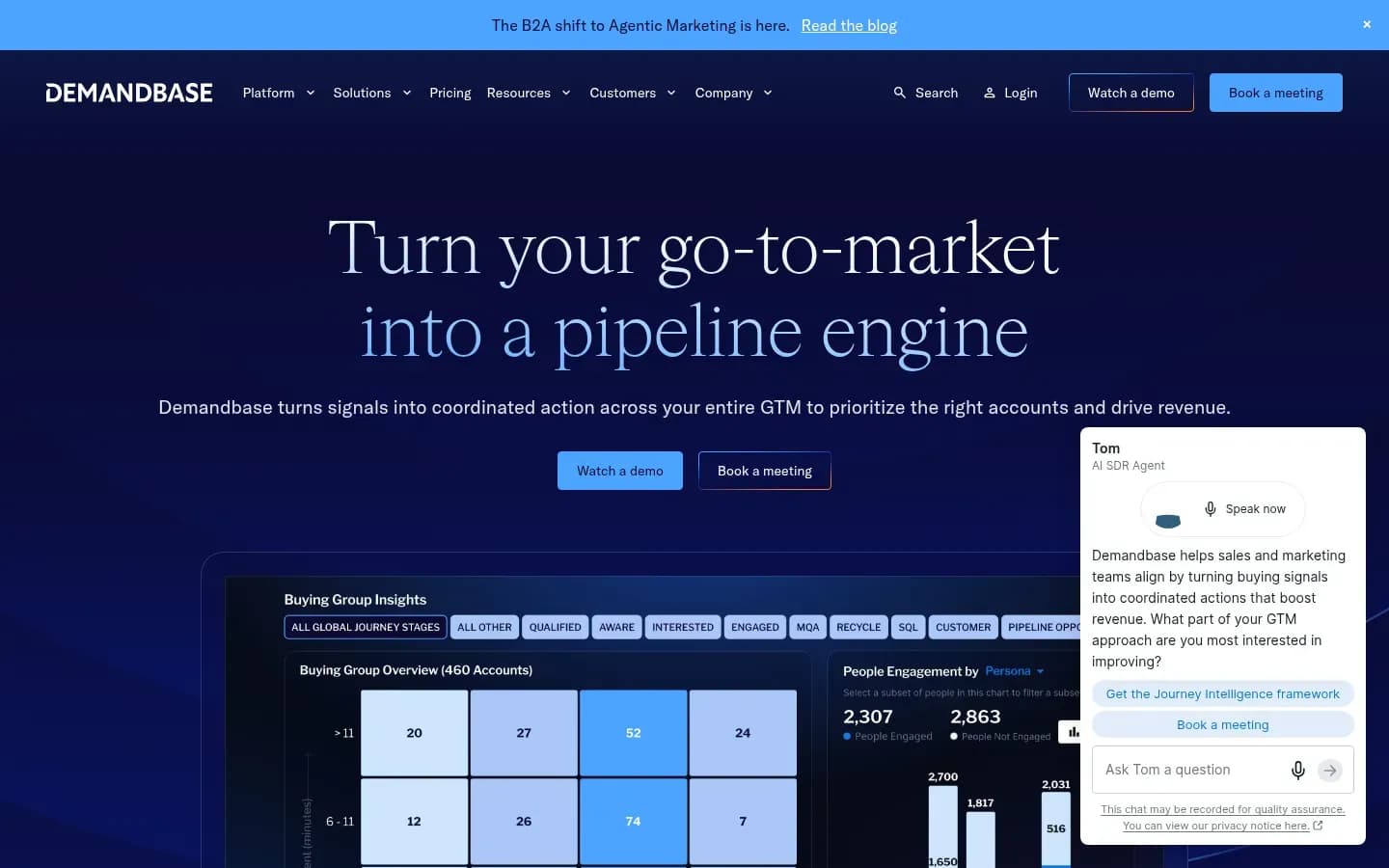
Demandbase identifies accounts from an identity graph of cookies, IP addresses and machine-learning predictions, and its own support documentation says data is inconsistent in India, the Middle East and APAC because of shared IPs and costlier third-party data.
Demandbase
Account-based marketing and go-to-market platform for B2B marketing, sales and revenue teams.
Demandbase is an account-based marketing and go-to-market platform for B2B marketing, sales and revenue teams. Website account identification is one part of a wider enterprise suite.
- Compliance
- ISO 27001, SOC 2
- Ratings
- G2 4.4/5 (2,025 reviews)
Verdict: A global enterprise ABM platform with a candid regional disclosure, best for teams that already run ABM and have staff to operate it.
What it does: Demandbase identifies visiting accounts from an identity graph that combines cookies, IP addresses and other signals with machine-learning predictions. Its blog claims around 3.7 billion IP addresses mapped to a company or otherwise classified and over a billion active cookies, both vendor figures.
Regional coverage: Demandbase's support FAQ says data availability is inconsistent in India, the Middle East and APAC because of shared IP use and costlier third-party data, and that dynamic IPs and remote work cause deviations. Its blog, dated 10 February 2026, says "our match rates are currently at 77%". The same support FAQ says its client-side integration "identifies about 20 percent of B2B traffic, translating to roughly 10 percent of all site traffic". Both are vendor claims, and they measure against different denominators, so neither tells you what share of your own visitors it will name.
Identification level: Account level, which is company-level identification fed into ABM targeting and advertising.
Pricing: Demandbase's pricing status is shown below.
Real cost: Demandbase charges a platform fee covering software and services plus a flat fee per user. Advertising is offered as a starting place and Data solutions can be bought on their own, while Sales and Marketing are not sold as separate solutions. Users and modules drive the bill.
Best fit: Enterprise teams already running ABM across regions, with a team to run the platform.
Limitations: G2 reviewers of Demandbase One most often report a steep learning curve and a dense interface. The most commonly reported implementation time is 1-3 months, with an average of 2 months, and the average reported time to ROI is 13 months. Perceived cost sits at the top of G2's scale.
Why it's on the list: It ranks third because it names the regions where its data is weaker and explains why, which helps teams with APAC or Indian traffic plan a test. Its cost and implementation effort put it out of reach for most SMB teams.
Albacross
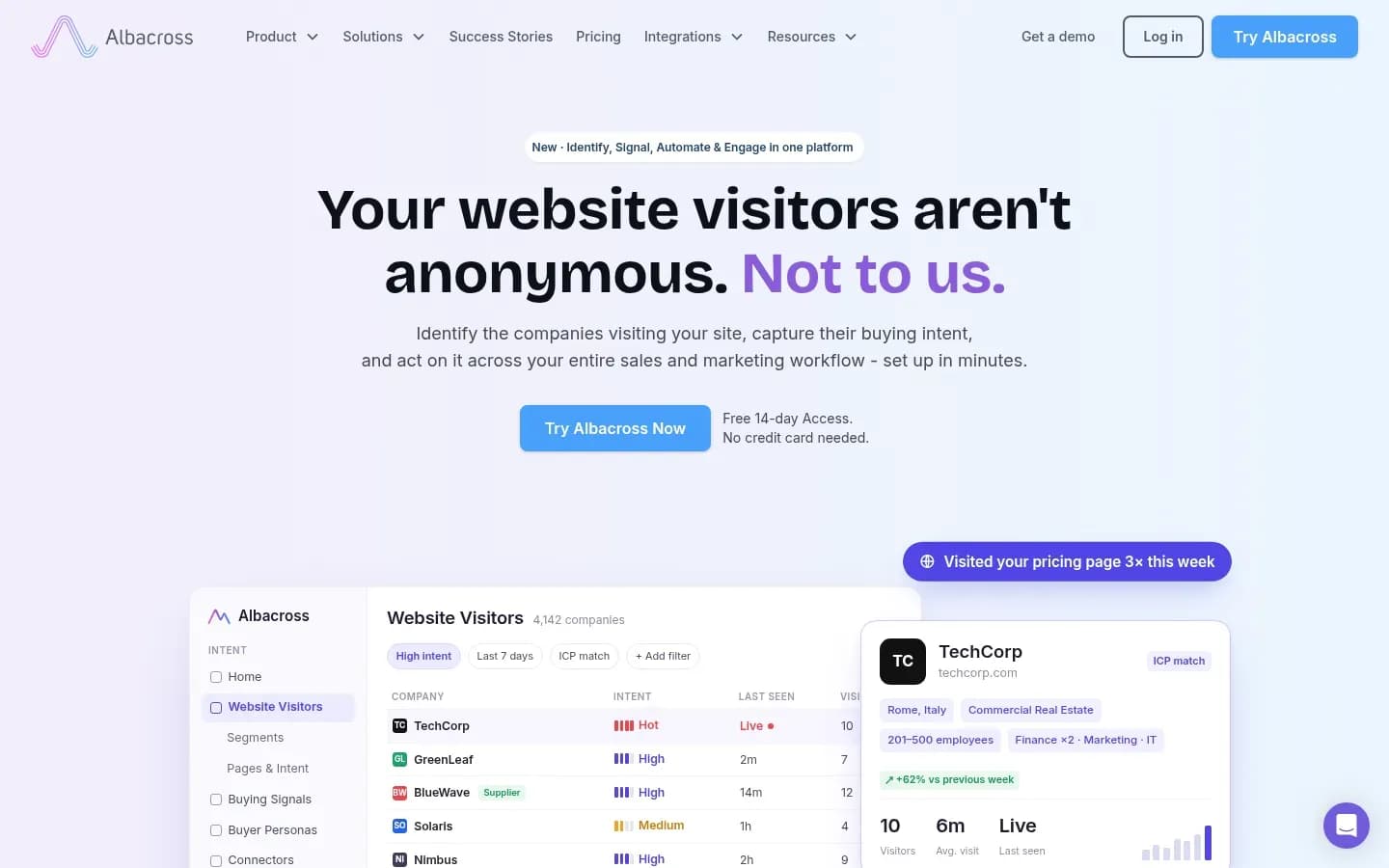
Albacross names the companies visiting a site, scores each account on fit and intent, and pushes hot accounts to CRM, Slack, Teams and ad audiences. In its own words, "B2B teams across Europe use Albacross".
Albacross
B2B website visitor identification and buying-intent platform that shows sales and marketing teams which companies visit their site and syncs scored accounts to their CRM.
Albacross is a B2B website visitor identification and buying-intent platform. It shows which companies visit a site and syncs scored accounts to CRM, chat and advertising tools.
- Free trial
- 14 days, no card needed
- Platforms
- Chrome extension
- Public API
- Yes
- Compliance
- GDPR
- Ratings
- G2 4.6/5 (129 reviews) · Capterra 4.5/5 (111 reviews)
Verdict: A good fit for European teams that want visiting companies turned into scored accounts, alerts and ad audiences.
What it does: Albacross identifies visiting companies, scores every account by fit and intent, and syncs hot accounts to CRM, Slack, Teams and ad audiences. It claims over 30 integrations and a database that maps over 3 billion events monthly, both vendor claims.
Regional coverage: Albacross's own site says "B2B teams across Europe use Albacross". That is the vendor's description of its users, not a statement of where its data is strongest.
Data handling: Albacross offers a data processing agreement and gives customers a guide to update their cookie policy so it covers the Albacross pixel.
Identification level: Company-level. Contact emails and phone numbers come through a LinkedIn Chrome extension, not by naming the people who visited the site.
Pricing: The Albacross plan ladder is shown below.
Albacross pricing
| Plan | Price | Billing | Notes |
|---|---|---|---|
| Starter |
|
| |
| Professional |
|
| |
| Organisation | Custom pricing |
Best fit: European marketing teams that want company visits pushed into ad audiences, Slack or Teams alerts and CRM records.
Limitations: Albacross's Capterra reviews describe identification accuracy as inconsistent, with several users reporting internet providers shown instead of companies. A reviewer in Southeast Asia reported placeholder or missing data for small companies. Support, onboarding and quick setup are praised.
Why it's on the list: It ranks fourth because its activation features suit European ad and alert workflows, while it publishes less about regional data strength than the three tools above.
Lead Forensics
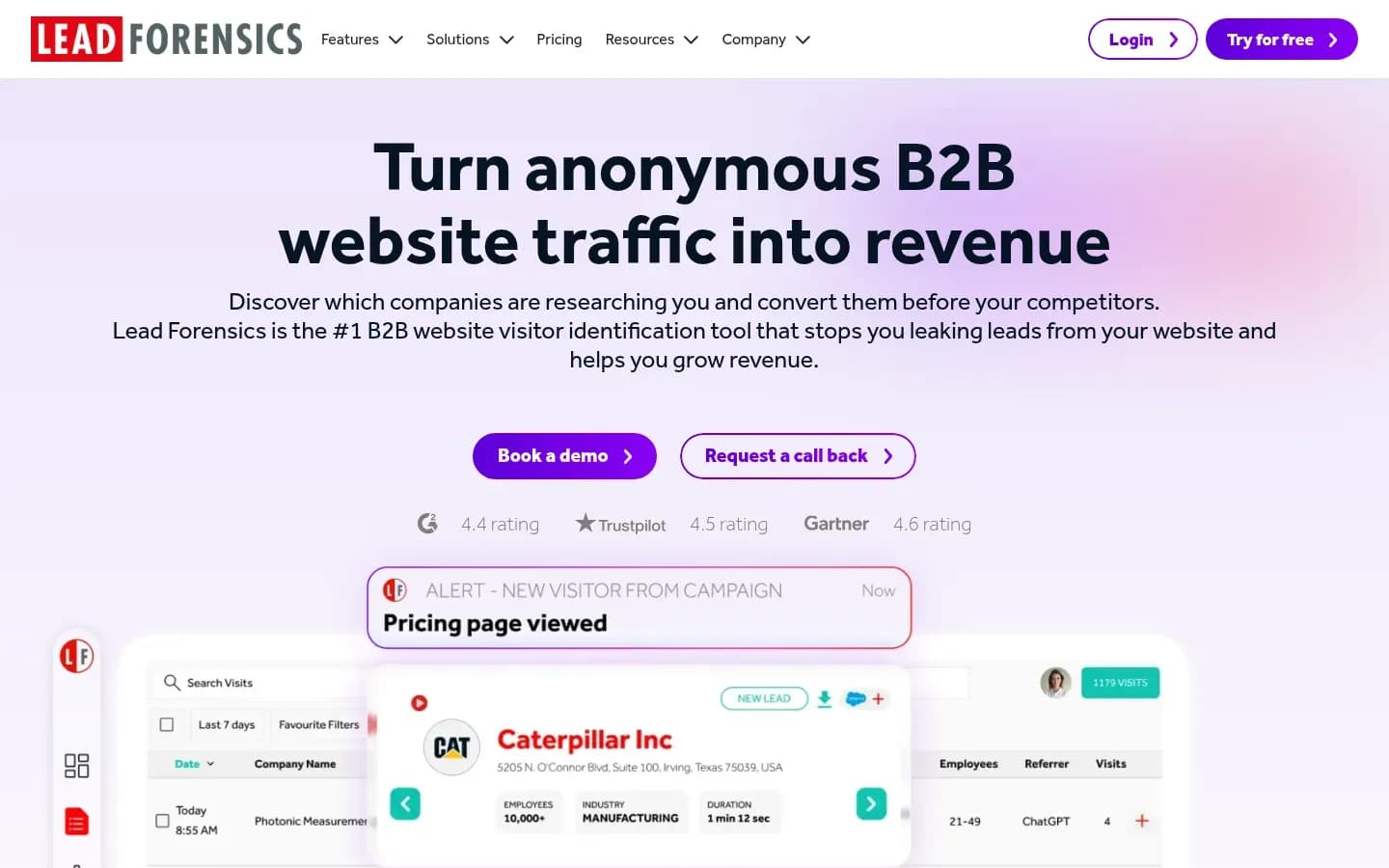
Lead Forensics quotes its price from your website traffic and the share of businesses it matched during a required trial, so the trial itself shows how well it recognises visitors from each of your markets.
Lead Forensics
B2B website visitor identification tool that shows the companies behind anonymous site visits.
Lead Forensics shows the companies behind anonymous B2B site visits and supplies contact details for people who work at those companies.
- Compliance
- GDPR, ISO 27001
- Ratings
- G2 4.4/5 (1,216 reviews) · Capterra 4.5/5 (270 reviews)
Verdict: A sales-led option whose quote is tied to matches on your own traffic, worth it only if you manage the contract terms closely.
What it does: Lead Forensics identifies the companies behind anonymous B2B visits and adds decision-maker contact details from its own data.
Data handling: Lead Forensics says processing may occur in countries where its systems or approved sub-processors operate.
Identification level: Company-level. Lead Forensics describes its contact data as "B2B contact information for individuals employed by matched businesses" and states it is "not the individuals who visited the customer's website".
Pricing: Lead Forensics' pricing status is shown below.
Real cost: Lead Forensics publishes no prices. The quote rests on website traffic volume and the percentage of businesses matched during the trial. There is no per-user charge, and decision-maker contact details use monthly credits that reset. Advanced Salesforce and HubSpot integrations and single sign-on are additional licence options, and contract terms are agreed per package.
Best fit: Teams that want a price tied to proven matches on their own traffic and can manage renewal dates.
Limitations: Lead Forensics' Trustpilot reviews praise account managers, onboarding and ease of use, but recurring complaints concern automatic renewal into a full 12-month term, short cancellation windows and price rises at renewal. Reviews rarely discuss accuracy or international coverage.
Why it's on the list: The trial-based quote doubles as a country test for international traffic. It ranks fifth because its regional strength has to be proven in that trial rather than read from vendor material, and its renewal terms need managing.
Why Do Visitor Identification Rates Drop Outside The US Or Europe?
Visitor identification rates change by country because IP-to-company matching depends on how many local visitors browse from company-registered networks and how deep the vendor's company data runs in that market, which Demandbase itself says is weaker in India, the Middle East and APAC.
Two things decide whether a visit gets a company name. The first is the network. A visitor on an office connection registered to their employer is easy to match, while a visitor on a VPN, a home broadband line or a mobile network is not. The second is the database. A vendor can only name a company it holds records for, and those records are deeper in some countries than others.
The vendors' own documentation points to the same causes:
- Leadinfo names VPNs that mask the real IP, home workers on consumer internet and consumer ISPs that assign dynamic IPs.
- Demandbase names shared IP use and costlier third-party data in India, the Middle East and APAC, plus dynamic IPs and remote work everywhere.
- Leadfeeder reports 38.0% of visits identified across its five core regions against 30.8% from the US and Canada in August 2026, so the drop can run in either direction depending on where a vendor's data is strongest.
Every regional rate above is a vendor claim. Vendors also measure against different denominators. Demandbase's 77% match rate and its figure of about 20% of B2B traffic come from the same company and describe different things.
Published figures with their owner, sample and denominator are collected in the visitor identification benchmarks by traffic segment, which also splits results by country where a source allows it.
Can Visitor Identification Tools Name Individual Visitors Outside The US?
The five tools in this guide name the company behind a visit, not the person. Lead Forensics states that the contacts it adds are employees of the matched business, not the individuals who visited. RB2B, a person-level tool, lists contact-level identification as US only, so for European traffic plan around company-level matches plus contact data.
RB2B's contact-level identification is listed as US only on its pricing page, as Happierleads reports, and EU and UK visitors appear at company level at best.
Three of the tools add contacts to company matches in different ways:
- Lead Forensics supplies contact details for people employed by the matched business and states they are not the visitors.
- Albacross offers contact emails and phone numbers through a LinkedIn Chrome extension.
- Leadfeeder uses monthly credits on its Activate and Scale plans for contact data.
The differences in coverage, match confidence and privacy law are set out in more depth in company-level vs person-level visitor identification.
Is Visitor Identification Legal For EU And UK Traffic?
Visitor identification on EU traffic touches two rules, the ePrivacy consent rule that the European Data Protection Board says covers tracking pixels and can cover IP-only tracking, and GDPR's requirement for a lawful basis, which vendors such as Leadfeeder rest on legitimate interest.
The EDPB's Guidelines 2/2023 on the technical scope of Article 5(3) of the ePrivacy Directive, version 2.0 adopted on 7 October 2024, state that tracking pixels and tracking links fall under Article 5(3) even if the storage is not permanent. They also include a section on tracking based on IP only and say Article 5(3) could apply to it.
That leaves two separate questions for your site:
- Placing or reading the tracking script. This is the ePrivacy layer, and it decides whether you need consent before the script runs.
- Processing the data it collects. This is the GDPR layer, which needs a lawful basis. Leadfeeder, for example, relies on legitimate interest under Article 6(1)(f) GDPR.
GDPR follows where the visitor is, not where your company or the vendor is based, as Leadfeeder's own GDPR page notes. A compliance badge on a vendor's site therefore does not settle the consent question for your site.
This section is general information, not legal advice.
How To Test Match Rates By Country Before You Buy
The match rate that matters is the one a tool achieves on your own traffic, split by visitor country, because Demandbase alone reports both a 77% match rate and identification of about 20% of B2B traffic depending on the denominator. Run shortlisted tools side by side and compare them market by market.
A fair test keeps everything constant except the tool. Use the same pages, the same dates and the same traffic, then judge each tool on the markets you sell into.
- Run trials in parallel on the same pages and over the same dates
- Split every tool's results by visitor country before comparing totals
- Count only identified companies that are real businesses and remove internet providers
- Check matches against visits you already know, such as customers and booked demos
- Ask each vendor whether its quoted rate uses all traffic or B2B traffic as the denominator
- Use Leadfeeder's Lite plan and the Lead Forensics trial as low-cost ways to test
- Compare each tool on your two or three priority markets, not on the blended figure
Removing internet providers matters because Albacross reviewers on Capterra report ISPs shown instead of companies, and the same problem inflates any tool's match count. The Lead Forensics trial is useful here twice over, because the matched share it records also sets the quote.
For a fuller protocol on checking named companies against accounts you can confirm, see the guide to visitor match accuracy on known accounts.
What Does Visitor Identification Cost For International Traffic?
Each tool meters its bill differently, with identified companies and credits at Leadfeeder, company ranges and seats at Leadinfo, a platform fee plus users at Demandbase, and traffic volume plus the match share from its trial at Lead Forensics. Knowing the meter tells you how international traffic will move the bill.
What sets the bill for each tool
| Tool | What sets the bill | Extra costs to plan for |
|---|---|---|
| Leadfeeder | Identified companies and credits | Credits for contact data |
| Leadinfo | Company ranges, seats, automations | Autopilot, Leadbot, Liquid content |
| Demandbase | Platform fee plus users | Extra modules |
| Lead Forensics | Traffic and trial match share | Integration licences and SSO |
Leadinfo's Autopilot and Leadbot Business add-ons are charged per seat, and Liquid content starts at EUR 39 per month. Lead Forensics contact details use monthly credits that reset. Albacross publishes a plan ladder, shown in its pricing table in the Albacross section.
International traffic raises identified-company counts unevenly. A meter based on identified companies grows fastest where the tool matches well, so a tool strong in DACH will cost more on DACH-heavy traffic than its entry plan suggests. At Lead Forensics, traffic volume and the share of businesses matched in the trial both set the quote, so read the trial results by country before you sign.
Contract terms matter as much as the meter. Lead Forensics reviewers repeatedly report automatic renewal into a full 12-month term and price rises at renewal, so put the renewal date in your calendar on day one.
To judge whether the spend pays back, separate incremental pipeline from pipeline the tool only touched, as set out in the guide on how to measure visitor identification ROI.
Which Visitor Identification Tool Should You Choose For Your Markets?
If most of your non-US traffic comes from Europe and North America, choose Leadfeeder; if it is concentrated in Benelux, DACH, the UK or the Nordics and you need EU-only hosting, choose Leadinfo; if you run enterprise ABM across regions, choose Demandbase and test its APAC traffic first.
Match the tool to your traffic mix:
- Mostly European plus North American traffic, SMB or mid-market, self-serve. Leadfeeder, for its stated focus on Europe and North America and its AWS Ireland hosting.
- Mostly Benelux, DACH, UK or Nordic traffic with EU-only hosting required. Leadinfo, for its deepest vendor-stated coverage in those markets and hosting in Ireland and Frankfurt.
- Enterprise ABM across regions with a team to run it. Demandbase, after testing its India and APAC traffic and planning for the implementation time G2 reviewers report.
- European team that wants company visits pushed to ad audiences and Slack. Albacross, for its fit and intent scoring and its syncs to ad audiences, Slack and Teams.
- A quote tied to proven matches on your own traffic. Lead Forensics, if you can manage its renewal terms.
The European picture is shifting. Leadfeeder's own study of 95,243 country-targeting decisions by 9,290 companies on its platform between 2017 and 2026 found the US share of new country targeting fell from 43.5% to 40.8% between 2023 and 2025, while Germany's rose from 15.4% to 18.1%. It is one platform's data, not a census, but it suggests European sellers are targeting other European markets more often, which raises the value of strong European coverage.
Frequently Asked Questions
Is there a free visitor identification tool for European traffic?
Leadfeeder's Lite plan is the clearest low-cost starting point for European traffic. It shows the last 100 identified companies with 7 days of visitor history and a ceiling of 50,000 unique visitors, and the pricing table in the Leadfeeder section shows its terms. That is enough to see how it handles your European visitors.
Does a VPN stop visitor identification?
Usually, yes. A VPN masks the real IP address, so the tool sees the VPN provider rather than the visitor's company. Leadinfo names VPNs as a cause of missed matches, along with home workers on consumer internet and dynamic consumer IPs, and Demandbase lists dynamic IPs and remote work as causes of deviations.
Does data hosting location matter for visitor identification?
Yes, for how personal data moves, though GDPR applies according to where the visitor is, not where the vendor sits, as Leadfeeder's GDPR page notes. Leadfeeder hosts on AWS in Ireland and uses Standard Contractual Clauses for transfers to its US entity, while Leadinfo keeps all data in Ireland and Frankfurt.
Are vendor match rates reliable for my traffic?
Treat them as a starting point, not a forecast. Each published rate is a vendor claim with its own denominator. Demandbase quotes a 77% match rate on its blog and about 20% of B2B traffic, roughly 10% of all traffic, in its support FAQ. Run a trial on your own traffic and split the results by country.
Sources
Sources
- The State of Account Identification: 2024 and Beyond - Demandbase · demandbase.com
- team.blue brand Leadinfo acquires Visitor Queue to boost global visitor intelligence · tools.prnewswire.com
- Leadinfo Reviews - G2 · g2.com
- Demandbase One Reviews - G2 · g2.com
- Albacross Reviews - Capterra · capterra.com
- Lead Forensics Reviews - Trustpilot · uk.trustpilot.com
- GDPR & Compliance - Leadfeeder · leadfeeder.com
- 10 Best Website Visitor Identification Software (2026) - Leadfeeder · leadfeeder.com
- Pricing - Leadinfo · leadinfo.com
- How Reliable is IP Tracking for Identifying Website Visitors? - Leadinfo · leadinfo.com
- The Cross-Border Selling Map: Where B2B Companies Look for Customers in 14 European Markets · leadfeeder.com
- Dealfront unifies under Leadfeeder brand · leadfeeder.com
- Guidelines 2/2023 on Technical Scope of Art. 5(3) of ePrivacy Directive · edpb.europa.eu
- Pricing - Leadfeeder · leadfeeder.com