A small team buys visitor identification to act on visits the same day, not to fill a dashboard. This shortlist ranks each tool on the work it creates after install as much as on what it finds.
These picks apply to B2B teams of one to ten people without a dedicated admin who need alerts they can act on the same day. Match quality differs by traffic mix and region, so run a known-visit test on two tools before committing.
How We Chose These Visitor Identification Tools
A visitor identification tool suits a small team when one person can set it up, route useful alerts without a dedicated admin, and see what the bill is based on, and five tools clear that bar.
Website visitor identification connects a visit to a company, and on some tools to a named person. For this list, "small team" means one to ten people with no dedicated admin. A tool qualifies when it publishes its plans and sends alerts to Slack without an admin.
Snitcher, RB2B, Leadinfo, Albacross and Warmly are covered. They are weighed on four criteria, in this order:
- Setup effort. How much one person has to do before the first useful alert arrives.
- Alert usefulness. Whether an alert pairs a trigger with a filter, so it fires only on visits worth answering.
- Follow-up load per seat. How many people can own alerts, and how much work each match creates.
- The meter. What the bill counts, and what pushes it past the plan price.
Vendor accuracy claims use different methods and samples, so the ranking does not use match rates. Two tools that appear on other shortlists were considered and left out:
Considered, not included
| Tool | Reason |
|---|---|
| Leadfeeder | Covered in a separate head-to-head |
| Lead Forensics | No list prices, proposal-led sales |
Visitor Identification Tools For Small Teams Comparison
The five tools split on two lines, identity level and meter, with Snitcher, Leadinfo and Albacross naming companies, RB2B adding named US contacts on paid plans, and Warmly selling credit-based bundles on annual or quarterly terms.
| Tool | Pricing model | Free trial | Identity level | Alert route | Best for |
|---|---|---|---|---|---|
| Snitcher | Paid | 14 days, no card needed | Company-level | Slack automations | Whole-team company-level alerts |
| RB2B | Freemium | 7 days, no card needed | Company, plus US contacts | Slack or Teams | US-focused Slack-first sellers |
| Leadinfo | Paid | 14 days, no card needed | Company-level | Slack triggers | European teams using triggers |
| Albacross | Paid | 14 days, no card needed | Company-level | Slack notifications | Alerts plus LinkedIn ad audiences |
| Warmly | Paid | Person-level | Slack alerts | High-volume inbound programmes |
Read the identity column first. A company-level match starts an account conversation, while a person-level match starts a message to one named buyer.
Then read the alert route. Every tool here reaches Slack, so the real difference is how finely each one filters what it sends, which the tool sections below cover.
Best Visitor Identification Tools For Small Teams
For a team of one to ten people, Snitcher ranks first because every plan carries unlimited users and real-time segment alerts, while Warmly ranks last because its bundles are sold on annual or quarterly terms built for larger inbound programmes.
- SnitcherBest for whole-team company-level alerts
- RB2BBest for uS-focused Slack-first sellers
- LeadinfoBest for european teams using triggers
- AlbacrossBest for alerts plus LinkedIn ad audiences
- WarmlyBest for high-volume inbound programmes
The order reflects fit for a small team, not feature count. Snitcher charges no seat fees and filters alerts by segment. RB2B is Slack-first and names US visitors on paid plans. Leadinfo is rooted in Europe, tiers plans by identified companies and caps users on lower plans. Albacross pairs company identification with ad audiences. Warmly is an inbound automation suite priced for larger budgets and now owned by HubSpot.
Snitcher For Company-Level Alerts With No Seat Fees
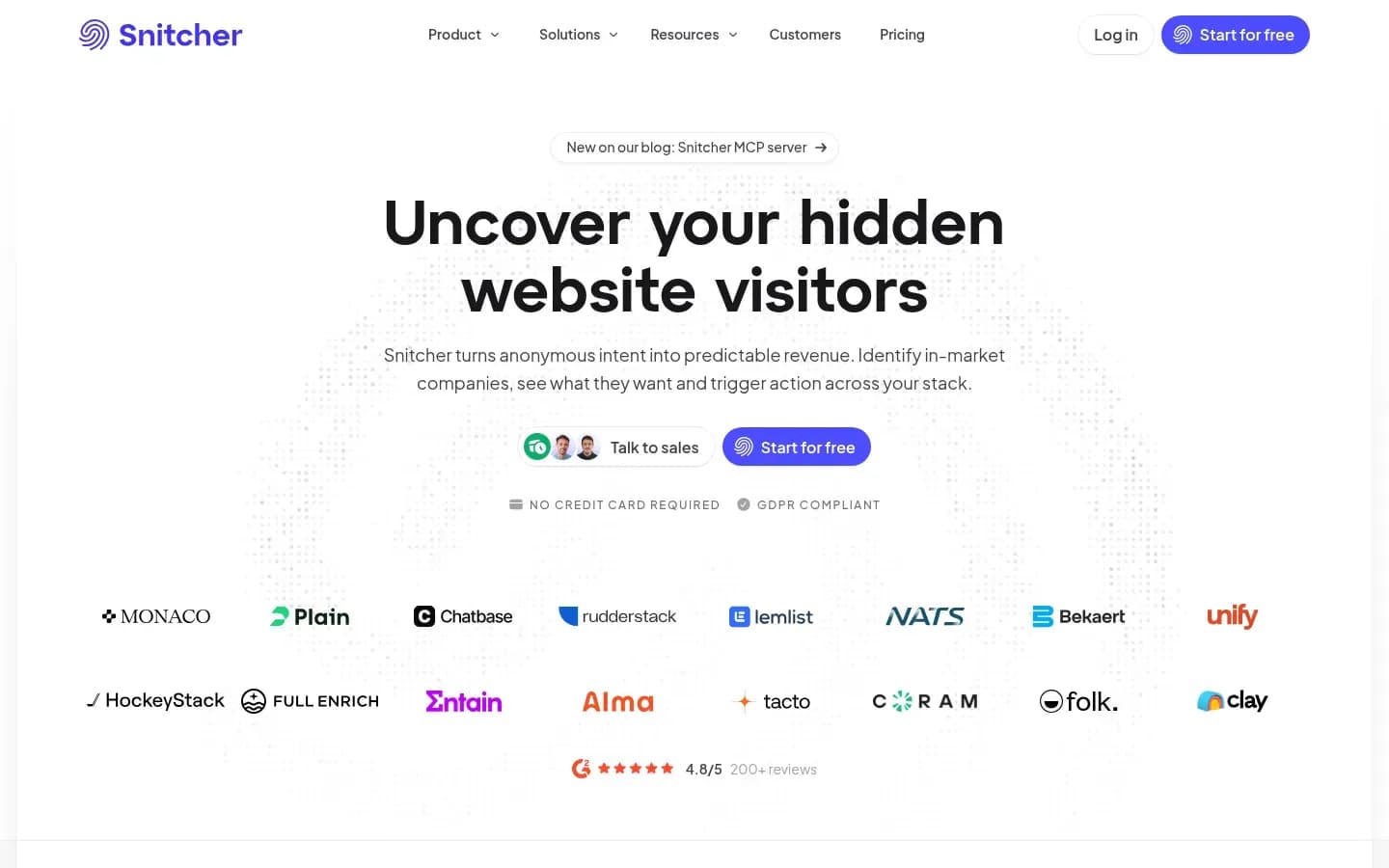
Snitcher fits small teams that want to share company-level visit data with everyone, because every plan includes unlimited users and the bill follows how many companies it identifies each month rather than how often they return.
Snitcher
Website visitor identification platform that shows which companies visit a site and their intent, for sales, marketing and RevOps teams.
Snitcher is a website visitor identification platform that shows which companies visit a site and their intent. It serves sales, marketing and RevOps teams, and sends identified companies to a CRM, Slack or an outreach tool through integrations including HubSpot, Salesforce, Slack and Zapier.
- Free trial
- 14 days, no card needed
- Public API
- Yes
- Compliance
- GDPR
- Ratings
- G2 4.8/5 (269 reviews)
Verdict: The best default for a team of one to ten, because nobody rations logins and alerts can be narrowed to the accounts that matter.
Identity level: Snitcher states that it identifies companies, not consumers. Identifying individual people works only with the customer's own consent setup.
Setup: Per Snitcher, a team adds a small script to the site and the first companies show up within minutes.
Alerts: Slack alerts run through Automations. Each automation pairs a trigger, such as "New company identified" or "Company visit", with a segment filter, such as "ICP Match" or "Named Accounts", and posts a real-time alert to a chosen channel with the pages viewed.
Seats and limits: Every plan includes unlimited users, with no seat fees on any plan.
Cost driver: The bill follows the plan and the number of companies identified each month, not how often they come back. Every plan includes credits for reveals and AI research.
Pricing: Plans step up with the number of companies identified each month.
Snitcher Platform pricing
| Plan | Price | Billing | Notes |
|---|---|---|---|
| Platform 0-50 company IDs |
|
| |
| Platform 51-100 company IDs |
|
| |
| Platform 101-250 company IDs |
|
| |
| Platform 251-500 company IDs |
|
| |
| Platform 501-750 company IDs |
|
| |
| Platform 751-1,000 company IDs |
|
| |
| Platform 1,001-2,000 company IDs |
|
| |
| Platform 2,001-3,000 company IDs |
|
| |
| Platform 3,001-4,000 company IDs |
|
| |
| Platform 4,001-5,000 company IDs |
|
| |
| Platform Custom | Custom pricing |
Best fit: Small B2B teams where founders, sales and marketing all want the same company feed, and where a company-level alert is enough to start a conversation.
Limitation: Snitcher names companies by default, so a team that wants a named person per visit has to support it with its own consent setup. Snitcher's accuracy claims are its own, like every vendor's here, so run a known-visit test before paying.
RB2B For Slack-First Alerts On US Traffic
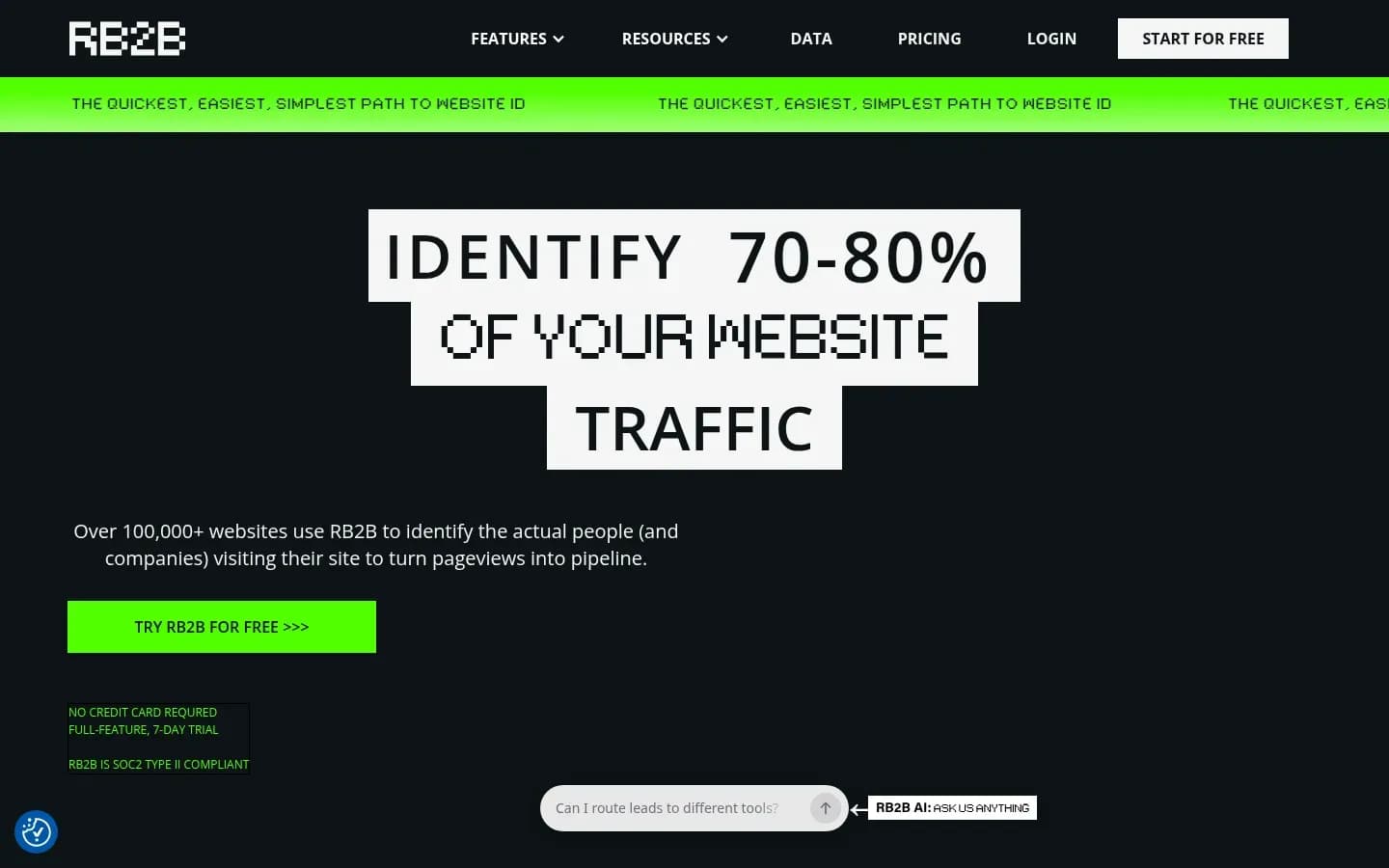
RB2B suits small US-facing sales teams that live in Slack, since it names individual visitors only for US traffic and bills overage per resolution once a plan's monthly allowance runs out, 45 cents on Starter and 25 cents on Pro.
RB2B
Website visitor identification tool that identifies visitors and sends their details to Slack, Teams and CRMs, for sales and marketing teams.
RB2B is a website visitor identification tool that identifies visitors and sends their details to Slack, Teams and CRMs. It serves sales and marketing teams, and its plans step up from company-level matches in Slack to named contacts with business email addresses.
- Free plan
- Yes
- Free trial
- 7 days, no card needed
- Platforms
- Web
- Compliance
- GDPR, SOC 2
- Ratings
- G2 4.5/5 (285 reviews) · Capterra 1/5 (1 reviews)
Verdict: A direct route to named US contacts in Slack, though the plan a small team can follow up from properly is Pro, not the entry tiers.
Identity level: Company-level identification is global on every plan. Contact-level identification is US only.
Setup: RB2B says a team can alert reps, start automated outreach and add to lead score in under five minutes.
Alerts: The entry tier pushes company-level matches to Slack. Starter pushes LinkedIn profile URLs to Slack or Teams, without email addresses or other integrations. Pro adds business email addresses and all other integrations, and Pro+ uses Premium Resolution.
Cost driver: Plans are metered in monthly resolutions. Extra resolutions are billed as overage at 45 cents each on Starter and 25 cents each on Pro and Pro+. Pro and Pro+ also offer an Additional Domains add-on, billed monthly, for up to five domains.
Pricing: The plans differ by resolution allowance and by what each match includes.
RB2B pricing
| Plan | Price | Billing | Notes |
|---|---|---|---|
| Free | $0 | per month | |
| Starter | $79 | per month | |
| Pro | $149 | per month | |
| Pro+ | $199 | per month |
Best fit: US-heavy B2B traffic, a seller who works from Slack, and a reason to message the named person rather than the account.
Limitation: The entry tier excludes person-level identification, email addresses and other integrations, and Starter adds LinkedIn URLs but still no emails or CRM sync. A small team that needs records in its CRM is looking at Pro. Person-level matches also stop at the US border, so EU and UK traffic stays at company level.
Leadinfo For European Small Teams That Want Triggers
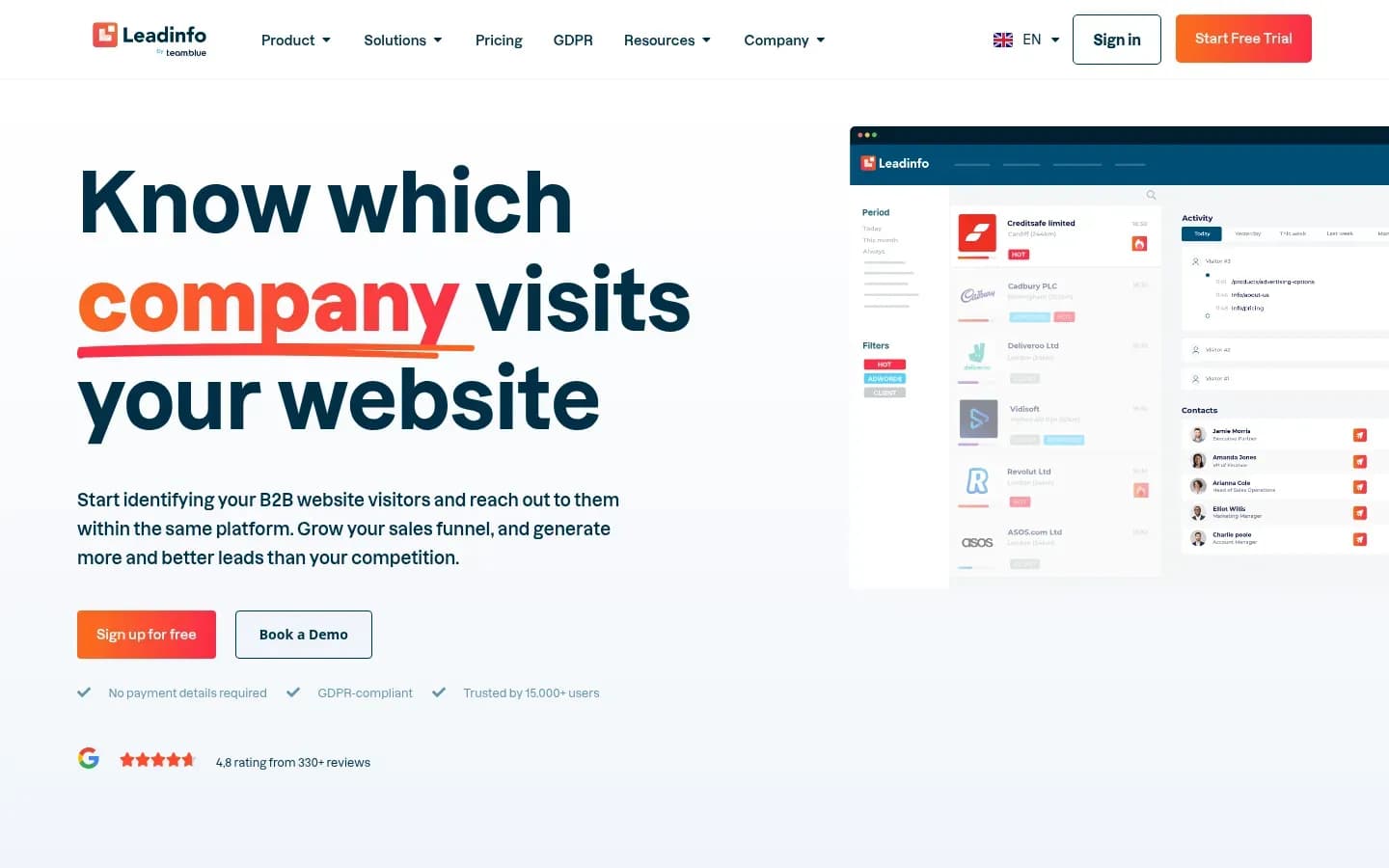
Leadinfo prices each plan by how many companies it identifies, and when a team passes its limit the leads keep being collected but stay hidden until the account upgrades, which makes the tier choice the main cost decision.
Leadinfo
B2B website visitor identification software that links visits to company data so sales and marketing teams can generate leads.
Leadinfo is B2B website visitor identification software that links visits to company data so sales and marketing teams can generate leads. Leadinfo is a team.blue brand and says it serves more than 9,000 clients in Europe.
- Free trial
- 14 days, no card needed
- Compliance
- GDPR, ISO 27001
- Ratings
- G2 4.3/5 (836 reviews)
Verdict: Leadinfo acquired Visitor Queue, a Canada-based visitor intelligence company, in January 2026, adding a North American customer base to its European one. For a small team it is a sound trigger-based tool, as long as the tier fits the traffic.
Identity level: Leadinfo identifies companies. Starter covers 0 to 100 identified companies, Scale 0 to 250 and Pro 0 to 750, with higher volumes quoted on request.
Setup: Leadinfo says connecting Slack takes a few minutes, under Settings and then Integrations.
Alerts: Slack notifications fire when a company visits the site or meets trigger criteria the team defines.
Seats and limits: Starter includes 3 users and 3 automations, with CRM records sent manually. Scale includes 10 users and 10 automations, plus HubSpot, MS Dynamics, LinkedIn Ads and GA4. Pro includes unlimited users and automations, plus Salesforce and Marketo. Leadinfo states it offers 67 free CRM integrations.
Cost driver: The identified-company tier sets the bill. Paid add-ons Autopilot and Leadbot Business are priced per seat, and Liquid content costs from EUR 39 a month. Screen recording is included from Scale.
Pricing: Each tier pairs a company allowance with a seat and automation allowance.
Leadinfo pricing
| Plan | Price | Billing | Notes |
|---|---|---|---|
| Starter |
|
| |
| Scale |
|
| |
| Pro |
|
|
Best fit: European small teams that want trigger-based Slack alerts and can work within three users, or that budget for Scale from the start.
Limitation: Over the plan limit, leads keep being collected but stay hidden until the account upgrades. With the Starter seat cap on top, the cheapest tier can quietly push a team into an upgrade.
Albacross For Company Identification Plus Ad Audiences
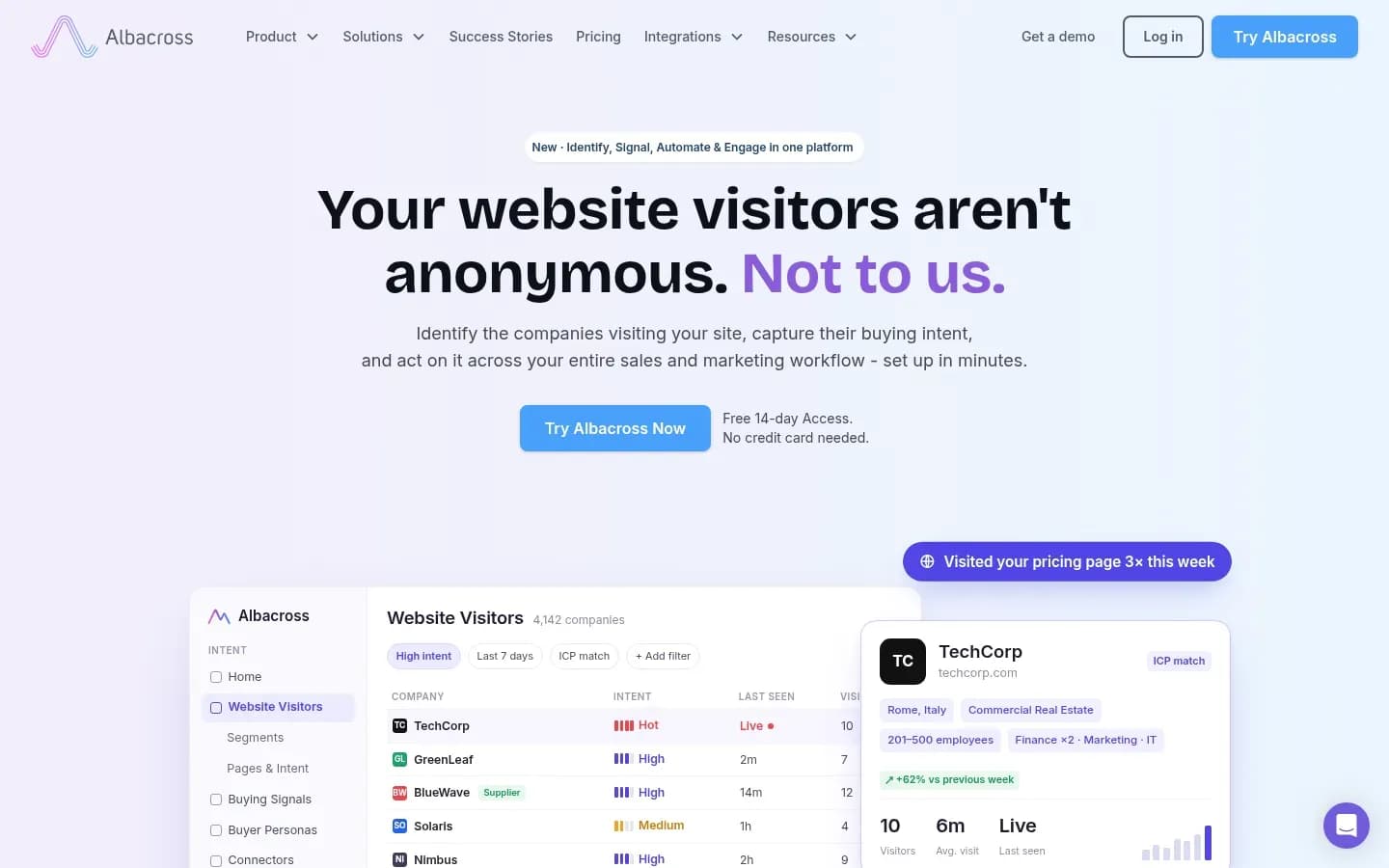
Albacross suits small B2B teams that want one tool to name visiting companies, alert sales in Slack and sync the same accounts into LinkedIn audiences for ads.
Albacross
B2B website visitor identification and buying-intent platform that shows sales and marketing teams which companies visit their site and syncs scored accounts to their CRM.
Albacross is a B2B website visitor identification and buying-intent platform. It shows sales and marketing teams which companies visit their site and syncs scored accounts to their CRM, through a four-part platform it calls Identify, Signal, Automate and Engage.
- Free trial
- 14 days, no card needed
- Platforms
- Chrome extension
- Public API
- Yes
- Compliance
- GDPR
- Ratings
- G2 4.6/5 (129 reviews) · Capterra 4.5/5 (111 reviews)
Verdict: A good pick when paid LinkedIn is already in the plan, and more tool than a one-person team needs when it is not.
Identity level: Albacross turns anonymous traffic into named companies.
Setup: Setup is a tracking snippet, and Albacross claims it is running in under two minutes.
Alerts: Albacross shows Slack notifications to a sales channel and lists 30+ integrations, including Google Analytics, HubSpot, Slack, Microsoft Teams, Pipedrive and Salesforce.
Pricing: Albacross lists its plans in euros.
Albacross pricing
| Plan | Price | Billing | Notes |
|---|---|---|---|
| Starter |
|
| |
| Professional |
|
| |
| Organisation | Custom pricing |
Best fit: Small teams that want identified accounts to feed LinkedIn ads as well as sales alerts, with fit-and-intent scoring deciding which accounts go where.
Limitation: The ad and intent layers add work a one-person team may never use. Judge Albacross on whether ads are part of the plan for the next quarter.
Warmly For Small Teams Running High-Volume Inbound
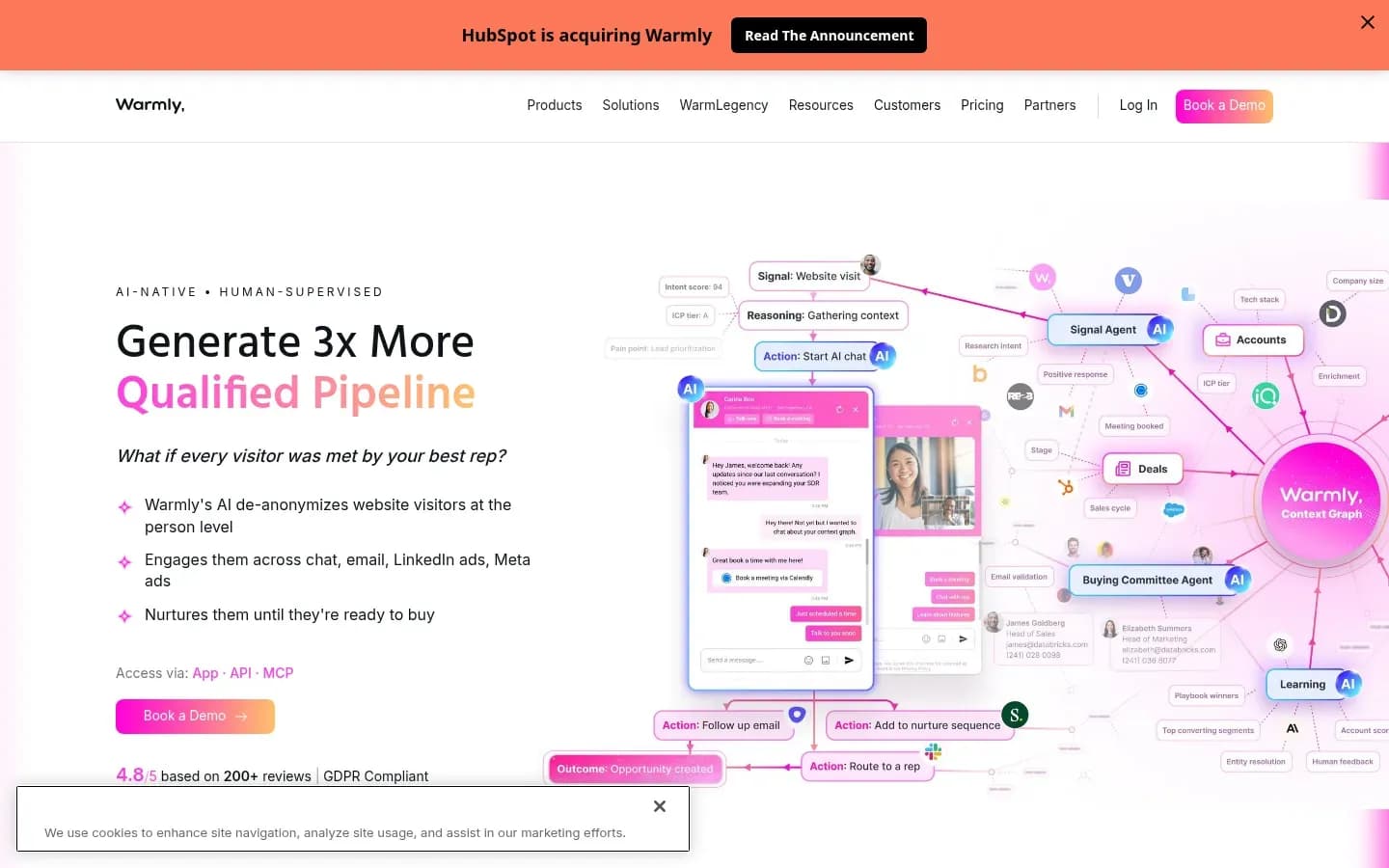
Warmly, which HubSpot agreed to acquire in a deal announced on 30 June 2026, fits a small team only when inbound volume justifies credit-based bundles sold on annual or quarterly terms.
Warmly
B2B go-to-market platform with AI agents that identify website visitors and engage them through chat, email and retargeting, for sales and marketing teams.
Warmly is a B2B go-to-market platform with AI agents that identify website visitors and engage them through chat, email and retargeting. It serves sales and marketing teams that run inbound programmes with people to staff them.
- Platforms
- API
- Compliance
- GDPR, SOC 2
- Ratings
- G2 4.5/5 (250 reviews)
Verdict: Warmly is now part of HubSpot, and it ranks last here because its bundles are built for staffed inbound programmes, not a team of three.
Identity level: MarTech describes Warmly as best known for identifying individual website visitors and using AI agents to help sales teams engage them.
Alerts: Slack alerts come in the AI Web-Deanonymization bundle, and each higher bundle includes everything in the one before.
Cost driver: Warmly sells three bundles, AI Web-Deanonymization, Inbound Chat and AI Inbound Autopilot, each from 10K credits a month and billed annually or quarterly. Warmly's own advice is "Pay quarterly to try, switch to annual to save", and its pricing toggle advertises a 30% saving on annual billing. The GTM Signals Package and Warm Experiences are paid add-ons priced per year, and the AI 24/7 Video Chat Agent is priced through sales.
Pricing: Each bundle is shown with its annual and quarterly terms.
Warmly AI Web-Deanonymization pricing
| Plan | Price | Billing | Notes |
|---|---|---|---|
| AI Web-Deanonymization |
|
|
Warmly Inbound Chat pricing
| Plan | Price | Billing | Notes |
|---|---|---|---|
| Inbound Chat |
|
|
Warmly AI Inbound Autopilot pricing
| Plan | Price | Billing | Notes |
|---|---|---|---|
| AI Inbound Autopilot |
|
|
Best fit: Small teams with enough inbound traffic, and enough people, to work chat, email and retargeting every day.
Limitation: The shortest term is a quarter and the meter is credits, so most small teams would pay for chat and agents they do not staff.
Visitor Identification Software Selection For Small Teams
Choosing visitor identification software for a small team comes down to five checks in order, identity level, seats, meter, consent setup and a known-visit accuracy test, and the meter usually decides the bill more than the headline plan does.
- Decide whether you need company-level or person-level matches, given where your traffic comes from
- Count who will own alerts, and check the seat allowance against that number
- Find out what the meter counts and what happens when you pass it
- Confirm the consent setup your markets require before the script goes live
- Run a known-visit accuracy test on two tools before paying
Identity level first. Snitcher identifies companies and leaves person-level identification to the customer's own consent setup. RB2B names contacts, but only for US visitors. A team whose buyers sit mostly in Europe gets company-level data from every tool on this list, so a person-level promise matters less than it looks.
Seats second. Snitcher includes unlimited users on every plan. Leadinfo's Starter plan includes 3 users and Scale includes 10. If a founder, two sellers and a marketer all want alerts, the seat cap decides the tier before traffic does.
The meter third. Snitcher counts companies identified each month. RB2B counts monthly resolutions and bills overage per resolution. Leadinfo counts identified companies per tier. Warmly counts credits per month on annual or quarterly terms. Estimate your monthly volume of identified companies before comparing plan prices, because the meter decides where you land.
Consent fourth. European regulators treat IP-based tracking as something ePrivacy rules can cover, so the script for EU and UK traffic usually belongs behind the consent tool. The legal section below sets out the primary sources.
Accuracy last, and before paying. Each vendor publishes its own accuracy claims, using its own method and sample, so the claims cannot be ranked against each other. The reliable test is your own traffic. Put two tools on the same site, compare their matches against visits you already know about, and keep the one that names the right companies. A step-by-step method to validate visitor identification accuracy with known visits makes the test repeatable.
How Much Setup Effort Does Visitor Identification Take?
Installing a visitor identification script takes minutes by the account of the four vendors here that publish a setup claim, but small-team reviewers on G2 describe the lasting work as reviewing each identified company, finding the contact and entering it in the CRM, often daily. Install effort is small, and operating effort is not.
The vendor setup claims, attributed to each vendor:
- Snitcher says a team adds a small script and sees the first companies within minutes.
- RB2B says a team can alert reps, start outreach and add to lead score in under five minutes.
- Albacross claims its tracking snippet is running in under two minutes.
- Leadinfo says its Slack connection takes a few minutes.
Those claims cover the script. The decisions around it take longer, and a small team should make each one before the first alert fires:
Setup steps for a small team
| Setup step | Who does it | What to decide |
|---|---|---|
| Add the script or tag | Site owner | Which pages carry it |
| Gate it through consent | Site owner | Which markets need consent first |
| Connect one Slack channel | Sales owner | Who answers each alert |
| Set a segment filter | Sales owner | ICP fit and buying pages |
| Connect CRM sync | Founder or RevOps | Which matches become records |
A full walkthrough of how to install a website visitor identification tool through a tag manager, gated by consent, covers the first two rows.
The rest is operating time. The G2 discussion's recurring caution is that easy setup only solves the first step. Someone still reviews the feed, finds the right contact and enters it in the CRM. Budget that time per day, not per install.
Which Visitor Alerts Are Useful For A Small Team?
A useful visitor alert for a small team combines a trigger, a filter and an owner, as in Snitcher's automations that fire a real-time Slack message only when a newly identified company matches a segment such as ICP Match. Anything less sends the whole site's traffic into a channel nobody can keep up with.
Each tool builds that alert differently:
- Snitcher pairs a trigger, such as a new company identified or a company visit, with a segment filter such as ICP Match or Named Accounts, and lists the pages viewed in the message.
- Leadinfo sends Slack notifications when a company visits or meets trigger criteria the team defines.
- RB2B pushes matches to Slack, with LinkedIn profile URLs from Starter and business email addresses from Pro.
- Albacross sends Slack notifications to a sales channel.
- Warmly includes Slack alerts in its AI Web-Deanonymization bundle.
Start narrow. One alert, filtered to ICP-fit companies viewing buying pages such as pricing or a demo page, sent to one channel with one named owner. That owner answers or dismisses each alert the same day.
Widen the filter only once the channel is consistently cleared. Add named target accounts next, then repeat visitors, and leave blog-only visits out of alerts entirely. The tiers and response times behind an actionable visitor signal give a fuller model for when an alert deserves a reply.
How Much Follow-Up Capacity Does A Small Team Need?
Follow-up capacity sets the ceiling for a small team, and with 67% of B2B buyers in a Gartner survey of 646 preferring a rep-free experience, the alerts worth working are the ones a named owner can answer with a relevant, low-pressure touch. More matches than the owner can work only add noise.
Gartner's same release describes buyer journeys becoming more self-directed, with buyers searching, vetting suppliers and shaping their needs with fewer early conversations with sellers. An identified visit often arrives long before any form fill. A heavy-handed follow-up to someone still researching alone is more likely to close the door than open it.
Seats set how many owners you can have. Snitcher includes unlimited users on every plan, so alerts can be split by territory or segment across the whole team. Leadinfo's Starter plan includes 3 users and Scale includes 10, which caps how many people can own alerts on the lower tiers.
Measure usable records, not raw matches. The G2 discussion advises small teams to count how many identified visits become records someone can act on, because each match still needs review, a contact and a CRM entry.
Decision rule: Cap alert volume at what one owner can work each day. Widen the filters only when that queue is cleared, and add a second owner before adding a second alert stream.
What Does Visitor Identification Cost A Small Team To Run?
The running cost of visitor identification for a small team is set by the meter, which counts identified companies on Snitcher and Leadinfo, monthly resolutions with per-resolution overage on RB2B, and monthly credits on Warmly. The plan price is the floor, and the meter decides how far above it the bill climbs.
What each meter counts
| Tool | What is metered | What pushes the bill up |
|---|---|---|
| Snitcher | Companies identified per month | More identified companies, reveal credits |
| RB2B | Monthly resolutions | Overage per resolution, extra domains |
| Leadinfo | Identified companies per tier | Hidden leads over limit, per-seat add-ons |
| Warmly | Credits per month | Contract term, yearly add-ons |
The figures that sit outside the pricing tables:
- RB2B bills overage at 45 cents per resolution on Starter and 25 cents on Pro and Pro+. An Additional Domains add-on, billed monthly, covers up to five domains on Pro and Pro+.
- Leadinfo keeps collecting leads over the plan limit but hides them until the account upgrades. Autopilot and Leadbot Business are priced per seat, and Liquid content starts at EUR 39 a month.
- Snitcher includes credits for reveals and AI research on every plan, and the bill follows companies identified each month, not repeat visits.
- Warmly bundles start from 10K credits a month on annual or quarterly terms, and the GTM Signals Package and Warm Experiences are add-ons priced per year.
The meter hides the real cost in different ways. On RB2B, a traffic spike turns into overage. On Leadinfo, it turns into leads you cannot see until you move up a tier. On Warmly, the commitment is set up front by the contract term.
To estimate a realistic bill, take a month of traffic, estimate how many companies a tool would identify, and price that volume on each meter. Then add the seats and add-ons the team will actually use. The pricing tables in each tool section show the plan prices.
Is Website Visitor Identification Legal In The EU And UK?
Under the EDPB's Guidelines 2/2023, adopted in version 2.0 on 7 October 2024, tracking based on IP only can fall within Art. 5(3) of the ePrivacy Directive, though that does not by itself mean consent is required in every case. Visitor identification can be lawful, but the consent setup decides it.
The same guidelines list URL and pixel tracking alongside IP-only tracking as use cases Art. 5(3) can cover, where the IP address originates from the user's device. The EDPB adds that applying Art. 5(3) does not systematically mean consent must be collected. Each case is assessed for consent or an exemption.
In the UK, the ICO's guidance on storage and access technologies under PECR sets out when such technologies need consent, with a "strictly necessary" exception and a "statistical purposes" exception. A visitor identification script used to route sales alerts is not obviously either.
The practical steps for a small team selling into Europe:
- Gate the script through the consent tool for EU and UK traffic.
- Check each vendor's stated legal basis and data processing terms before install.
- Treat person-level identification as the higher-risk case. Snitcher ties it to the customer's own consent setup, and RB2B limits contact-level matches to US traffic.
This section is general information, not legal advice.
Which Visitor Identification Tool Should A Small Team Choose?
If a small team sells mainly to US buyers from Slack, RB2B is the pick, and if everyone on the team needs access to company-level alerts without seat fees, Snitcher is. The other three tools fit narrower cases, namely European triggers, LinkedIn ads or a fully staffed inbound programme.
Pick by situation:
- US-heavy traffic, Slack-first selling, named contacts needed. Choose RB2B, which names contacts for US visitors and pushes matches to Slack or Teams.
- The whole team needs access, company-level alerts are enough. Choose Snitcher, with unlimited users and segment-filtered Slack automations.
- EU-based team that wants plan-level triggers and accepts seat caps. Choose Leadinfo, with trigger-based Slack notifications and 3 users on Starter.
- Identified accounts should feed LinkedIn ads. Choose Albacross, which scores accounts by fit and intent and syncs LinkedIn audiences.
- Inbound volume justifies an annual or quarterly suite with chat and agents. Choose Warmly, sold in credit-based bundles on those terms.
If none of these situations is clear yet, start with company-level alerts. They cost less effort to work, and they show whether the team has the capacity for person-level follow-up.
Frequently Asked Questions
Can visitor identification name individual people?
Some tools can, in some regions. RB2B names contacts only for US visitors and identifies companies everywhere else. Snitcher identifies companies and leaves person-level identification to the site's own consent setup. Most small teams start at company level, and company-level vs person-level visitor identification explains how coverage, confidence and privacy differ between them.
Does visitor identification work for traffic outside the US?
Yes, at company level. RB2B identifies companies globally on every plan but limits contact-level matches to US traffic. Snitcher, Leadinfo and Albacross name companies, and Leadinfo cites more than 9,000 clients in Europe. Teams selling into Europe should expect company-level data and plan their follow-up around accounts rather than named people.
How accurate is website visitor identification?
Accuracy depends on your traffic mix and region, and vendor accuracy claims use different methods, so they cannot be compared directly. The dependable measure is a known-visit test. Put two tools on the same site, check their matches against visits you can already identify, and keep the tool that names the right companies.
Does visitor identification replace forms?
No. Visitor identification tells a team which company visited and which pages it viewed, while a form captures a buyer who chose to raise a hand. With most B2B buyers in Gartner's survey preferring a rep-free experience, identification adds signal from visitors who never fill a form, but it does not replace a stated request.
Sources
Sources
- Which Visitor Identification Tools Stay Useful for Small Teams Without Enterprise Complexity? · g2.com
- HubSpot's Warmly deal points to the next generation of CRM · martech.org
- gartner.com
- Guidelines 2/2023 on Technical Scope of Art. 5(3) of ePrivacy Directive · edpb.europa.eu
- leadinfo.com
- rb2b.com
- leadinfo.com
- snitcher.com
- Guidance on the use of storage and access technologies | ICO · ico.org.uk