These picks apply to B2B teams that already know AI answers matter and now need to see which URLs get cited, not just whether the brand is named. Every tool samples answers that change between runs, so treat citation data as a trend across many prompts and weeks, never a single reading.
What Is AI Citation Tracking?
AI citation tracking records which web pages an AI answer links as its sources, and BuzzStream's study of 12,000 AI responses found only 23.1% of brand mentions were backed by a citation in the same answer, so a tool that counts mentions alone misses most of the source picture.
Mention tracking and citation tracking answer different questions. Mention tracking asks whether ChatGPT or Google's AI Overviews name your brand. Citation tracking asks which pages the answer credits as evidence, yours or someone else's.
The two overlap less than most dashboards suggest. In the same BuzzStream data, 69.9% of citations included the brand's name in the answer text. GPT-5.4-mini cited brands it mentioned 28.3% of the time, against about 22% on Google's platforms.
There is a third layer most roundups skip. A page can be retrieved while an engine builds its answer and still never be credited in the final response. TechRadar's review of Ahrefs Brand Radar describes the tool reporting this split for individual URLs, as "Found in" (retrieved during answer generation) and "Cited in" (linked in the answer). A page that is found but not cited is being read and then passed over, which is a content problem you can fix.
These layers decide which tool you need. If you only want to know whether AI names you, a mention tracker covers it, and the wider picture of AI search visibility explains how mentions, citations and referrals differ.
If you need to know which of your pages earn the credit, which competitor pages do, and which pages are read but ignored, you need a tool that works at URL level and keeps that history. The five tools below all do.
How These Tools Were Chosen
A tool makes this list only if its own documentation shows it records the specific pages AI answers cite, across more than one AI engine, with a way to export or report those URLs, which rules out trackers that count brand mentions alone.
Each tool that cleared that bar was compared on six criteria:
- Citation depth, meaning URL, page or domain, and retrieved versus cited
- Engines covered, and how coverage changes by plan or add-on
- Where prompts come from, whether your own list, keywords or a vendor index
- Citation history and exports
- What drives the bill
- A documented limitation
Ten tools that recur in the leading roundups were considered against the bar, and five are covered here. The ranking puts citation depth first, then history and exports, then the cost of running a realistic setup. The comparison draws on vendor documentation and pricing pages, independent reviews and published studies of AI citation behaviour.
AI answers vary from run to run, and vendors change engines and plan limits often. The tool sections describe what each vendor documents, not a measured accuracy score.
Three tools that appear on most shortlists are not covered here. Scrunch is compared in depth in the roundup of the best AI visibility platforms, and the other two sit closer to mention tracking than to cited-URL tracking.
Tools considered, not included
| Tool | Why it is not covered here |
|---|---|
| Scrunch | Compared in depth in the broader platforms guide |
| Peec AI | Public pages do not clearly separate citations from mentions |
| Semrush AI Visibility Toolkit | Marketed around mentions and share of voice |
Rework's citation tracker roundup draws the same line. It groups Semrush's toolkit with trackers marketed around mentions and share of voice rather than citations, and places Peec AI where its public copy does not clearly use citation language.
Best AI Citation Tracking Tools Compared
The five AI citation trackers worth shortlisting are Ahrefs Brand Radar, Profound, OtterlyAI, LLMrefs and Promptwatch, and they differ most in citation depth, from domain lists to individual URLs to pages retrieved but never credited.
- Ahrefs Brand RadarBest for competitor citation research
- ProfoundBest for enterprise citation reporting
- OtterlyAIBest for lean teams starting out
- LLMrefsBest for keyword-led SEO teams
- PromptwatchBest for turning citations into outreach
The table sets the five side by side on the criteria that separate them most.
| Tool | Pricing model | Citation depth | Where prompts come from | Best for |
|---|---|---|---|---|
| Ahrefs Brand Radar | Paid | Found-in vs cited pages | Search-informed index plus custom | Competitor citation research |
| Profound | Quote only | URL citation count and share | Your own prompt list | Enterprise citation reporting |
| OtterlyAI | Paid | Cited URL and domain lists | Your own prompt list | Lean teams starting out |
| LLMrefs | Paid | Filterable cited source URLs | Keywords, auto-generated prompts | Keyword-led SEO teams |
| Promptwatch | Paid | Cited pages by source type | Your own prompt list | Turning citations into outreach |
Plans and prices for each tool sit in the pricing table in its own section below. Read the citation-depth column first, because it decides what the tool can tell you about a single page.
Two things the table cannot show matter as much. Engine coverage often depends on the plan or add-ons you buy, and citation history may start only on the day you set the tool up. Each tool section covers both.
Ahrefs Brand Radar
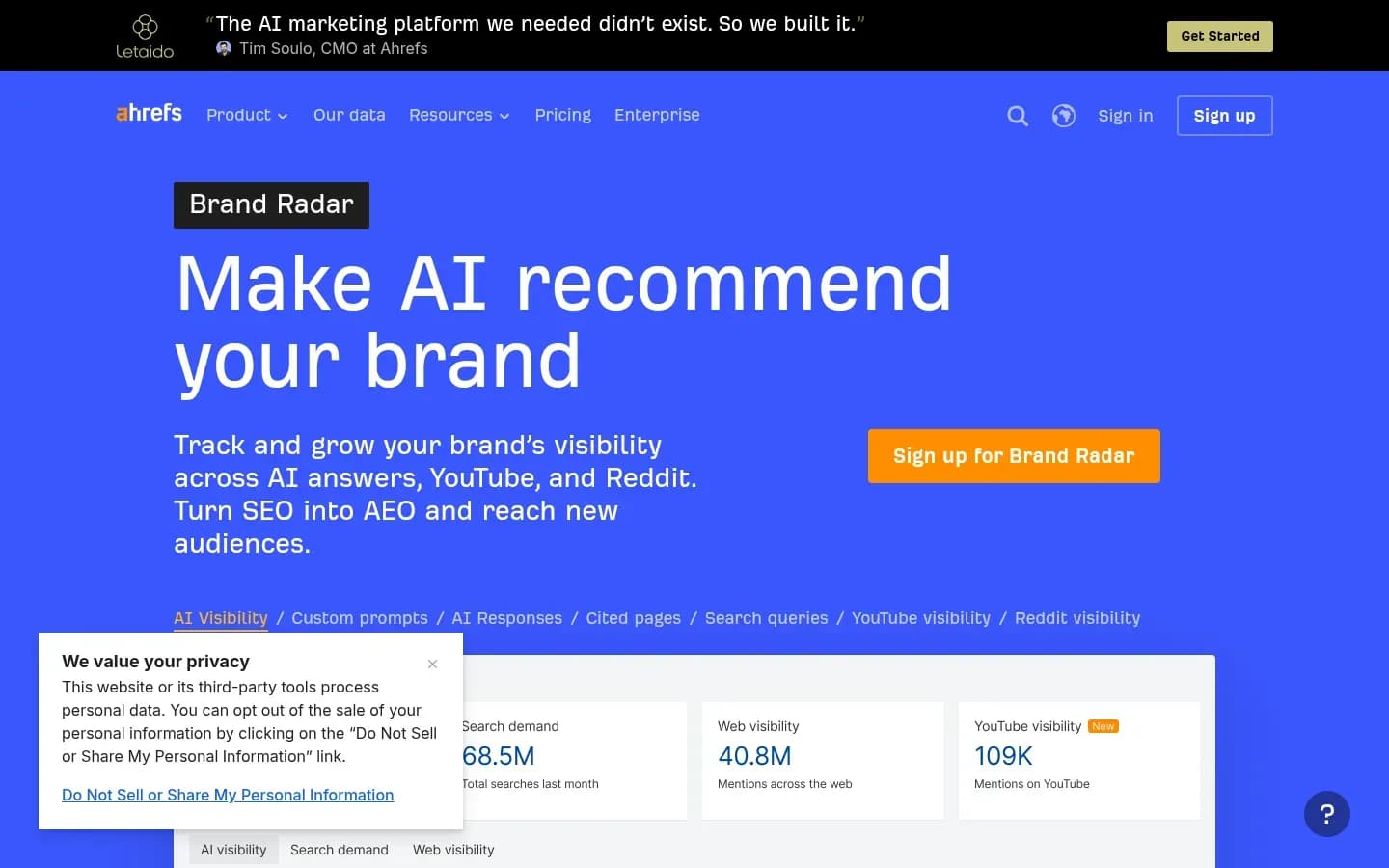
Ahrefs Brand Radar is the strongest choice for citation research because, as TechRadar's review describes, it separates pages an AI engine retrieved while building an answer from pages it actually linked, which shows where content is read but not credited.
Ahrefs Brand Radar
Ahrefs add-on that tracks a brand's visibility in AI answers (AI Overviews, ChatGPT, Perplexity, Gemini, Copilot), YouTube and Reddit, for marketers and SEO teams.
Ahrefs Brand Radar is an Ahrefs add-on that tracks how a brand appears in AI answers. It pairs a ready-made AI Visibility Index with Custom Prompts you write yourself. It suits SEO and content teams that want citation data next to the rest of their Ahrefs research.
- Free plan
- No
- Public API
- Yes
Citation depth: TechRadar's review describes individual URLs showing "Found in" separately from "Cited in", and a Cited pages report that groups sources by page type. Ahrefs defines a citation as how often AI links to your pages or domains as a source, and reports both.
Engines: The AI Visibility Index covers Google AI Overviews, AI Mode, ChatGPT, Perplexity, Gemini and Copilot. Custom Prompts add Claude.
Where prompts come from: The index is built from search-informed prompts drawn from sources such as People Also Ask, not from private ChatGPT conversations. Treat it as a map of likely questions rather than measured user demand. Custom Prompts cover the questions you write yourself.
History and exports: The index already holds historical data and re-tests its question sets monthly on a 90-day reporting window. Custom Prompts history begins on the day you set them up. Ahrefs' API covers brand mentions, citations, impressions and AI share of voice.
Real cost to run: Checks are the meter. Each custom prompt uses one check per platform, location and update, and Claude uses eight checks per update. Paid Ahrefs plans include a Custom Prompts allowance, from 5 prompts and 150 checks a month on Lite to 20 prompts and 600 checks on Advanced. Add-on tiers named Basic, Growth and Scale add 2,500, 7,000 or 25,000 checks a month, and extra checks bill as overage at $0.020 per check.
Best fit: Teams researching several competitors across many questions, as TechRadar's review puts it. A team watching a small set of recurring questions is better served by a smaller Custom Prompts allowance.
Limitation: TechRadar's review reports some answers displaying raw markup, domain categories that need manual checks, and Grok collection paused.
Pricing: The AI Visibility Index and Custom Prompts are priced separately, as the table shows.
Ahrefs Brand Radar Custom prompts pricing
| Plan | Price | Billing | Notes |
|---|---|---|---|
| Custom prompt package Basic | $50 | per month | |
| Custom prompts (starts at) | $50 | per month | |
| Custom prompt package Growth | $100 | per month | |
| Custom prompt package Scale | $250 | per month | |
| Custom prompts, all models | $699 | per month |
Ahrefs Brand Radar AI Visibility Index pricing
| Plan | Price | Billing | Notes |
|---|---|---|---|
| AI Visibility Index | $199 | per month |
Profound
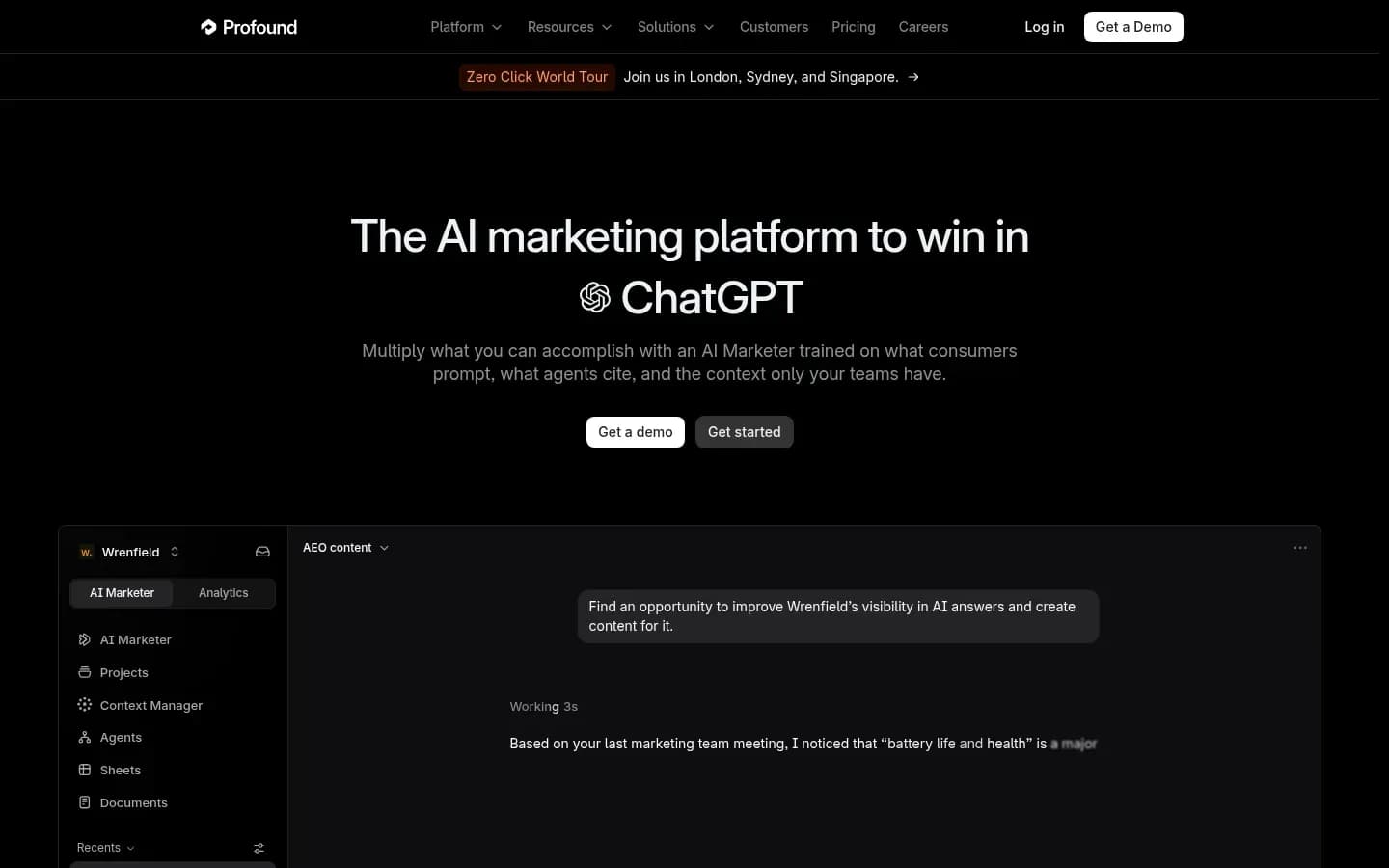
Profound reports citations at the page level, returning each watched URL with its citation count or citation share by day, week, month or year, and keeps all-time history, CSV and JSON exports and API access on its Enterprise plan. That makes it the enterprise pick for URL-level citation reporting.
Profound
AI marketing platform that shows marketing and AEO teams what customers ask AI tools and how their brand appears in the answers.
Profound is an AI marketing platform that shows marketing and AEO teams what customers ask AI tools and how their brand appears in the answers. Its citation features sit inside a wider suite that includes Agent Analytics, which shows how bots view, cite and refer to pages.
- Free plan
- No
- Compliance
- SOC 2
- Ratings
- G2 4.5/5 (1,133 reviews)
Citation depth: Citation Analytics shows the sources cited across answers. The Citation Watched Pages node returns your priority URLs with Citation Share or Citation Count for a chosen date range, grouped by day, week, month or year. It filters by platform, hostname, citation category, prompt, region and topic, and outputs JSON, a Markdown table or a URL list.
Engines: The Trial tier covers ChatGPT, Gemini and Google AI Overviews. Enterprise tracks up to nine answer engines, adding Perplexity, Copilot, DeepSeek, Claude and Exa Search.
Where prompts come from: You track your own prompt list. Profound also offers Prompt Volumes, which it describes as analysis of billions of real user conversations. That figure is Profound's own claim, not independent demand data.
History and exports: All-time history, CSV and JSON exports, API access and SSO/SAML are on Enterprise. The Trial tier runs in one language and one region.
Real cost to run: Prompts tracked, engines, regions and AI Marketer agent credits drive the bill, since the agents consume credits on every run. Seats are unlimited on both tiers, so headcount adds nothing. The Agency Growth plan gives 400 credits a month per client workspace.
Best fit: Larger teams that report citations by page and feed them into BI dashboards or a data warehouse.
Limitation: The Trial tier has no history, exports or API, so a trial cannot show how your citations move over time. Judging Profound on trends needs the Enterprise plan.
Pricing: Profound's plans are quoted, as the table shows.
Profound pricing
| Plan | Price | Billing | Notes |
|---|---|---|---|
| Agency Enterprise (agency tab) | Custom pricing | ||
| Agency Growth (agency tab) | Custom pricing | ||
| Enterprise | Custom pricing | ||
| Trial | Custom pricing |
OtterlyAI
OtterlyAI lists every unique URL that appears in tracked AI answers and exports both its cited-URL and cited-domain lists as CSV files, with ChatGPT, Google AI Overviews, Perplexity and Microsoft Copilot included and Google AI Mode, Gemini and Claude sold as add-ons. It is the practical starting point for teams that want cited URLs without an enterprise contract.
OtterlyAI
AI search monitoring platform that tracks brand mentions and website citations across ChatGPT, Perplexity, Google AI Overviews and other AI engines, for marketing teams and agencies.
OtterlyAI is an AI search monitoring platform that tracks brand mentions and website citations across AI engines. It is built for marketing teams and agencies, with daily tracking and unlimited team members on every plan.
- Free trial
- Yes
- Platforms
- Web
- Public API
- Yes
- Compliance
- GDPR, ISO 27001, SOC 2
- Ratings
- G2 4.7/5 (54 reviews)
Citation depth: Citation Source Tracking, Link Citations Analysis and Domain Ranking are in every plan, including the entry plan. A Show Links option lists every unique cited URL. The Domain Sources report sorts cited domains by coverage, filters to you and the competitors you list, and groups domains into categories such as News/Media, Community/Forum and Video.
Engines: ChatGPT, Google AI Overviews, Perplexity and Microsoft Copilot are on all plans. Google AI Mode, Gemini and Claude are paid add-ons priced by plan tier.
Where prompts come from: You write your own prompt list, and OtterlyAI checks it daily.
History and exports: Both the cited-domain and cited-URL lists export as CSV. API, MCP access, Agent Analytics and a Data Studio connector start on Standard.
Real cost to run: The prompt allowance is the main meter, at 15 search prompts on Lite, 100 on Standard and 400 on Premium, with Enterprise from 1,000. Standard and Premium add prompts in packs of 100, and Standard can add up to 300 before you need Premium. Each engine add-on is priced by tier, so the cost of adding AI Mode, Gemini and Claude grows with the plan you are on.
Best fit: Lean in-house teams and small agencies starting citation tracking on the core engines.
Limitation: Lite's 15 prompts and lack of API make it a starting point rather than a dataset. A sample large enough to read trends needs Standard or above.
Pricing: OtterlyAI's monthly and annual plans are in the table.
OtterlyAI pricing
| Plan | Price | Billing | Notes |
|---|---|---|---|
| Lite |
|
| |
| Standard |
|
| |
| Premium |
|
| |
| Enterprise | Custom pricing |
LLMrefs
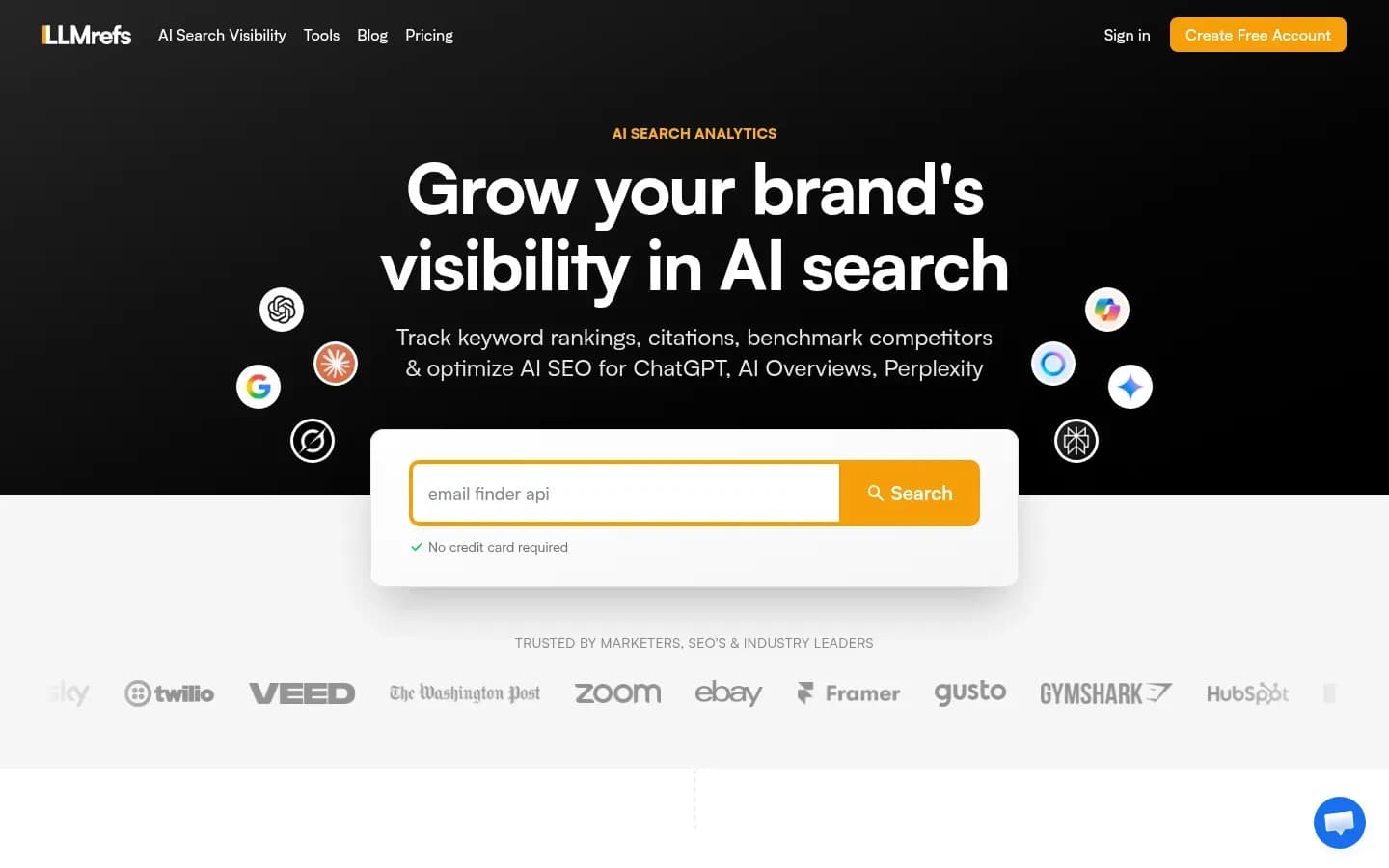
LLMrefs tracks keywords instead of hand-written prompts, generates the prompts itself and lets teams filter the full set of source URLs that ChatGPT, Perplexity, Gemini, Google's AI features and five other engines cite, with no extra charge per engine. It is the keyword-led option for SEO teams who think in keywords, not prompts.
LLMrefs
AI search analytics platform that tracks how brands appear in ChatGPT, Google AI Overviews, Perplexity and Gemini, for brands, agencies and SEO teams.
LLMrefs is an AI search analytics platform that tracks how brands appear in ChatGPT, Google AI Overviews, Perplexity, Gemini and other engines. It is aimed at brands, agencies and SEO teams that already plan their work around keyword lists.
- Free plan
- Yes
- Free trial
- 7 days
- Public API
- Yes
Citation depth: Users can view and filter the full set of source URLs generative engines cite, alongside a list of top cited domains. LLMrefs also reports share of voice, weighted position and competitor gaps.
Engines: ChatGPT, Google AI Overviews and AI Mode, Gemini, Perplexity, Claude, Grok, Microsoft Copilot, Meta AI and DeepSeek, all with no additional fee per engine.
Where prompts come from: You enter keywords and LLMrefs writes the prompts. Each keyword refreshes in the dashboard at least once a week.
History and exports: CSV export and API access, with geo and language targeting for teams that track several markets.
Real cost to run: The keyword allowance is the meter. Engines carry no extra fee, and seats and projects are unlimited, so the bill tracks how many keywords you watch, not how many people or engines.
Best fit: SEO teams that want broad engine coverage on an existing keyword list, without add-on maths.
Limitation: A weekly refresh is coarser than daily trackers, which matters on engines whose cited sources churn every week. Rankability's review, written by a competing vendor, relays community feedback that the step up to the paid plan feels steep for smaller businesses, that reports are sometimes slow to generate, and that users want more prescriptive guidance beyond monitoring.
Pricing: LLMrefs' plan is in the table.
LLMrefs pricing
| Plan | Price | Billing | Notes |
|---|---|---|---|
| All in One | $79 | per month |
Promptwatch
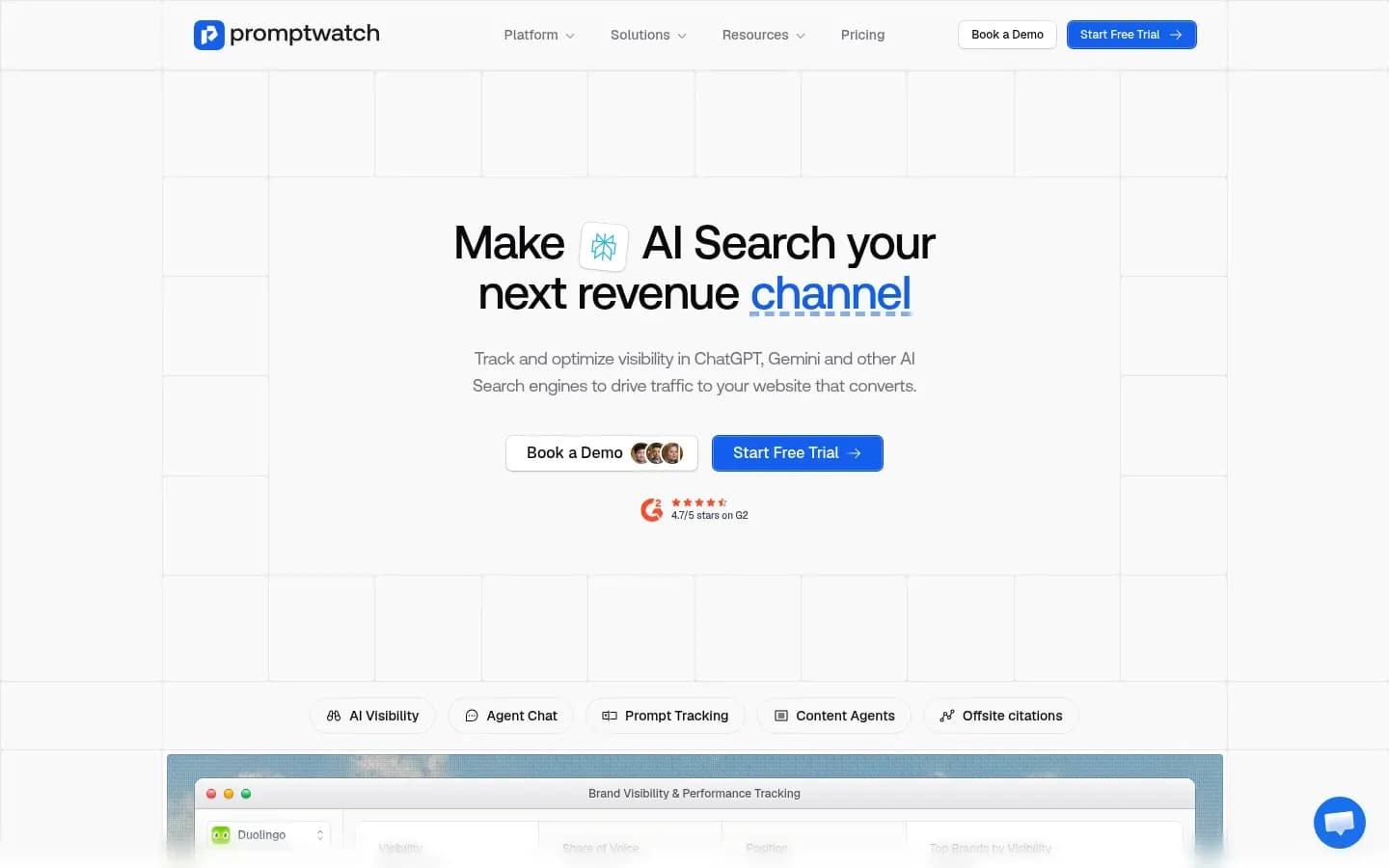
Promptwatch goes beyond reporting citations by finding the pages AI engines cite for your prompts that do not mention your brand, including Reddit threads and YouTube videos, and turning them into outreach targets and content drafts. It is the pick when the goal is acting on citations, not only reporting them.
Promptwatch
AI search visibility platform that tracks how brands appear in AI answers and helps create content designed to be cited, for marketers, SEO teams and agencies.
Promptwatch is an AI search visibility platform that tracks how brands appear in AI answers and helps create content designed to be cited. It serves marketers, SEO teams and agencies, and also monitors AI crawlers.
- Free trial
- 7 days
- Platforms
- Chrome extension
- Public API
- Yes
- Compliance
- GDPR, ISO 27001
- Ratings
- G2 4.6/5 (22 reviews)
Citation depth: Promptwatch tracks which pages AI models read, cite and recommend, and which Reddit threads and YouTube videos get cited in your category. SE Visible's review, written by a competing vendor, describes cited pages broken down by source type.
Engines: GEO Compass's profile lists nine engines. SE Visible's review reports that brand plans track ChatGPT, Perplexity, Gemini and Claude, while agency plans add Google AI Overviews and AI Mode, so Google coverage depends on the plan you buy.
Where prompts come from: You track your own prompts, metered with projects per plan. Promptwatch does not publish how it collects AI answers, and GEO Compass rates its methodology transparency low.
Real cost to run: SE Visible reports that brand plans meter projects, prompts and AEO articles, from 1 project and 50 prompts on Essential to 2 projects and 150 prompts on Professional and 5 projects and 350 prompts on Business. Agency plans share a monthly response pool across clients. Agent credits pay for drafting, and AI crawler logs need a CDN or log integration from Professional upward.
Best fit: Teams that want citation gaps turned into outreach targets and article drafts in one place.
Limitation: Reviewers report that agent credits run down quickly, so heavy users of the drafting and outreach agents should budget for more credits than the plan suggests.
Pricing: Promptwatch's plans are in the table.
Promptwatch pricing
| Plan | Price | Billing | Notes |
|---|---|---|---|
| Essential | $95 | per month | |
| Professional | $245 | per month | |
| Business | $579 | per month |
What To Look For In An AI Citation Tracking Tool
Choose a citation tracker that samples answers repeatedly and keeps history, because SISTRIX's 17-week study of 82,619 prompts found ChatGPT replaces 74% of its cited sources every week and Google AI Mode 56%, so one snapshot says little about where you stand.
Google AI Overviews behaved differently in the same study, staying completely stable for just over half of queries, with about 5% weekly drift. The engines you care about change how often you need fresh data.
Use this checklist when you shortlist tools:
- Citation data goes to URL level, not just domains
- Retrieved-but-not-cited pages are reported separately
- Answers are sampled repeatedly and history is kept
- You know where the prompts come from
- The engines you need are in your plan
- Citations export as CSV or through an API
- Competitor citations can be filtered
URL depth: A domain count tells you that a site earned credit, not which page did. OtterlyAI's Show Links view and LLMrefs' source URL filter both work at URL level, and Ahrefs Brand Radar adds the found-versus-cited split for individual URLs.
History: Weekly churn means a trend needs several weeks of data. Check whether history starts on setup day, as it does for Ahrefs Custom Prompts, or arrives with a ready-made index.
Prompt source: Your own list measures what you chose to ask. LLMrefs generates prompts from keywords. Ahrefs' index is search-informed, built from sources such as People Also Ask, which helps coverage but is not a record of real user conversations.
Engines in your plan: Read the plan, not the homepage. OtterlyAI sells Google AI Mode, Gemini and Claude as add-ons. Profound's Trial tier covers three engines against up to nine on Enterprise. SE Visible reports that Promptwatch's brand plans leave out Google's AI features.
Exports: Citation data earns its keep once it is joined to page data in a spreadsheet or BI tool. OtterlyAI and LLMrefs export CSV, Profound puts exports and API access on Enterprise, and Ahrefs' API covers citations.
Competitor views: OtterlyAI's "Me + all competitors" view, limited to the competitors you list, shows who earns the citations you miss.
Two checks settle most shortlists before you commit. First, export the citation list and see whether it returns URLs or only domains. Second, filter the citation view by a named competitor and see whether the tool shows which of their pages are cited.
How Many Prompts Do You Need To Track AI Citations?
Track enough prompts that no single answer decides the result, because SparkToro found less than a 1 in 100 chance that ChatGPT or Google's AI returns the same brand list in any two responses, across 2,961 responses to 12 prompts. Group prompts by intent and read results as weekly trends.
The right number depends on how many intent clusters you need to cover, not on a fixed target. A cluster is a group of prompts that share one buyer need, such as category questions, comparison questions or problem questions. Tracking by cluster stops a swing in one group from hiding inside an average.
The SparkToro research ran each prompt roughly 60 to 100 times with about 600 volunteers, and brand lists still rarely repeated. Citation churn adds to that, since SISTRIX measured ChatGPT replacing most of its cited sources every week. Both findings point the same way. Many prompts, run repeatedly and read over several weeks, beat a large list run once.
A workable setup follows four steps:
- Group prompts into intent clusters that match your buying journey.
- Track each cluster on the engines your buyers use, not every engine on offer.
- Re-run ChatGPT and AI Mode prompts at least weekly, and AI Overviews less often.
- Judge movement across several weeks before acting on it.
Then budget the checks. In Ahrefs Brand Radar, every prompt uses one check per platform, location and update, so doubling the engines doubles the checks. OtterlyAI's allowances step from 15 prompts on Lite to 100 on Standard and 400 on Premium, which sets how many clusters you can cover before upgrading.
The workflow to build an AI search prompt tracking list covers prompt research, intent segmentation, list size and refresh cadence step by step.
How Much Does AI Citation Tracking Cost To Run?
The bill for AI citation tracking is driven less by the entry price than by its meter, which is checks per prompt, engine and update in Ahrefs Brand Radar, prompts plus paid engine add-ons in OtterlyAI, keywords in LLMrefs, and prompts plus agent credits in Profound and Promptwatch.
Entry prices hide the real number because each tool meters something different. Price the setup you need, which is prompts multiplied by engines multiplied by how often you re-run them, then check which plan or add-on covers it. Each tool's pricing table above shows its plans.
What drives the bill for each tool
| Tool | What you pay for | What adds cost |
|---|---|---|
| Ahrefs Brand Radar | Checks per prompt, engine, update | Claude checks, overage |
| Profound | Prompts, engines, regions | Agent credits, Enterprise-only exports |
| OtterlyAI | Prompt allowance per plan | Prompt packs, engine add-ons |
| LLMrefs | Keyword allowance | Engines and seats included |
| Promptwatch | Projects, prompts, articles | Agent credits, agency plans |
Ahrefs Brand Radar: Custom Prompts allowances come with paid Ahrefs plans, add-on tiers add 2,500 to 25,000 checks a month, and extra checks bill at $0.020 each. Claude's eight checks per update make it the most check-hungry engine to add.
Profound: Prompts, engines, regions and agent credits set the price. Seats are unlimited, and history and exports sit on Enterprise.
OtterlyAI: The prompt allowance sets the plan, packs of 100 extend it, and Google AI Mode, Gemini and Claude are each a separate add-on priced by tier.
LLMrefs: Keywords are the meter. Every engine, seat and project is included.
Promptwatch: Projects, prompts and article allowances set the plan, and agent credits run down with use. SE Visible's review places Google's AI features on the agency plans.
A worked example shows how fast the meter moves. Tracking 50 custom prompts weekly across four engines in Ahrefs Brand Radar uses about 800 checks a month. Adding Claude to the same schedule needs about 1,600 more checks a month, because each Claude update costs eight checks per prompt.
The same logic applies elsewhere. In OtterlyAI, adding three engines means three add-ons at your plan's tier. In LLMrefs, it costs nothing extra, and only more keywords move the bill.
Teams working to a tight limit can compare entry plans in the guide to AI visibility tools for small budgets.
Which AI Citation Tracking Tool Should You Choose?
If you need to see which of your pages AI engines read but never credit, choose Ahrefs Brand Radar; if you need page-level citation history exported into BI, choose Profound; if you are starting with a small team, choose OtterlyAI.
Match the tool to the decision you need citation data to make.
Pages AI reads but never credits: Choose Ahrefs Brand Radar. Its "Found in" and "Cited in" split shows where content is retrieved and passed over, and it suits research across several competitors and many questions.
Page-level reporting into BI: Choose Profound. Watched pages return citation counts or share by period, and Enterprise adds all-time history, CSV and JSON exports and API access.
A lean team starting out: Choose OtterlyAI. It lists cited URLs and exports CSV on the four core engines, and AI Mode, Gemini and Claude can be added later.
Keyword-led SEO work across many engines: Choose LLMrefs. You track keywords, it writes the prompts, and no engine costs extra.
Turning citations into outreach and content: Choose Promptwatch. It finds cited pages that do not mention you, then drafts outreach and articles.
Each pick has a group it does not suit. Ahrefs Brand Radar is built for research across many questions, and a team watching a small set of recurring questions is better served by a smaller Custom Prompts allowance. Profound's trial cannot show trends. OtterlyAI's entry plan is too small for a real sample. LLMrefs commits to updating each keyword at least once a week, while OtterlyAI tracks daily. GEO Compass found no page documenting how Promptwatch collects answers.
Agencies: Client separation, reporting and seats matter more than citation depth, and the comparison of AI visibility tools for agencies covers those.
How To Use AI Citation Data
Ranking well in Google no longer predicts an AI Overview citation, since Ahrefs' analysis of 863,000 search results found only 37.9% of URLs cited in AI Overviews also appear in the top 10, so citation data has to be read page by page.
Ahrefs, which sells Brand Radar, ran that study. It also found the share of cited pages drawn from the results page had fallen from about 76% in July 2025.
Five steps turn citation data into work:
- Separate owned pages from third-party sources
- Fix pages that are retrieved but not cited
- Target cited pages that do not mention you
- Track citations apart from rankings
- Measure without double-counting
Separate owned from third-party sources: Split cited sources into your own pages and everyone else's. OtterlyAI's domain categories, such as Brand, News/Media, Community/Forum and Video, make the split quick and show which kinds of site the engines lean on in your category.
Fix pages that are found but not cited: A page that is retrieved but not credited is being read and passed over. Rewrite its key passage so it answers the question directly, then watch its found-versus-cited status in Ahrefs Brand Radar.
Target cited pages that do not mention you: Third-party pages that AI cites for your prompts, and that leave you out, are outreach targets. Promptwatch finds these, including Reddit threads and YouTube videos, and drafts the outreach email.
Track citations apart from rankings: With most AI Overview citations coming from outside the top 10, a page can earn citations without ranking, and a top-ranked page can miss them. Report the two separately.
Measure without double-counting: Keep one row per answer and one denominator per metric, as set out in the guide to measure AI visibility without double-counting.
Frequently Asked Questions
Can Google Search Console show AI citations?
Google Search Console cannot isolate AI citations, because Google counts sites appearing in AI Overviews and AI Mode in the overall search traffic of the Performance report under the Web search type, with no separate AI breakdown. To see which pages AI features cite, you need a dedicated citation tracker.
How often should you check AI citation data?
Check ChatGPT and Google AI Mode citations at least weekly, because SISTRIX's 17-week study found ChatGPT replaces 74% of its cited sources each week and AI Mode 56%. Google AI Overviews drift about 5% a week, so a slower cadence works there. Read results as trends over several weeks, never as a single snapshot.
Which AI engines cite the most sources per answer?
Google AI Mode cites far more sources per answer than GPT-5.4-mini. In BuzzStream's study of 12,000 AI responses, Google AI Mode averaged 33.1 citations per response against 3.8 for GPT-5.4-mini. More citations per answer give more pages a chance to be credited, so AI Mode citation counts run higher by design.
Does ranking in Google's top 10 get you cited in AI Overviews?
Ranking in the top 10 does not guarantee an AI Overview citation. Ahrefs' study of 863,000 search results found 37.9% of cited URLs appear in the top 10, 31.2% in positions 11 to 100 and 31.0% beyond the top 100. Ahrefs sells Brand Radar, the tool behind that data.
Sources
Sources
- How AI Mentions and Cites Your Brand (New Study) · buzzstream.com
- AI Citation drift: How stable are sources in AI search results? · sistrix.com
- otterly.ai
- llmrefs.com
- NEW Research: AIs are highly inconsistent when recommending brands or products; marketers should take care when tracking AI visibility · sparktoro.com
- AI Features and Your Website · developers.google.com
- Update: 38% of AI Overview Citations Pull From The Top 10 · ahrefs.com