Account-based marketing lives or dies on knowing which target accounts are already on your site. A visitor identification tool turns those anonymous visits into named accounts, and sometimes named people, that sales and paid media can act on. The tools below differ most on what they identify, where they push it and what sets the bill.
These picks apply to B2B teams with a defined target account list, and the full platforms pay off when you also run paid ABM programmes. Match rates depend on your traffic mix. Contact-level identification is US-only for Vector, and it needs a lawful basis for UK and EU visitors.
How We Chose These ABM Visitor Identification Tools
This shortlist ranks five visitor identification tools by how well each turns an anonymous visit into ABM action, which means matching the visit to a target account, adding signals beyond the page view, and pushing that account into ads, alerts or the CRM.
Inclusion bar: A tool had to identify website visitors and act on a target account list. That means matching visits to named accounts, scoring or tiering them, and pushing them into ads, alerts or the CRM.
Every tool was then judged on the same five criteria:
- Identification level: Account, buying group or named person.
- ABM signals: What the tool adds beyond the visit, such as intent, scoring or stages.
- Activation: Where identified accounts go, from ad audiences to sales alerts and CRM records.
- Cost meter: What drives the bill, such as accounts monitored, traffic, credits or seats.
- Team fit: Which size and kind of ABM team the tool suits.
Two limits apply. Match rates depend on your traffic mix, and any accuracy figure quoted here is the vendor's own. If your priority is governance, single sign-on and account hierarchies, our guide to enterprise visitor identification tools covers that angle instead.
Tools Considered But Not Included
ZoomInfo, RB2B, Factors.ai and Breeze Intelligence (formerly Clearbit) appear on many visitor identification lists but miss this list's ABM bar, because each is built around a different core job.
Tools considered for ABM but not included
| Tool | Why it is not on this list |
|---|---|
| ZoomInfo | Sold as a sales data and intent platform first, with visitor identification inside a wider data contract |
| RB2B | Person-level Slack alerts for US visitors, with no target-account scoring or ad activation of its own |
| Factors.ai | Built around account analytics and LinkedIn ad attribution rather than identification as the core job |
| Breeze Intelligence (formerly Clearbit) | Bundled into HubSpot rather than sold as a standalone ABM tool |
Each of these can still sit in an ABM stack. None of them leads with matching visits to a target account list and activating those accounts.
Best Visitor Identification Tools For ABM
For account-based marketing, Demandbase and 6sense are the full platforms, Vector and Warmly turn visits into named contacts for ads and outreach, and Leadfeeder is the lighter company-level option.
- DemandbaseBest for enterprise ABM teams that also buy media
- 6senseBest for aBM run on predicted buying stages
- VectorBest for uS programmes led by paid social and search
- WarmlyBest for hubSpot teams that want AI agents on target accounts
- LeadfeederBest for small and mid-market teams starting ABM on a target list
The order follows how much of the ABM workflow each tool covers in one place. Demandbase and 6sense identify accounts, score them and buy media against them. Vector and Warmly go further on named people and lighter on platform scope. Leadfeeder covers identification and engagement history and leaves heavy activation to your ad and CRM tools.
Visitor Identification Tools For ABM Comparison
The five tools split on three things that matter for ABM, namely what they identify, which signals they add and where they send the result. The pricing model and starting price columns come from each tool's record, and the cost section below explains what drives each bill.
| Tool | Pricing model | Starting price | Identifies | ABM Signals | Activation |
|---|---|---|---|---|---|
| Demandbase | Quote only | See pricing → | Accounts and buying groups | Intent plus predictive scoring | Own DSP, LinkedIn sync |
| 6sense | See pricing → | Accounts via Company Graph | Predictive buying stages | Own DSP, LinkedIn sync | |
| Vector | Paid | From $36,000 per year | US named contacts | 30+ signals, six stages | LinkedIn, Meta, Google |
| Warmly | Paid | From $10,000 per year | Named people and companies | Bombora intent, AI agents | LinkedIn and Meta |
| Leadfeeder | Freemium | From €79 per month, billed annually | Companies, enriched contacts | Account feeds, web scoring | LinkedIn CSV, Campaigns |
Read the table by the job your programme does. An account-led programme needs the Identifies and ABM Signals columns to be strong. An ad-led programme lives in the Activation column. The tool sections below explain each cell.
Demandbase
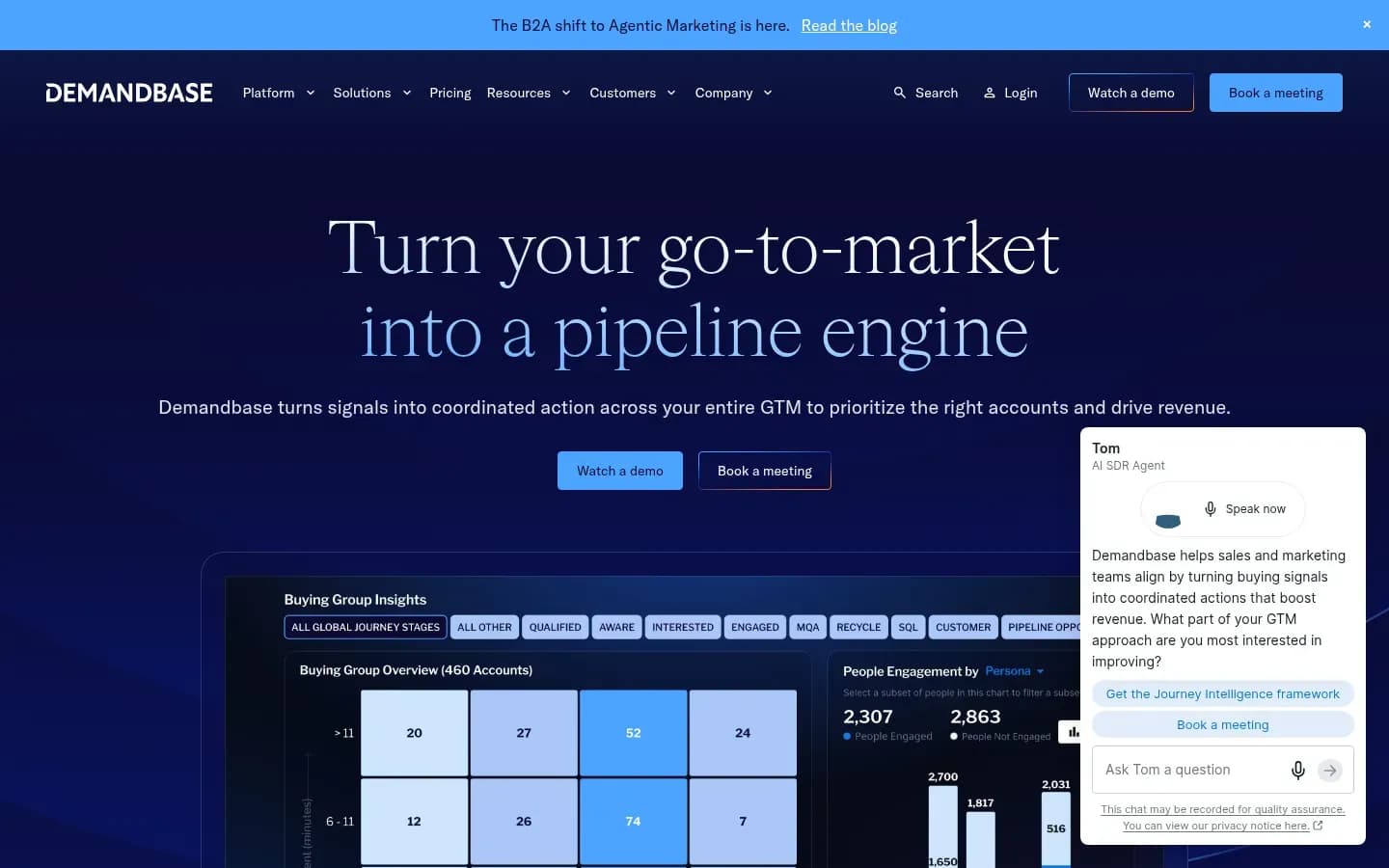
Demandbase identifies the companies behind anonymous visits, links visitors to buying committees and runs its own B2B ad platform, so an enterprise ABM team can identify, score and advertise to target accounts in one contract.
Demandbase
Account-based marketing and go-to-market platform for B2B marketing, sales and revenue teams.
Demandbase is an account-based marketing platform that combines account identification, buying-committee mapping, intent and its own B2B ad buying. It serves enterprise marketing, sales and revenue teams that run ABM across several channels.
- Compliance
- ISO 27001, SOC 2
- Ratings
- G2 4.4/5 (2,015 reviews)
Verdict: The most complete single platform for an enterprise ABM team that also buys media.
What it identifies: Demandbase resolves visits to accounts with IP-to-account matching and links people to those accounts to show buying committees. Its Account ID product appends company, industry, segment, company size, revenue range and HQ location to each visit inside Google Analytics.
ABM signals: Demandbase combines first- and third-party intent data with predictive scoring, so a target account can be ranked by both what it does on your site and what it researches elsewhere.
Activation: Demandbase runs a native B2B demand-side platform for display, video, CTV and social ads, and syncs audiences to LinkedIn Campaign Manager daily.
Real cost: Demandbase's pricing page describes a platform fee covering the software and services plus a flat fee per user, and says the platform is not split into separate solutions. Vendr names the cost drivers as product bundles (Demandbase One, ABM and Advertising, Sales Intelligence, Data), per-seat pricing on some modules, account volume, advertising spend, data enrichment and intent, and contract term. Ad media budgets sit on top of the platform fee.
Best fit: Teams with a defined target account list that will run paid ABM programmes and want identification and ad buying under one roof.
Limitation: Demandbase is complex for small teams, and programmatic advertising adds media and operations overhead. TrustRadius reviewers call the Demandbase One interface user-friendly but say it requires more effort to get started, and some find its engagement scoring confusing.
Why it ranks first: Demandbase pairs account identification, buying-committee mapping, intent and its own ad buying in one platform. TrustRadius reviewers call its interface user-friendly, while 6sense reviewers are mixed on the learning curve.
Pricing: Demandbase's plans are shown below.
6sense
6sense matches anonymous traffic to accounts with its Company Graph and predicts each account's buying stage, and Vendr names the number of accounts 6sense monitors as the primary cost driver.
6sense
Account-based marketing and revenue intelligence platform for B2B revenue, marketing and sales teams.
6sense is an account-based marketing and revenue intelligence platform that identifies accounts, scores their intent and predicts where each one sits in its buying journey. It serves B2B revenue, marketing and sales teams that plan ABM around buying stages.
- Public API
- Yes
- Compliance
- GDPR, ISO 27001, SOC 2
- Ratings
- G2 4.2/5 (1,570 reviews)
Verdict: The pick for teams that run ABM on predicted buying stages.
What it identifies: 6sense matches anonymous visitors to companies with its Company Graph, which combines cookies, IP addresses and mobile advertising IDs.
ABM signals: 6sense combines first-party intent, second-party intent from G2 and TrustRadius, and third-party intent. It predicts each account's buying stage and gives every account an Intent score and an Engagement score from 0 to 100.
Activation: 6sense builds dynamic segments from those scores, runs its own B2B demand-side platform and syncs audiences natively to LinkedIn.
Real cost: Vendr's data from 387 purchases puts the median 6sense contract at $62,000 a year, with a range from $11,183 to $176,213. After accounts monitored and scored, the next drivers are modules (Sales Intelligence, Advertising, Conversational Email), premium intent, technographic and contact data, contract term, professional services and integrations. On the Sales Intelligence side, data credits unlock and export emails and phone numbers.
Best fit: Mid-to-large B2B teams with enough historic conversions for predictive models to learn from.
Limitation: The scoring model is pre-defined and cannot be customised, so a team with its own view of fit and intent has to work around it. Review-site users also cite a steep learning curve, performance lag and high cost, although TrustRadius reviewers rate its data capabilities as stronger.
Why it is on the list: 6sense gives an ABM team account identification, three layers of intent and predicted buying stages, then activates segments in its own ad platform and LinkedIn.
Pricing: 6sense's plans are shown below.
Vector
Vector turns US website visitors into named contacts and pushes them into LinkedIn, Meta and Google Ads audiences, and its own help centre sets expectations at about a 10% contact match rate plus roughly 30% more at company level.
Vector
Account-based marketing platform that turns buyer signals and account scoring into contact-level ad audiences for B2B marketing teams.
Vector is an account-based marketing platform that turns buyer signals and account scores into contact-level ad audiences. It serves B2B marketing teams whose ABM programmes run mainly through paid social and search.
- Public API
- Yes
- Compliance
- GDPR
Verdict: The pick for ABM teams whose activation channel is paid social and search.
What it identifies: Vector identifies US visitors at contact level by matching device fingerprints against its identity graph, and falls back to IP-to-company matching when no contact matches. Across a target list, it de-anonymises both contacts and accounts. For a wider view of contact-level matching, see our comparison of person-level visitor identification tools.
ABM signals: Vector tracks 30+ native signals, including ad clicks and impressions, job changes, funding, hiring, CRM deal stage changes and webinar attendance, plus custom agentic signals. Account scores move through six stages, from Identified, Aware and Interested to Considering, Selecting and Customer.
Activation: Vector pushes contact-level audiences to LinkedIn, Meta and Google Ads, sends Slack sales alerts and integrates with Salesforce, HubSpot and Pardot. On October 29, 2025, Vector repositioned around building contact-level ad audiences and moved away from sales and outbound use cases, with two packages called Reveal and Target.
Real cost: Vector sets the plan tier by the larger of unique monthly site visitors or total monthly ad spend. Seats are unlimited on every plan, and every plan includes the same features. Credits pay for visitor identification and custom AI research, while intent and scoring use no credits. SAML and SCIM single sign-on and a data processing agreement are not on the entry plan.
Best fit: US-focused ABM programmes that want named-contact audiences for paid media.
Limitation: Vector's own help centre expects about a 10% contact match rate, plus roughly 30% more from IP-to-company fallback, and reports 60 to 75% accuracy against cookied HubSpot contacts in Vector's own checks. These are Vector's figures, not independent ones. Vector is geofenced to the US, so EU visitors may get company-level information only, and monthly caps apply to visitors identified and ad audiences.
Why it is on the list: Vector builds named-contact audiences from target account visits and pushes them into the three ad platforms most ABM programmes buy.
Pricing: Vector's plans are shown below.
Vector pricing
| Plan | Price | Billing | Notes |
|---|---|---|---|
| Starter | $36,000 | per year |
Warmly
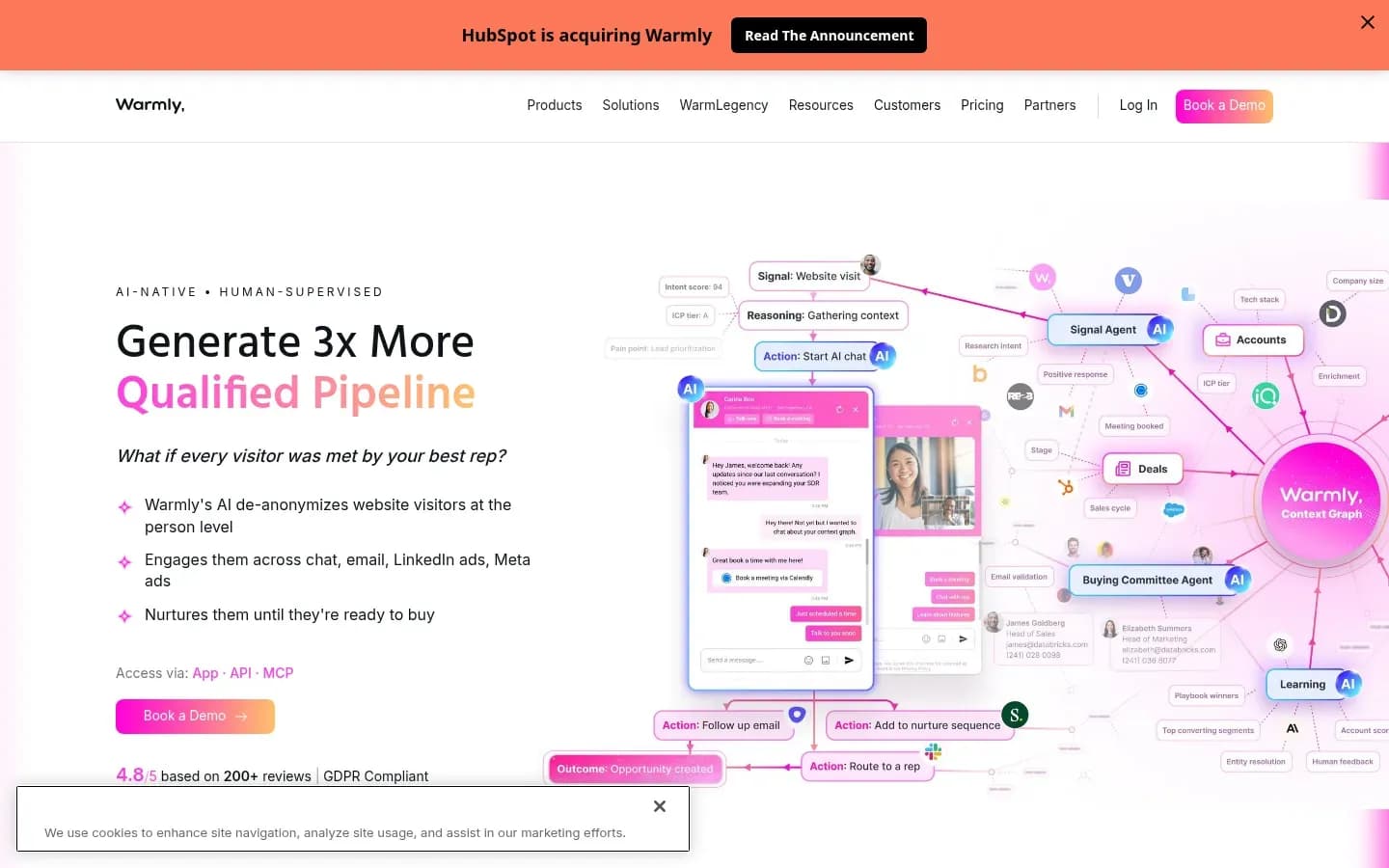
Warmly names the people behind visits, scores target accounts daily with first-, second- and third-party signals, and HubSpot agreed to acquire Warmly in June 2026, which matters for teams whose CRM is not HubSpot.
Warmly
B2B go-to-market platform with AI agents that identify website visitors and engage them through chat, email and retargeting, for sales and marketing teams.
Warmly is a B2B go-to-market platform with AI agents that identify website visitors and engage them through chat, email and retargeting. It serves sales and marketing teams that want identified target accounts worked automatically.
- Platforms
- API
- Compliance
- GDPR, SOC 2
- Ratings
- G2 4.5/5 (250 reviews)
Verdict: The pick for teams that want identification and AI agents to act on target accounts.
What it identifies: Warmly identifies the individual behind a visit, with role and email, as well as the company.
ABM signals: Warmly scores target lists with AI, refreshes them daily and tiers them by ICP. It draws on first-party signals (pages, return visits, chat), second-party signals (LinkedIn engagement, ad interactions) and third-party signals (Bombora research topics, job postings, funding, technographics). Extra intent, hiring, funding and competitive signals sit in the paid GTM Signals Package add-on.
Activation: Warmly retargets buying-committee contacts on LinkedIn and Meta automatically, runs AI chat, call and inbound agents, and syncs natively with HubSpot and Salesforce. Outreach guardrails allow one direct touch per account per day and a 72-hour email cooldown. Our RB2B vs Warmly comparison shows how those agents differ from person-level Slack alerts.
Real cost: Warmly meters its plans on a monthly credit allotment, billed quarterly or annually. Paid add-ons are the GTM Signals Package, Warm Experiences for personalised website experiences and an AI video chat agent that runs around the clock.
Best fit: HubSpot-centred teams that want automated follow-up on target accounts.
Limitation: Warmly announced its agreement to be acquired by HubSpot on June 30, 2026, and says existing contracts, pricing, product and integrations remain unchanged for now. Deeper HubSpot integration is planned, so Salesforce-first teams should ask about the roadmap before signing. On G2, data inaccuracy and bugs are the recurring cons, while reviewers most often praise ease of use and quick onboarding.
Why it is on the list: Warmly pairs person-level identification with AI agents that act on target accounts across chat, calls and ads.
Pricing: Warmly's plans are shown below.
Warmly AI Web-Deanonymization pricing
| Plan | Price | Billing | Notes |
|---|---|---|---|
| AI Web-Deanonymization |
|
|
Warmly Inbound Chat pricing
| Plan | Price | Billing | Notes |
|---|---|---|---|
| Inbound Chat |
|
|
Warmly AI Inbound Autopilot pricing
| Plan | Price | Billing | Notes |
|---|---|---|---|
| AI Inbound Autopilot |
|
|
Leadfeeder
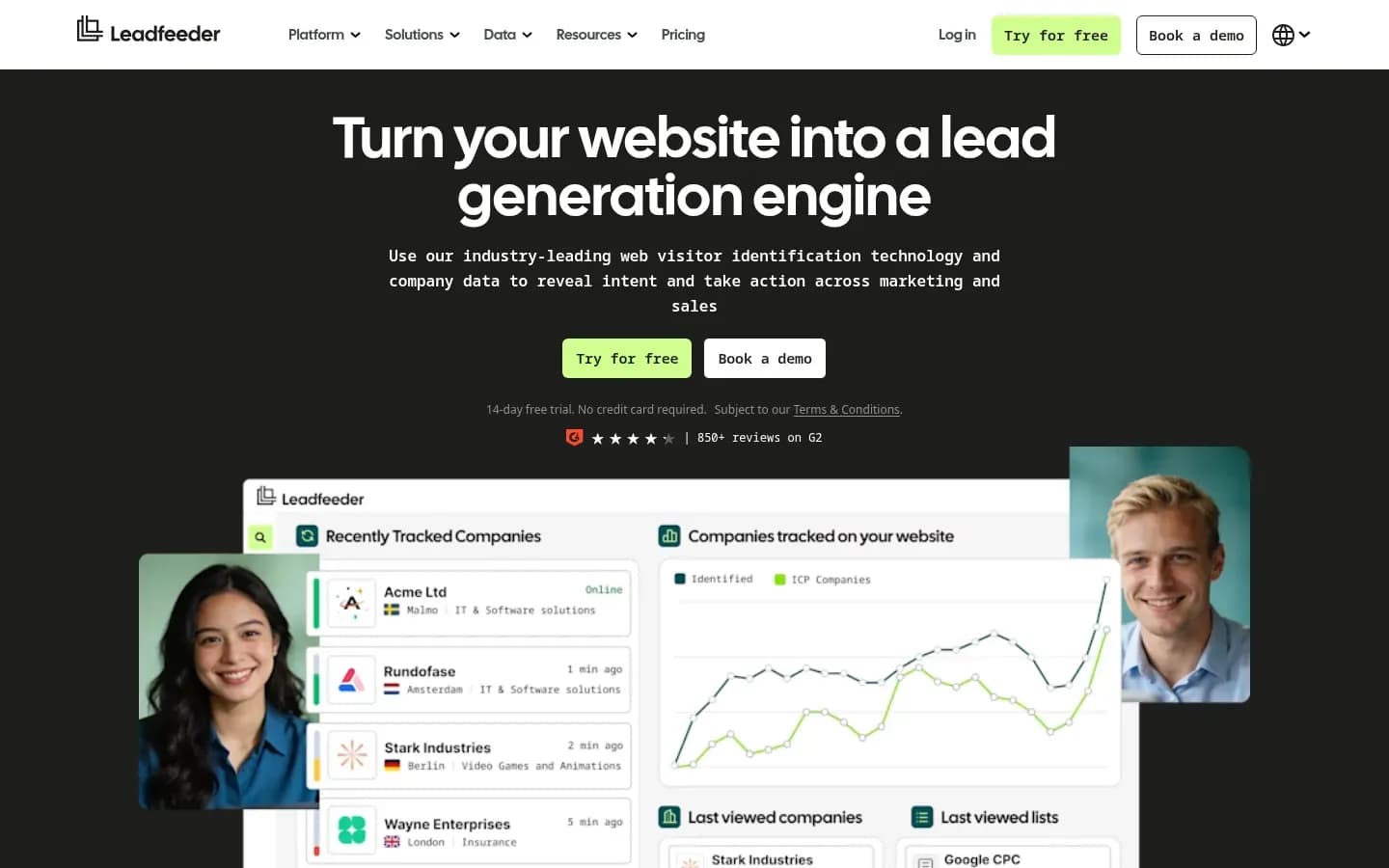
Leadfeeder (formerly Dealfront) shows which companies visit, what each account reads and how often it returns, and lets teams sync a target account list and export it to LinkedIn matched audiences.
Leadfeeder
Website visitor identification software that shows B2B marketing and sales teams which companies visit their site and syncs them to their CRM.
Leadfeeder is website visitor identification software that shows B2B marketing and sales teams which companies visit their site and syncs them to the CRM. It serves teams that want account engagement history on a target list without an ABM platform contract.
- Free plan
- Yes
- Free trial
- 14 days, no card needed
- Platforms
- API, Chrome extension, Web
- Public API
- Yes
- Compliance
- GDPR, ISO 27001
- Ratings
- G2 4.3/5 (869 reviews)
Verdict: The lighter company-level option for teams starting ABM on a synced target list.
What it identifies: Leadfeeder identifies the companies behind anonymous traffic. Contact enrichment, with verified emails, titles and direct dials, draws on credits. Dealfront rebranded as Leadfeeder on March 24, 2026, with the same company, team and platform, and the visitor product is now called Web Visitors.
ABM signals: Leadfeeder builds custom account feeds by industry, employee number, web activity and custom properties. It shows what each account browses page by page, scores leads by web activity and lets you follow companies for notifications.
Activation: Leadfeeder syncs account lists and assigns an SDR to each, exports target accounts as CSV for LinkedIn matched audiences and runs display ads on saved lists through Campaigns (formerly Promote). CRM and tool integrations include HubSpot, Pipedrive, Salesforce, SuperOffice, Zoho, Slack, GA4 and Google Ads.
Real cost: Leadfeeder tiers its plans by companies identified per month and by a shared monthly credit allowance for enrichment, exports and CRM syncs. Users are unlimited with no seat fees, and extra credits come in top-up blocks of 100 to 5,000.
Best fit: Small and mid-market teams that need engagement history on a target list without an ABM platform contract.
Limitation: Software Advice reviewers report IP matching that misidentifies companies and weaker results with remote workers. They also note that Leadfeeder shows the company but not who inside it is researching, and some smaller teams find the paid tiers pricey.
Why it is on the list: Leadfeeder gives a target account list its engagement history and a route into LinkedIn and display ads at a lighter weight than a full platform.
Pricing: Leadfeeder's plans are shown below.
Leadfeeder pricing
| Plan | Price | Billing | Notes |
|---|---|---|---|
| Lite | €0 | per month | |
| Discover | €79 | per month, billed annually | |
| Activate | €369 | per month, billed annually | |
| Scale | €599 | per month, billed annually | |
| Enterprise | Custom pricing |
How Does Visitor Identification Work For ABM?
Visitor identification for ABM matches an anonymous visit to a company on the target account list, and sometimes to a named person, and 6sense's 2025 survey of nearly 4,000 buyers found they first contact sellers about 61% of the way through the buying process. That is why website visitor identification matters for ABM.
There are two ways a tool makes the match, and they return different records.
- Account-level matching: The tool resolves the visitor's IP address, and in 6sense's case cookies and mobile advertising IDs as well, to a company. You get the account and its engagement history, not the person.
- Contact-level matching: The tool compares a device fingerprint against an identity graph to find a named person. You get a contact you can put into an ad audience, but far fewer visits match.
ABM teams care about the account first because the target account list is the unit of the programme. An account match tells you which target accounts are active and what they read. Our explainer on how company matching works goes deeper on the mechanics.
Accuracy is where vendor claims run ahead of evidence. Vector publishes its own expectations, about a 10% contact match rate plus roughly 30% more from IP-to-company fallback. Reviewers of company-level tools such as Leadfeeder report IP matches that misidentify companies and weaker results with remote workers, whose home IP addresses carry no company.
Timing is the reason to accept those limits. In the same 6sense study, buyers contacted their top-ranked vendor first about 80% of the time, and 6sense's own report says the winning vendor is on the Day One shortlist 95% of the time. Seeing a target account early is a chance to reach that shortlist.
Decision rule: If your programme is account-led, an account match plus engagement history is enough. If it is ad-led, you need contact-level audiences.
How To Choose Visitor Identification Software For ABM
Choosing visitor identification software for ABM starts with one question, which is whether your programme acts on accounts or on people, because Leadfeeder and Demandbase lead with accounts while Vector and Warmly lead with named contacts. Answer that first, then work through the eight checks below.
- Match the identification level to your programme. Account-led programmes need account matching, and ad-led programmes need buying groups or named people.
- Check the geography of your traffic. Vector's contact-level identification is US-only, so a team with heavy EU traffic gets company-level data there.
- Confirm target account list sync and tiering. Warmly scores and tiers target lists daily, and Leadfeeder syncs account lists and assigns an SDR to each.
- Ask which signals come beyond the visit. 6sense adds second-party intent from G2 and TrustRadius, and Warmly adds Bombora research topics.
- List your activation destinations. Demandbase buys its own media, Vector feeds LinkedIn, Meta and Google Ads, and Leadfeeder exports to LinkedIn and syncs to CRMs.
- Find the meter that sets the bill. Vector bills on traffic or ad spend, Warmly on monthly credits and Leadfeeder on companies identified plus credits.
- Weigh ownership risk and roadmap. HubSpot agreed to acquire Warmly, and Dealfront rebranded as Leadfeeder with no pricing changes.
- Read independent review patterns. Reviewers flag 6sense's learning curve, Warmly's data inaccuracy and Leadfeeder's IP misidentification.
Every vendor claims accuracy, and few publish figures. Ask each vendor on your shortlist for its match rate on your own traffic, split by company and contact level, before you sign.
Decision rule: If two tools pass the first two checks, let the cost meter decide. A meter that grows with something you control, such as ad spend or companies identified, is easier to budget than one tied to accounts monitored.
How Much Do Visitor Identification Tools For ABM Cost?
What an ABM visitor identification tool costs depends on its meter, and for the full platforms that meter is set contract by contract. Vendr's data from 187 purchases puts the median Demandbase contract at $68,591 a year, while Leadfeeder, Vector and Warmly bill on identified companies, traffic or ad spend, and credits.
The same Vendr data gives a Demandbase range from $24,000 to $164,037 a year. The 6sense median of $62,000 a year, cited in the 6sense section, comes from Vendr's 387 purchases and runs from $11,183 to $176,213.
What sets each ABM tool's bill
| Tool | What sets the bill | What adds to it |
|---|---|---|
| Demandbase | Platform fee plus per-user fee | Modules, account volume, ad spend |
| 6sense | Accounts monitored and scored | Modules, premium data, services, data credits |
| Vector | Larger of visitors or ad spend | Credits for identification and AI research |
| Warmly | Monthly credit allotment | Paid add-ons, quarterly or annual billing |
| Leadfeeder | Companies identified per month | Shared credits and top-ups, no seat fees |
For each tool's plans, the pricing widget in its own section shows the current plan structure.
Ad media is the cost that list prices hide. Demandbase and 6sense both run their own demand-side platforms, so a DSP-led programme pays the platform contract and the media budget on top. Programmatic advertising also adds operations overhead to run.
Seat pricing differs by tool. Vector and Leadfeeder offer unlimited users, while Demandbase charges a flat fee per user, with per-seat pricing on some modules.
Decision rule: Budget the platform, the media and the people to run both. If your own media budget will not fund a demand-side programme, price a lighter route instead, such as Leadfeeder, which exports target accounts as CSV for LinkedIn matched audiences, or Vector, which feeds LinkedIn, Meta and Google Ads audiences.
How To Use Visitor Identification Data In ABM Campaigns
Identified accounts become ABM campaigns in three moves, which are filtering them against the target account list, routing each to its owner, and pushing the account or its buying committee into a LinkedIn, Meta or programmatic audience. Scoring and guardrails then keep the programme focused.
- Sync the target account list into the tool. Leadfeeder syncs account lists, and Warmly scores and tiers target lists daily.
- Filter alerts to target accounts only, so sales sees visits that matter.
- Route each account to its owner, with a clear follow-up rule.
- Push matched accounts or contacts into ad audiences. Demandbase syncs to LinkedIn daily, Vector feeds LinkedIn, Meta and Google Ads, and Leadfeeder exports CSV lists.
- Score and stage accounts. 6sense predicts buying stages, and Vector moves accounts through six stages from Identified to Customer.
- Set outreach guardrails. Warmly caps direct touches at one per account per day with a 72-hour email cooldown.
Routing is the step most programmes get wrong. Our playbook on how to route identified accounts to sales covers ownership, qualification rules and follow-up timing.
Ad audiences are where contact-level data earns its keep. A buying-committee audience on LinkedIn reaches the people inside a target account, while an account-level CSV reaches anyone LinkedIn matches to that company.
Decision rule: Start with filtered alerts and one ad audience. Add AI agents and automated outreach only once routing works and the alerts are being acted on.
Is Website Visitor Identification GDPR Compliant?
Under the UK GDPR, the ICO says 'online identifiers' fall within the definition of personal data, so person-level identification of UK or EU visitors needs a lawful basis and consent where tracking technologies are used, while company-level matching carries less personal data. The answer depends on what the tool identifies.
The ICO points to Recital 30's examples of online identifiers, which include IP addresses and cookie identifiers. A tool that names the person behind a visit processes personal data about that person. A tool that resolves a visit to a company processes less, although the IP address itself can still count.
Vector's US geofence shows how vendors handle this. Its contact-level identification runs for US visitors, and EU visitors may get company-level information only.
For an ABM programme with UK or EU target accounts, company-level matching plus engagement history is the lower-risk starting point.
This section is general information, not legal advice.
Which Visitor Identification Tool Should I Choose For ABM?
Choose Demandbase if you run paid ABM programmes at enterprise scale, 6sense if you plan around predicted buying stages, Vector if your US programme is ad-led, Warmly if HubSpot is your CRM and you want agents to act, and Leadfeeder if you need account engagement history without a platform contract.
- Enterprise team buying media on a full ABM platform: Demandbase, for identification, buying committees, intent and its own demand-side platform.
- Team that plans around predicted buying stages: 6sense, as long as you can accept a fixed scoring model and a contract driven by accounts monitored.
- US-focused, ad-led programme: Vector, for named-contact audiences in LinkedIn, Meta and Google Ads, metered on traffic or ad spend.
- HubSpot-centred team that wants AI agents on target accounts: Warmly, for person-level identification, Bombora intent and agents with outreach guardrails.
- Small or mid-market team starting ABM, including with EU traffic: Leadfeeder, for company-level identification, engagement history and LinkedIn exports, with no seat fees.
Frequently Asked Questions
Do I need intent data as well as visitor identification for ABM?
Most ABM teams need both, because visitor identification shows which target accounts visit your site while intent data, such as the Bombora topics Warmly uses, shows which accounts research the category elsewhere. Together they separate accounts that are in market from accounts that only browse.
How long does it take to set up a visitor identification tool?
Basic setup is quick, because most tools start with a tracking tag on your site. Demandbase says its Account ID setup takes under 10 minutes. The longer work is syncing the target account list, routing alerts to owners and connecting ad platforms, which takes days of configuration rather than minutes.
Can I use more than one visitor identification tool?
Yes, and some teams pair an account-level tool with a contact-level one. A company-level tool such as Leadfeeder shows the account and its engagement, while Vector adds named US contacts for ad audiences. Check that both write to the CRM without creating duplicate records, and load each only after consent.
Sources
- 6sense Software Pricing & Plans 2026: See Your Cost · vendr.com
- demandbase.com
- Demandbase Software Pricing & Plans 2026: See Your Cost · vendr.com
- [Research Round-Up] 6sense Study Provides Critical Insights on B2B Buyer Behavior · customerthink.com
- 6sense.com
- learn.vector.co
- leadfeeder.com
- softwareadvice.com
- What are identifiers and related factors? · ico.org.uk
- HubSpot Acquires Warmly to Boost AI Sales Agents · cmswire.com
- vector.co
- warmly.ai
- warmly.ai