These picks apply to sites with mostly US traffic that need individuals, not accounts. Every match rate in this space is vendor-reported on a different denominator, so measure each shortlisted tool on your own traffic before you commit.
Person-Level Visitor Identification Tools Comparison
Person-level visitor identification tools split into three kinds. RB2B and Warmly name the US professional behind a B2B visit, Vector turns visitors into contact-level ad audiences, and Retention and CustomersAI resolve shoppers to consumer identities for email and ad flows.
That split matters more than any feature list. A sales team needs a name, a LinkedIn profile and a work email it can act on today. A paid-media team needs an audience it can bid on. An ecommerce team needs a shopper identity that drops into a Klaviyo flow. "Person-level" covers all three, and the record each tool returns decides which team it serves.
| Tool | Pricing model | Free trial | Identity returned | Matching method | Where matches go | Best fit |
|---|---|---|---|---|---|---|
| RB2B | Freemium | 7 days, no card needed | LinkedIn profile, work email | Publisher network, cookies, IP | Slack, Teams, CRM, Clay | US B2B sales teams |
| Warmly | Paid | Work email, title, LinkedIn | Pixel, IP, provider waterfall | AI chat, routing, ads | Teams wanting AI agents | |
| Vector | Paid | Contact-level ad audience | Device fingerprinting | Ten ad platforms | ABM and paid media | |
| Retention | Consumer identity, HEM, MAID | Single tag, identity graph | Klaviyo, CDP, warehouse | DTC and data teams | ||
| CustomersAI | Paid | 7 days, no card needed | Shopper identity, B2B profile | Cross-device X-Ray pixel | Klaviyo flows, ad audiences | Shopify and Klaviyo brands |
- RB2BBest for named US B2B visitors in Slack
- WarmlyBest for identification plus AI agents
- VectorBest for contact-level ABM advertising
- RetentionBest for consumer identities for data teams
- CustomersAIBest for shopify and Klaviyo brands
The ranking follows fit for the most common reader of this guide, a US-heavy B2B team that wants named people. It does not rank tools on their headline match rates, because those figures are not comparable.
How We Chose These Tools
Each tool on this list resolves an anonymous website visit to a named individual or contact and describes how it matches. Account-level platforms such as 6sense and Demandbase were left out because they identify companies, not people.
Inclusion bar: The tool must return an individual or contact, not only a company, from a website visit. It must also describe its matching method. Where person-level identification works is compared below, not required.
Criteria: Every tool is compared on the same five points.
- Identity evidence returned, from a LinkedIn profile to a hashed email
- Supported regions for person-level matching
- Matching method and its limits
- What happens after a match
- What drives spend as volume grows
Limits: Match rates are vendor-reported and use different denominators. One analysis of RB2B match-rate figures, published by a competing vendor, found published figures for the same tool spread nearly tenfold, so no tool here is ranked on its headline rate.
Ranking lists in this space often mix person-level tools with account-level platforms. One third-party list labels 6sense and Demandbase as account-level enterprise tools and Clearbit as company-level. Those three were considered and left out for the reasons below.
Considered, not included
| Tool | Why it is not on this list |
|---|---|
| 6sense | Account-level enterprise platform that identifies companies, not people |
| Demandbase | Account-level platform that supplies RB2B's company-level ID, not person-level matches |
| Clearbit (Breeze Intelligence) | Company-level enrichment, now part of HubSpot |
RB2B
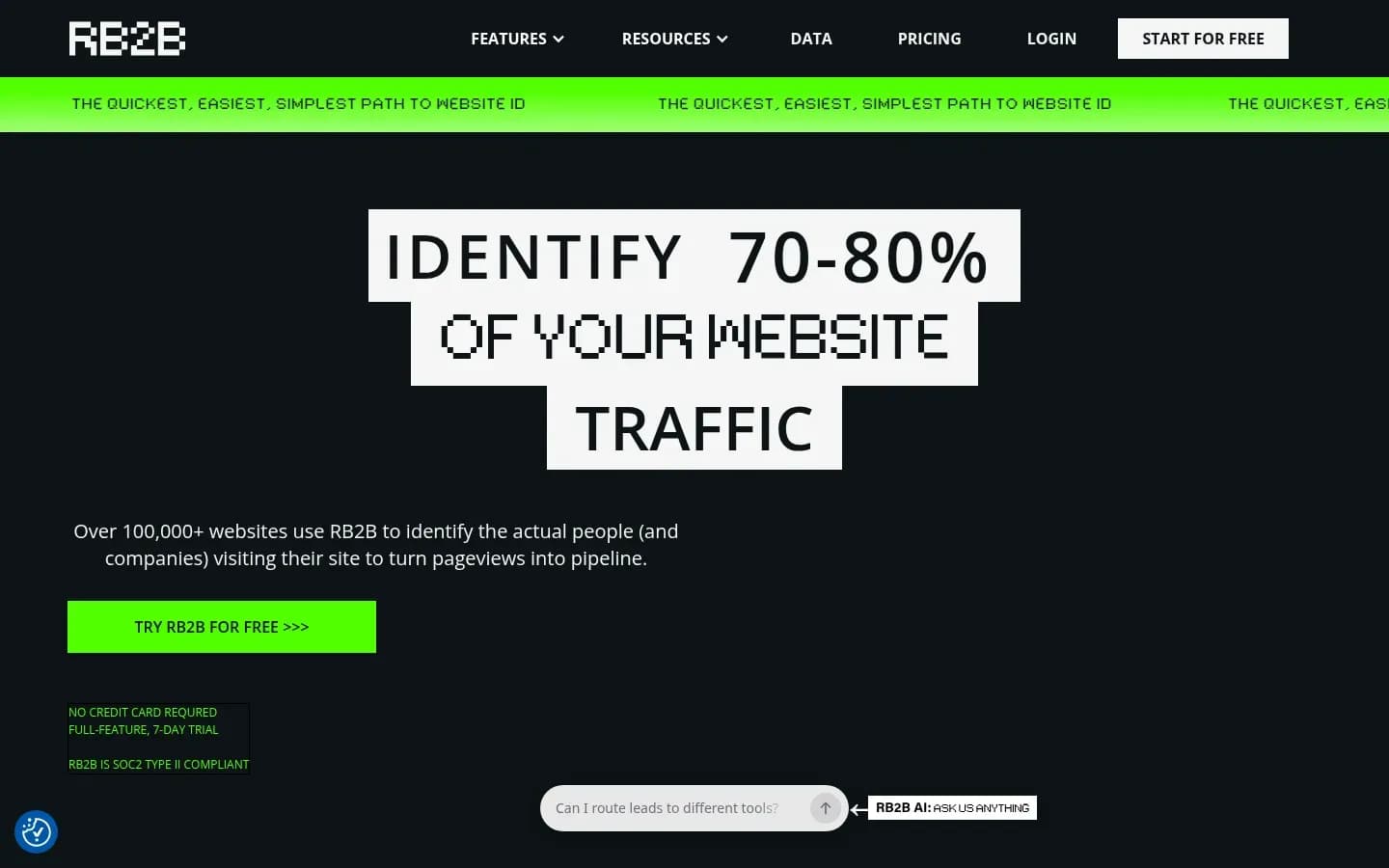
RB2B names the US professionals visiting a B2B website, sending each visitor's LinkedIn profile and business email to Slack, Teams or a CRM, but its own FAQ says person-level ID will not identify anyone located outside the US.
RB2B
Website visitor identification tool that identifies visitors and sends their details to Slack, Teams and CRMs, for sales and marketing teams.
RB2B is a website visitor identification tool built for B2B sales and marketing teams that want named US visitors pushed straight into the tools they already work in.
- Free plan
- Yes
- Free trial
- 7 days, no card needed
- Platforms
- Web
- Compliance
- GDPR, SOC 2
- Ratings
- G2 4.5/5 (284 reviews) · Capterra 1/5 (1 reviews)
Verdict: RB2B is a direct route from an anonymous US visit to a named person a seller can contact. It does one job, and it does it inside Slack.
Identity Evidence: RB2B sends names, LinkedIn profiles, business emails and company data for each identified visitor.
Regions: Person-level ID covers US visitors only. Company-level ID runs globally through RB2B's Demandbase partnership.
Matching Method: RB2B matches visitors at person level against what it calls a fully-permissioned publisher network, combining first- and third-party cookies, device IDs and IP addresses. Company-level ID uses Demandbase's reverse-IP lookup network. RB2B also shares one identity backbone with Retention.com, which lists RB2B as its B2B person-level product.
After The Match: Records land in Slack, Teams, the CRM, Clay and more than 50 other apps.
What Drives Spend: RB2B meters person-level identification in monthly resolutions. Spend scales with how many visitors are resolved each month, not with seats, so a traffic spike raises the bill faster than a new hire does.
Best Fit: US B2B sales teams with steady inbound traffic that want named visitors in Slack, where sellers already work.
Limitation: RB2B identifies nobody at person level outside the US, because its database only contains profiles matched to US home addresses and it uses IP ringfencing to resolve only US traffic. Results also depend on traffic mix. RB2B says customers typically see 30-40% of visitors identified at person level in the US and 70-80% with company-level ID added, a figure RB2B publishes with no methodology or denominator.
Teams choosing between the two leading B2B options can read RB2B vs Warmly for the head-to-head.
RB2B pricing
| Plan | Price | Billing | Notes |
|---|---|---|---|
| Free | $0 | per month | |
| Starter | $79 | per month | |
| Pro | $149 | per month | |
| Pro+ | $199 | per month |
Warmly
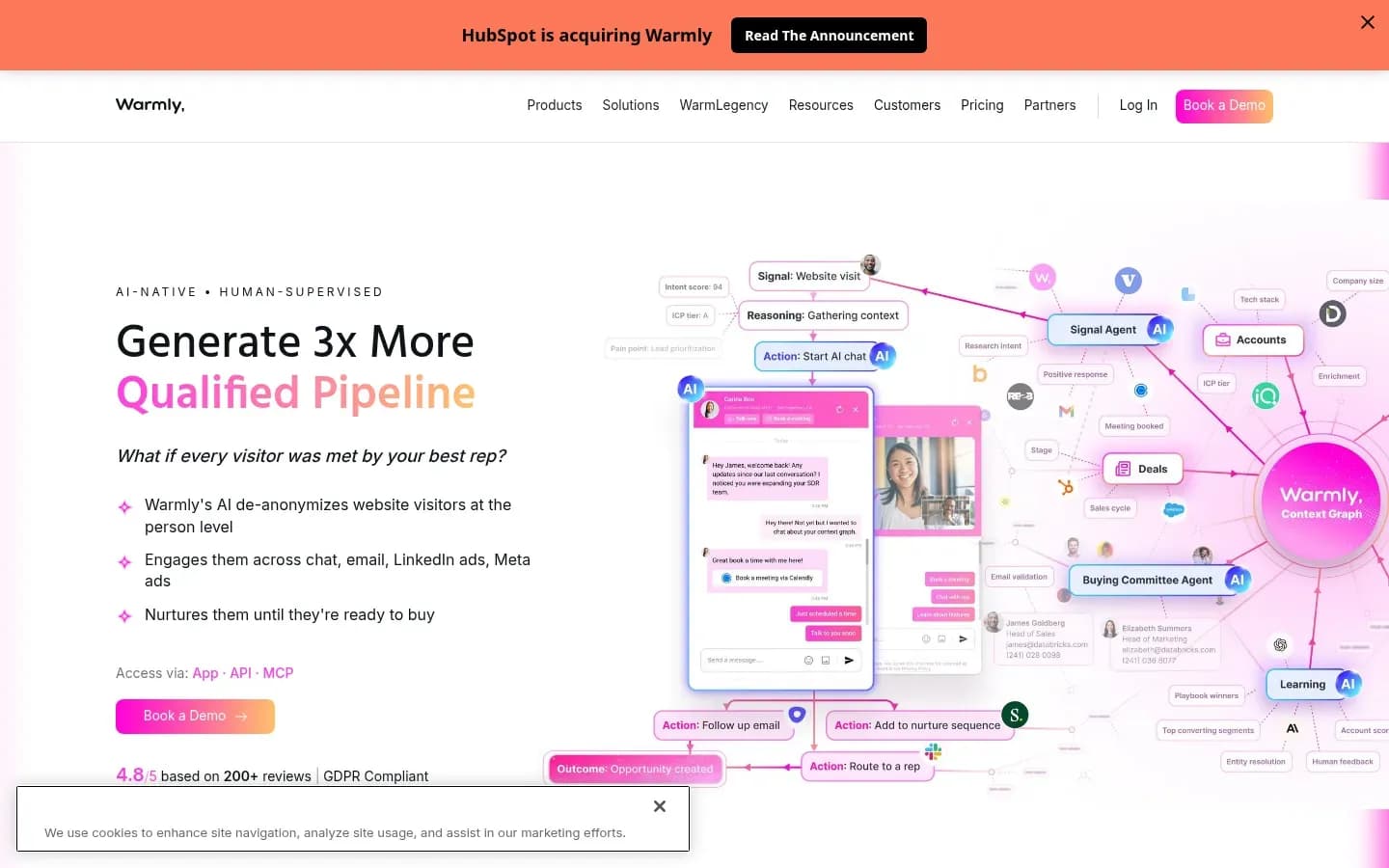
Warmly identifies visitors through a waterfall of data providers, including RB2B and Vector, then acts on each match with AI chat, routing and retargeting, and HubSpot announced on June 30, 2026 that it is acquiring Warmly.
Warmly
B2B go-to-market platform with AI agents that identify website visitors and engage them through chat, email and retargeting, for sales and marketing teams.
Warmly is a B2B go-to-market platform that pairs website visitor identification with AI agents for chat, routing, outbound and retargeting.
- Platforms
- API
- Compliance
- GDPR, SOC 2
- Ratings
- G2 4.5/5 (250 reviews)
Verdict: Warmly fits teams that want identification and an action layer in one contract. It is more platform than feed.
Identity Evidence: Person-level records include work email, job title, seniority, department and LinkedIn profile. Warmly describes an identity graph of more than 220 million contact records and uses Bombora for research-intent topics.
Regions: Warmly lets customers limit person-level identification to US visitors and integrates with cookie-consent platforms for EU visitors. In Warmly's own words, person-level identification is severely limited when an audience is primarily European.
Matching Method: A first-party pixel, IP intelligence and identity-graph matching (IP-to-company, cookie matching, email pixel correlation) feed a waterfall of providers. Warmly lists Vector, RB2B, Clearbit, ZoomInfo, Apollo, People Data Labs and Demandbase in that waterfall, and treats a match as validated when two or more providers agree.
After The Match: Warmly offers AI chat with full visit context, intent-triggered popups, live chat, meeting booking, lead routing, real-time alerts, an AI call agent, email and LinkedIn or Meta ad retargeting, and a TAM Agent for outbound orchestration.
Best Fit: B2B teams that want to identify, engage and route visitors without stitching three tools together.
Limitation: Person-level reach drops sharply outside the US, and Warmly's own production data puts US person-level matches at about 15% on average. Ownership is also changing under the announced HubSpot acquisition. Warmly said existing contracts, pricing, account teams and integrations stay unchanged for current customers, so a buyer new to Warmly should ask how terms apply to them.
Warmly AI Web-Deanonymization pricing
| Plan | Price | Billing | Notes |
|---|---|---|---|
| AI Web-Deanonymization |
|
|
Warmly Inbound Chat pricing
| Plan | Price | Billing | Notes |
|---|---|---|---|
| Inbound Chat |
|
|
Warmly AI Inbound Autopilot pricing
| Plan | Price | Billing | Notes |
|---|---|---|---|
| AI Inbound Autopilot |
|
|
Vector
Vector turns website visitors and in-market researchers into contact-level ad audiences, using device fingerprinting to map contact IDs and syncing those audiences to LinkedIn, Google, Meta and seven other ad platforms.
Vector
Account-based marketing platform that turns buyer signals and account scoring into contact-level ad audiences for B2B marketing teams.
Vector is an account-based marketing platform that turns buyer signals and account scoring into contact-level ad audiences for B2B marketing teams.
- Public API
- Yes
- Compliance
- GDPR
Verdict: Vector is the pick when the goal is to put ads in front of the people researching you, not to hand their names to an SDR.
Identity Evidence: Vector returns contact-level audiences built from website activity, research intent, CRM data, tracked accounts or buying stages.
Matching Method: Vector says it uses device fingerprinting to map contacts' IDs, then groups those contacts into audiences by signal.
After The Match: Audiences push natively to LinkedIn, Google, Meta, YouTube, Reddit, TikTok, Snapchat, Pinterest, X and Bing. Vector claims ad-audience match rates of up to 90% on LinkedIn, up to 45% on Meta, Google and YouTube, and up to 30% on TikTok, Reddit and X, and says rates vary by platform and traffic mix, with benchmarks shared at onboarding.
What Drives Spend: Vector sells one plan on one annual contract, bought through a demo. Its presets set scale rather than unlock features, and each of its 30-plus signals is priced on its own toggle. Spend rises with the number of tracked accounts and the signals switched on.
Best Fit: ABM and paid-media teams running campaigns against a defined list of target accounts, starting from a few hundred.
Limitation: Vector is built for ad audiences and buyer journeys, not as a named-visitor feed. An SDR team that wants a name and an email in Slack will find the workflow points the other way.
Vector pricing
| Plan | Price | Billing | Notes |
|---|---|---|---|
| Starter | $36,000 | per year |
Retention
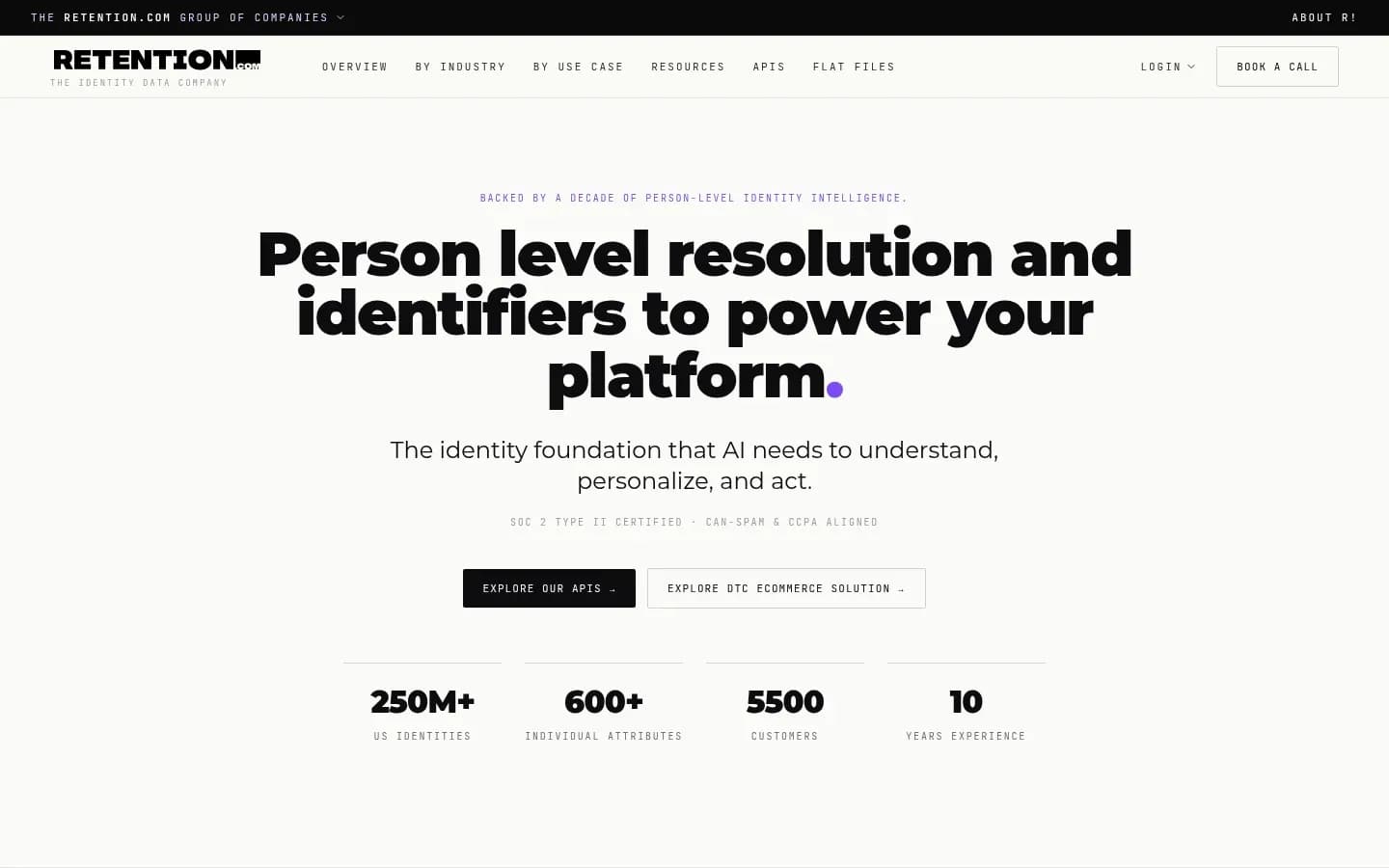
Retention.com resolves anonymous website traffic to US consumers from a base of more than 250 million identities, enriching each with hashed emails, mobile ad IDs and attributes that flow into Klaviyo, Iterable, Segment or a data warehouse.
Retention
Identity data company offering person-level identity resolution and website visitor identification for ecommerce, publishers and B2B teams.
Retention.com is an identity data company offering person-level identity resolution and website visitor identification for ecommerce brands, publishers and B2B teams.
- Public API
- Yes
- Compliance
- SOC 2
Verdict: Retention (formerly R! Data) is the data layer underneath consumer identification, and the same backbone that powers RB2B.
Identity Evidence: Retention.com enriches identifiers such as hashed emails (HEMs), mobile ad IDs (MAIDs) and IPs, then layers on demographic, professional, intent and behavioural attributes. It cites more than 600 attributes.
Regions: The identity base is US consumers, with more than 250 million US identities.
Matching Method: A single tag resolves anonymous traffic to a person using consent-aware signals, matched against that US identity base.
After The Match: Identities flow to Klaviyo, Iterable, Customer.io, Segment, Snowflake, BigQuery and Salesforce Data Cloud, among others. That makes Retention.com a fit for teams that want the identity in their own stack rather than in a vendor dashboard.
What Drives Spend: Retention's self-serve help centre says billing is per contact from the first contact, with no monthly fee or subscription, and large volumes may qualify for volume pricing. Spend scales with contacts resolved.
Best Fit: Ecommerce, DTC and data teams that want consumer identities in an ESP, a CDP or a warehouse.
Limitation: The records are consumer-oriented and the base is US-only. A B2B sales team wanting work emails and job titles will get a closer fit from RB2B, which runs on the same backbone.
CustomersAI
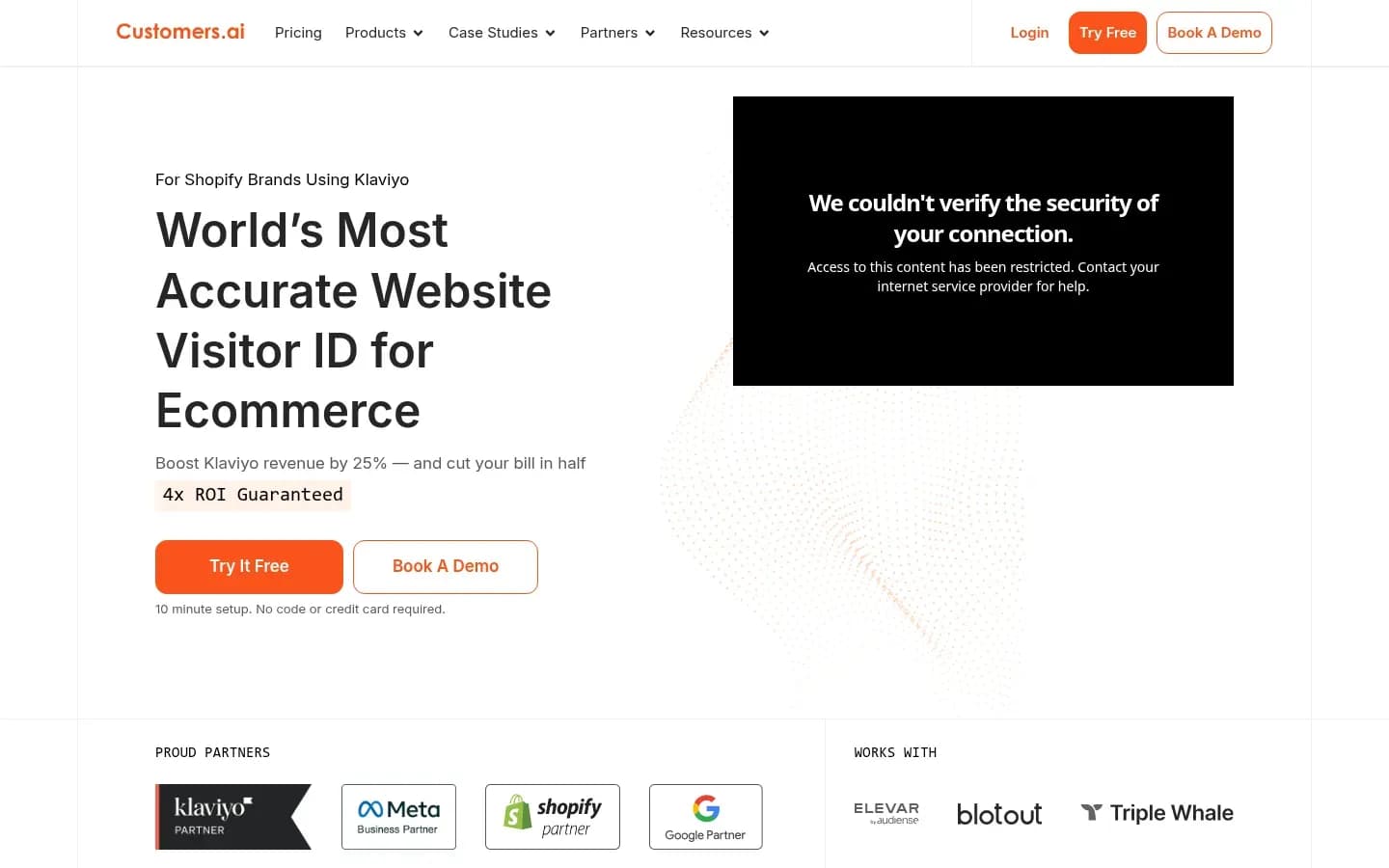
CustomersAI identifies shoppers across browsers and devices with its X-Ray pixel and feeds them into Klaviyo flows and ad audiences, and its B2B mode adds LinkedIn profiles, work emails and in-app email and SMS outreach.
CustomersAI
Website visitor identification and first-party identity resolution platform for ecommerce brands, especially Shopify stores using Klaviyo.
CustomersAI is a website visitor identification and first-party identity resolution platform for ecommerce brands, especially Shopify stores using Klaviyo.
- Free trial
- 7 days, no card needed
- Public API
- Yes
- Compliance
- GDPR
Verdict: CustomersAI suits Shopify and Klaviyo brands that want identification and the outreach that follows in one place.
Identity Evidence: The B2B product returns personal details (name, personal email, mobile, address), employee details (LinkedIn profile, job title, department, seniority, work email) and company details.
Matching Method: The X-Ray pixel identifies the same shopper across browsers and devices, links sessions over multiple visits, and can retroactively enrich a profile when a visitor opts in.
After The Match: CustomersAI offers in-app email and SMS outreach, real-time high-intent alerts, CRM and marketing-automation sync, and LinkedIn, Meta and Google ad audiences. On the ecommerce side, identities feed Klaviyo flows and an AI audience agent, with integrations including Shopify, Klaviyo, Meta Ads, Google Ads, HighLevel, SendGrid and Salesforce.
Best Fit: Ecommerce brands on Shopify and Klaviyo that want more of their anonymous shoppers in Klaviyo flows and ad audiences.
Limitation: CustomersAI's accuracy claims rest on no published method. It says it is 2-7x more accurate, with a 2-18x higher true match rate than other visitor ID tools, which it says get identities right 5-30% of the time, and it advertises a 4x ROI guarantee. It publishes no methodology for any of these figures, so treat them as marketing until your own test agrees.
CustomersAI X-Ray pricing
| Plan | Price | Billing | Notes |
|---|---|---|---|
| Signal Fidelity: Platinum | $299 | per month |
CustomersAI Alfred AI Agent pricing
| Plan | Price | Billing | Notes |
|---|---|---|---|
| Daily Sync, Shared Model | $149 | per month |
CustomersAI Super CAPI pricing
| Plan | Price | Billing | Notes |
|---|---|---|---|
| 30 Days Retention, Normal Sync Tier | $149 | per month |
What Is Person-Level Visitor Identification?
Person-level website visitor identification names the individual behind a website visit, such as a buyer's LinkedIn profile and work email, while company-level identification only names the organisation whose network the visit came from. The difference decides what a team can do next with each visit.
The record differs by tool, and that is where most confusion starts. RB2B returns a named B2B professional with a LinkedIn profile and business email. Warmly returns work email, job title, seniority, department and LinkedIn profile. Retention.com returns a consumer identity built on hashed emails and mobile ad IDs. All three count as person-level, but only the first two give a seller someone to call.
Company-level identification answers a narrower question, which organisation is on the site. It works through reverse-IP lookup, which is why it runs globally while person-level does not. RB2B itself uses Demandbase's reverse-IP network for its company-level layer.
Person-level data is also more sensitive. GDPR treats an online identifier as personal data, so a person-level match carries legal weight that a company match does not. The legal section below covers what that means in practice.
Teams that only need accounts can compare company-level visitor identification tools instead, and skip the regional and legal limits that come with naming people.
How Does Person-Level Visitor Identification Work?
Person-level tools match a visit to a person by comparing cookies, device IDs, IP addresses and hashed emails against an identity graph, and several share suppliers. Warmly's provider waterfall includes RB2B and Vector, and RB2B shares an identity backbone with Retention.com, so stacked tools can buy the same match twice.
Each vendor names a different method, and the method shapes the record that comes back.
How each tool matches a visit to a person
| Tool | Matching method | Record returned |
|---|---|---|
| RB2B | Publisher network, cookies, IP | Named B2B professional |
| Warmly | Pixel, identity graph, waterfall | Named B2B professional |
| Vector | Device fingerprinting | Contact-level ad audience |
| Retention.com | Single tag, HEMs, MAIDs | US consumer identity |
| CustomersAI | Cross-device X-Ray pixel | Shopper identity or B2B profile |
Publisher networks and cookies: RB2B matches visitors against what it calls a fully-permissioned publisher network, combining first- and third-party cookies, device IDs and IP addresses.
Identity graphs and waterfalls: Warmly correlates IP-to-company data, cookies and email pixels in an identity graph, then asks several providers in turn. A match counts as validated when two or more providers agree.
Device fingerprinting: Vector says it uses device fingerprinting to map contacts' IDs, then builds contact-level audiences that it pushes to ad platforms.
Hashed emails and MAIDs: Retention.com resolves traffic to a person through a single tag and enriches identifiers such as hashed emails and mobile ad IDs.
Cross-device pixels: CustomersAI's X-Ray pixel links the same shopper across browsers and devices and enriches the profile retroactively once the visitor opts in.
The shared supply is the part buyers miss. Warmly's waterfall includes RB2B and Vector. RB2B shares an identity backbone with Retention.com. A team that runs Warmly and RB2B together may pay twice for one identity from one source. Before stacking tools, ask each vendor which providers sit behind its matches.
For the company-matching side, see how company matching works.
Which Regions Do Person-Level Visitor Identification Tools Support?
Person-level visitor identification works almost only on US traffic. RB2B resolves US visitors exclusively, Warmly's own data puts international person-level matches at 3-8%, and Retention.com's identity base is US consumers. A site with mostly non-US traffic should plan around company-level data.
The reasons are structural, not temporary. RB2B's database only contains profiles matched to US home addresses, and it uses IP ringfencing so that only US traffic is resolved. Its company-level layer, run through Demandbase, is global.
Warmly gives customers a setting to limit person-level identification to US visitors and connects to cookie-consent platforms for EU visitors. Warmly states that if an audience is primarily European, person-level identification is severely limited.
Retention.com builds on more than 250 million US identities, so its reach follows that base.
Vector and CustomersAI frame their results differently. Vector says its ad-audience match rates vary by platform and traffic mix and shares benchmarks at onboarding. CustomersAI builds its product around Shopify and Klaviyo flows. For both, ask what the tool returns for your own non-US traffic before signing.
For a global site, the practical answer is a split setup. Use person-level identification on US traffic, where the data exists, and company-level identification everywhere else.
How Accurate Are Person-Level Visitor Identification Tools?
One competing vendor's analysis found that published match rates for a single person-level tool range from 5-20% to 15-45% because vendors divide by different denominators, so the only comparable figure is the one a team measures on its own traffic. Accuracy depends on traffic mix, device, region and whether the visitor has an active LinkedIn account.
That analysis, published by a competing vendor, traced the spread, nearly tenfold, to denominators. Some figures divide by all sessions, others by high-intent sessions or US-only sessions. It also notes that person-level resolution depends on the visitor having an active LinkedIn account, and that mobile carrier-grade NAT breaks reverse-IP lookup.
Each vendor's own figure belongs to its owner:
- RB2B says customers typically see 30-40% of US visitors identified at person level, with no denominator published.
- Warmly publishes production data of about 15% for US traffic (5-20% across customers), 3-8% for international traffic, 2-5% for mobile, and 30-50% in demo environments.
- Vector claims ad-audience match rates of up to 90% on LinkedIn, a different measure from visitor identification.
- CustomersAI says other tools get identities right 5-30% of the time, with no methodology.
Warmly's gap between demo and production is the clearest warning. A demo environment can show two or three times the rate a live site will see.
The fix is a side-by-side test. The same analysis recommends running tools for 14 days on the same traffic and dividing identified visitors by engaged sessions. Google Analytics 4 counts an engaged session as one that lasts longer than 10 seconds, has a key event, or has at least 2 pageviews or screenviews, which gives every tool the same denominator.
- Install two shortlisted tools on the same pages for the same 14 days
- Pull GA4 engaged sessions for those pages and that window
- Divide each tool's identified visitors by US engaged sessions
- Split the result by desktop and mobile traffic
- Spot-check named visitors you already know, such as customers and colleagues
- Count how many matches each tool shares with the other
- Compare the cost per usable record, not the headline rate
Spot-checking known visitors is the step most teams skip. A tool that names the wrong person at a target account is worse than one that names no one.
Is Person-Level Visitor Identification Legal?
GDPR counts an online identifier as personal data, which is why person-level vendors such as RB2B ringfence identification to US traffic. For US traffic, the duties that remain sit with the site owner, chiefly disclosing the tool in the privacy policy and honouring California opt-outs.
US sites still owe California visitors the CCPA rights to know, delete and opt out of sale or sharing of their personal information, including sharing for cross-context behavioural advertising. A site that pushes identified visitors into ad audiences should treat that as sharing and make the opt-out work.
The vendors' own design choices follow the law. RB2B resolves only US traffic through IP ringfencing. Warmly offers a US-only setting and integrates with cookie-consent platforms for EU visitors. Retention.com describes consent-aware signals. None of these settings removes the site owner's own duties.
A workable baseline for a US-heavy site:
- Name person-level identification in the privacy policy, using the vendor's sample language as a start
- Run the tag behind a consent platform for EU visitors, or limit person-level matching to US traffic
- Keep a working opt-out for California visitors before syncing anyone to ad audiences
This section is general information, not legal advice.
How To Approach Visitor Identification Software Selection
Choose a person-level tool by the record you need. RB2B suits named US professionals in Slack, Warmly suits identification plus AI agents, Vector suits contact-level ads, and Retention or CustomersAI suit consumer identities in email flows.
US B2B sales team wanting named visitors in Slack: Choose RB2B. It sends LinkedIn profiles and business emails to Slack, Teams and the CRM, and spend tracks monthly resolutions.
Best for
- US B2B sales teams that want named visitors in Slack
Not for
- Sites with mostly non-US traffic
Team wanting identification plus AI chat, routing and agents: Choose Warmly, and ask how terms apply to new customers under the announced HubSpot acquisition before signing.
Best for
- Teams that want identification and AI agents in one platform
Not for
- Buyers who only need a named-visitor feed
ABM or paid-media team advertising to buying committees: Choose Vector. It builds contact-level audiences and pushes them to ten ad platforms, with spend set by tracked accounts and signals.
Best for
- ABM teams advertising to target-account contacts
Not for
- SDR teams that want names and emails to call
DTC or data team needing consumer identities in Klaviyo, a CDP or a warehouse: Choose Retention.com. Billing is per contact, and identities land in the stack you already run.
Best for
- Data teams loading consumer identities into a warehouse or ESP
Not for
- B2B sellers who need job titles and work emails
Shopify and Klaviyo brand wanting identification plus done-for-you flows: Choose CustomersAI, and hold its accuracy claims to your own test.
Best for
- Shopify and Klaviyo brands feeding Klaviyo flows
Not for
- Buyers who need published match-rate methodology
Mostly non-US traffic: Buy a company-level tool instead. Person-level data outside the US is thin by design.
Avoid stacking tools that share a supplier: Warmly's waterfall already includes RB2B and Vector, and RB2B shares an identity backbone with Retention.com. Two of these together can mean paying twice for one identity.
Setup rule: Put the tag behind consent and keep it off low-value pages. The steps to install a website visitor identification tool cover tag management and testing.
Follow-up rule: A named visitor is worth little without an owner and a response time. Agree ownership and SLAs before go-live, then route identified accounts to sales through the CRM and Slack.
Frequently Asked Questions
Can I email visitors identified at person level?
The tools deliver emails, and the disclosure duties sit with the site owner. RB2B delivers business emails and CustomersAI delivers work and personal emails. RB2B tells customers to disclose it in their privacy policy and consult their own privacy counsel, and California visitors keep the CCPA right to opt out. This is general information, not legal advice.
Do person-level tools work on mobile traffic?
Poorly. Mobile visits are the hardest to resolve to a person, and Warmly's own production data puts mobile person-level matches at 2-5%. Mobile carrier-grade NAT also breaks reverse-IP lookup, so a site with mostly phone traffic should expect far fewer named visitors than desktop-heavy B2B sites see.
Can I use two visitor identification tools together?
Yes, but check the supply first. Warmly's waterfall already includes RB2B and Vector, and RB2B shares an identity backbone with Retention.com, so two tools can return the same identity from one source. Running two tools side by side for 14 days is still a reliable way to measure which one earns its cost.
What does person-level visitor identification cost to run?
Cost follows volume, and each tool meters it differently. RB2B charges by monthly resolutions, Retention.com bills per contact resolved, and Vector scales one annual contract by tracked accounts and signals. The pricing widget in each tool's section shows its current plans, so model cost against your expected US engaged sessions.
Sources
Sources
- warmly.ai
- Rights under the California Consumer Privacy Act · privacy.ca.gov
- HubSpot Acquires Warmly to Boost AI Sales Agents · cmswire.com
- happierleads.com
- rb2b.com
- customers.ai
- intercom.help
- vector.co
- retention.com
- Why No Two "RB2B Match Rate" Numbers Ever Agree (And How to Test Yours) · knock2.ai
- Session - Analytics Help · support.google.com
- Regulation (EU) 2016/679, Article 4: Definitions · legislation.gov.uk
- customers.ai