Company-level tools tell you which businesses visit your site, not which people. This guide ranks the five that do that job best for small and mid-market B2B teams, and shows how far to trust each one's match claims.
These picks apply when you need to know which companies visit, not which individuals, and most of your buyers browse from company networks. No tool identifies every visit. Home, mobile and VPN traffic often stays anonymous, and every published match rate is the vendor's own.
What Is Company-Level Visitor Identification?
Company-level visitor identification matches a website visit's IP address to a company's network and returns the organisation and its firmographics, not the person, which matters because 67% of B2B buyers say they prefer a rep-free experience and leave few other signals. Gartner surveyed 646 B2B buyers in 2025 for that figure.
It is the account-level branch of website visitor identification, and the mechanics are simple. A tracking script on your site records each visit's IP address. The tool compares that address against known company network ranges. Leadfeeder describes those ranges as built from registry allocations, ISP ranges and first-party observations.
When the address falls inside a company's range, the tool returns the organisation and enriches it. Snitcher, for example, returns the company name and domain, industry, employee count, headquarters location and social profiles such as LinkedIn.
Three limits shape everything that follows:
- A match is an estimate. Leadfeeder calls the result "an assessment rather than a definitive phone book lookup".
- Some traffic cannot be matched. Residential and mobile connections, carrier-grade NAT and VPNs make matching less reliable.
- The person stays unknown. Even a correct company match does not show which employee visited.
The account behind the visit is still worth knowing. When most buyers research on their own, the companies reading your pricing page are often the earliest sign that an account is in market, long before anyone fills in a form.
What Is The Difference Between Company-Level And Person-Level Visitor Identification?
A company-level tool tells a sales team which organisation visited, while a person-level tool tries to name the individual, a capability Leadfeeder describes as primarily available in the US and harder to justify under EU privacy law. Company-level suits account scoring and routing, and person-level suits contact outreach.
Company-level and person-level identification compared
| Question | Company-level | Person-level |
|---|---|---|
| What it returns | Company name and firmographics | A named individual |
| Where it works | Business networks mapped to companies | Primarily the US |
| EU legal exposure | Lower, still regulated | Higher |
| Typical use | ABM, account scoring, routing | One-to-one outreach |
Leadfeeder's own explainer rates EU legal exposure as lower for company-level identification, "although GDPR and ePrivacy laws may still apply". It adds that the position "remains contested because the process may still involve personal data before the company match appears". Person-level identification carries higher exposure.
The line between the two is blurring in one specific way. Several company-level tools add a person only after the visitor identifies themselves:
- Snitcher's identity layer links an email address to a visitor's browsing sessions, including past ones, once they fill in a form or click an email link.
- Albacross captures forms and downloads and tracks email links, then ties earlier anonymous visits to the person once they identify.
- Leadinfo's Persona Insights adds identification through form tracking and email campaign tracking.
None of these names an anonymous visitor. They connect a known person to their own earlier visits.
If you need contact details for the people at an account, pair your visitor tool with one of the B2B contact databases rather than switching to person-level tracking. If you want both levels compared side by side, our roundup of the best website visitor identification tools covers person-level options as well.
What Are The Best Company-Level Visitor Identification Tools?
For most B2B teams Leadfeeder is the strongest company-level visitor identification tool, with Snitcher, Leadinfo, Albacross and Lead Forensics each winning a narrower case on ease of use and consent fit, European focus, account scoring or decision-maker contacts. The ranking below gives each tool's best fit, and the table compares how each recognises and enriches accounts.
- LeadfeederBest for all-round, EU-hosted data
- SnitcherBest for ease of use, consent fit
- LeadinfoBest for european small and mid-sized teams
- AlbacrossBest for account scoring and LinkedIn ads
- Lead ForensicsBest for sales-led teams wanting contacts
Company-level visitor identification tools compared
| Tool | Best for | Signals beyond IP | Firmographic depth | After the match |
|---|---|---|---|---|
| Leadfeeder | All-round, EU-hosted data | Intent data | 100+ firmographic filters | Fit and intent scoring |
| Snitcher | Ease of use, consent fit | Email identity layer | Industry, size, HQ, socials | Intent signals, CRM sync |
| Leadinfo | European small and mid-sized teams | Form and email tracking | Public-source company data | 70+ CRM integrations |
| Albacross | Account scoring and LinkedIn ads | Forms, email links, cookies | Industry, size, revenue, tech | Signal score, LinkedIn ads |
| Lead Forensics | Sales-led teams wanting contacts | Visit trails, return visits | Industry, size, location | Alerts, decision-maker contacts |
The table reads in two directions. Down the "Firmographic depth" column, Leadfeeder documents 100+ filters, Albacross documents revenue and tech stack, and Snitcher keeps to five core fields. Across the "After the match" column, the tools split by what your team does next. Marketing teams that score and advertise lean towards Albacross or Leadfeeder, and sales teams that want someone to call lean towards Lead Forensics.
How We Chose These Tools
Twelve tools were considered against one bar, that the core product names visiting companies from IP data with firmographics and no form fill, and five passed, judged on account recognition, firmographic depth, match evidence, activation and privacy posture.
To make the list, a tool also had to sell to self-serve or mid-market teams and sync identified companies to a CRM. Each tool was then judged on five criteria:
Criteria used to rank the tools
| Criterion | What it covers |
|---|---|
| Account recognition | How matches are made, and what happens to residential or VPN traffic |
| Firmographic depth | Which company fields arrive with each match |
| Match evidence | What the vendor claims, and how it frames confidence |
| Activation | Scoring, alerts, CRM sync and ad audiences |
| Privacy posture | Legal basis, data hosting and consent support |
Every match rate quoted in this guide is the vendor's own figure, labelled as such. Vendors measure on different denominators and traffic, so the figures are reported side by side, never ranked against each other.
Seven tools that appear often on other lists were considered and left out, because they do a different job or serve a different buyer:
Considered, not included
| Tool | Why it is not on this list |
|---|---|
| RB2B | Person-level identification for US visitors, a different job |
| 6sense | Enterprise account-based platform, covered in our enterprise guide |
| Demandbase | Enterprise account-based platform, covered in our enterprise guide |
| Warmly | Person-level identification plus outbound automation |
| ZoomInfo | Visitor identification sold inside a wider data platform |
| Clearbit | Now HubSpot Breeze Intelligence, not a standalone tool |
| Vector | Contact-level identification with ad targeting |
Teams that need account hierarchies, SSO and governance at scale should read our guide to enterprise visitor identification tools, which covers 6sense and Demandbase in depth.
Leadfeeder
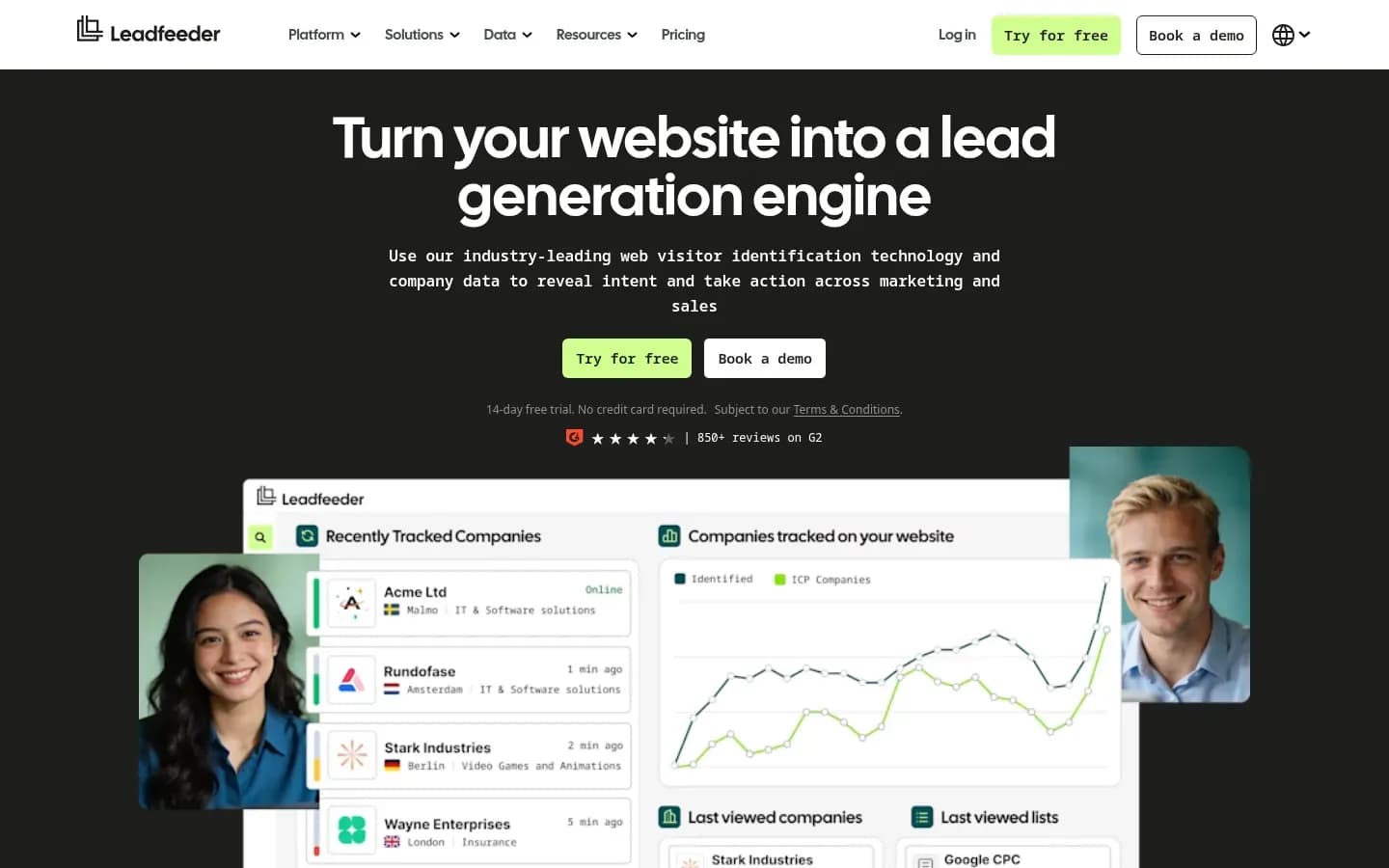
Leadfeeder, which absorbed the Dealfront brand in March 2026 without changing contracts or plans, ranks first here because it pairs an IP-to-company database it says covers about 9M companies with 100+ firmographic and intent filters and EU-hosted data. The rebrand took effect on 24 March 2026, and the visitor product is now called Web Visitors.
Leadfeeder
Website visitor identification software that shows B2B marketing and sales teams which companies visit their site and syncs them to their CRM.
Leadfeeder (formerly Dealfront) identifies the companies visiting a B2B website, scores them by fit and intent, and syncs them to the CRM. It suits marketing and sales teams that want broad filtering and data hosted in the EU.
- Free plan
- Yes
- Free trial
- 14 days, no card needed
- Platforms
- API, Chrome extension, Web
- Public API
- Yes
- Compliance
- GDPR, ISO 27001
- Ratings
- G2 4.3/5 (869 reviews)
Verdict: The safest all-round pick for a mid-market team that wants deep filtering and a clear EU data position.
How It Recognises Accounts: Leadfeeder compares each visitor's IP address against company network ranges built from registry allocations, ISP ranges and first-party observations, and calls the result an assessment rather than a lookup. It says it can still identify some companies when employees work remotely, though matching is less reliable on residential and mobile connections, carrier-grade NAT and VPNs.
Firmographics And Filters: Leadfeeder offers 100+ filters on firmographic, intent and ICP data. For sales teams it adds a database it puts at 60M companies and 400M verified contacts.
Confidence And Match Evidence: Leadfeeder says it identifies up to 45% of companies visiting a site. Its own measurement in August 2026 was 38.0% of visits identified across its five core regions and 30.8% in the US and Canada, drawn from 45M+ IP-to-company mappings. These are Leadfeeder's figures, not an independent audit.
Activation And Integrations: Accounts are scored by fit and intent and sync to Salesforce, HubSpot, Pipedrive, Microsoft Dynamics and Zoho. Slack, Zapier, Google Ads and GA4 connections push alerts and audiences further.
Privacy Posture: Leadfeeder processes personal data on legitimate interest under Article 6(1)(f) GDPR, after a balancing test with external counsel. Data is hosted and processed on AWS in Ireland, Leadfeeder signs a DPA where it acts as processor, and it deletes the data of people who object. Customers remain responsible for their own legal basis.
Best Fit: Mid-market B2B teams with EU traffic and an ICP model that needs many filters. It is less suited to a small team that only wants a list of company names.
Limitation: On G2, reviewers name data accuracy and cost as the main cons, with five mentions each, against lead generation (23) and ease of use (22) as the leading pros.
Leadfeeder pricing
| Plan | Price | Billing | Notes |
|---|---|---|---|
| Lite | €0 | per month | |
| Discover | €79 | per month, billed annually | |
| Activate | €369 | per month, billed annually | |
| Scale | €599 | per month, billed annually | |
| Enterprise | Custom pricing |
Snitcher
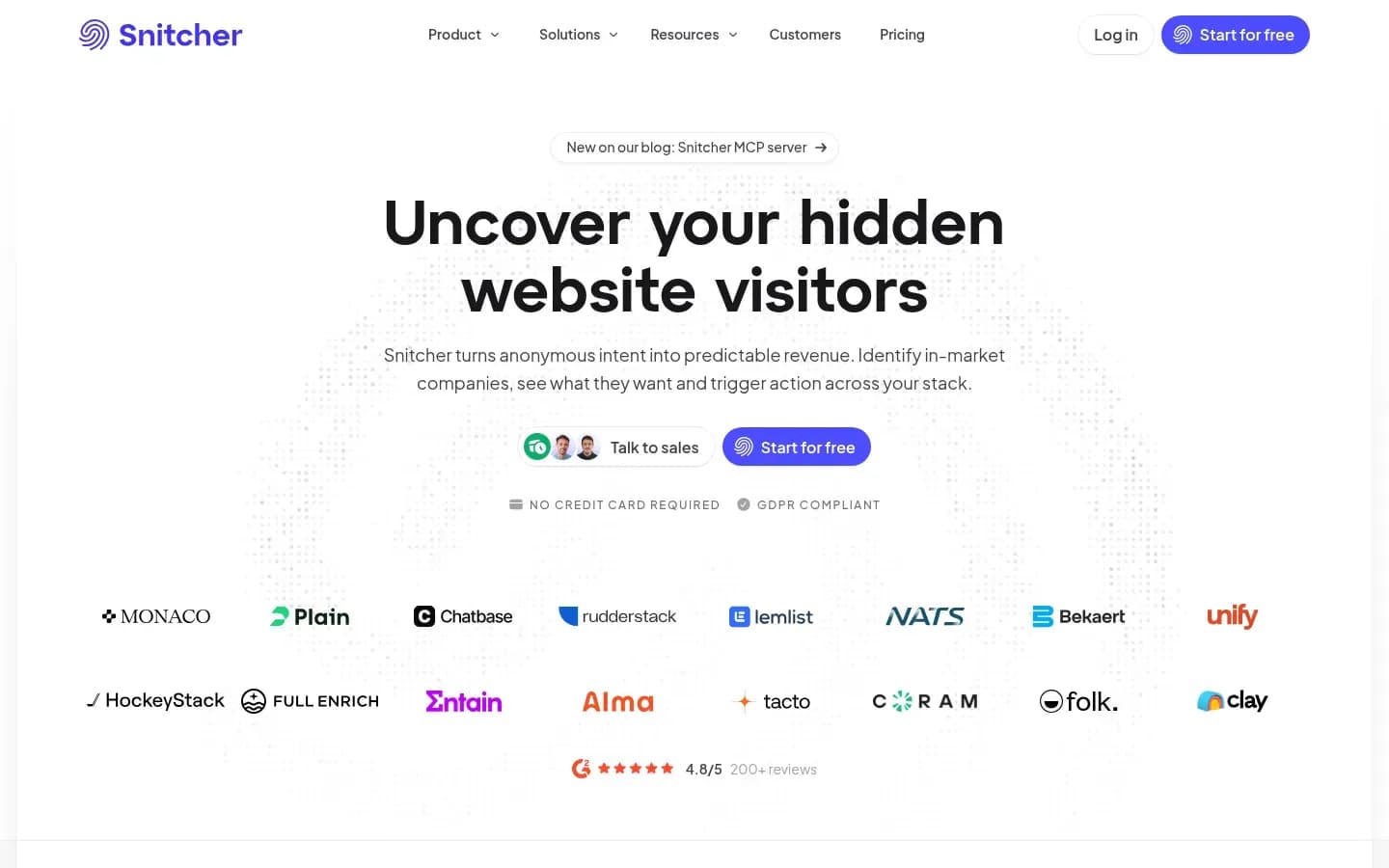
Snitcher suits SaaS teams that value ease of use, support and consent-mode tracking, scoring 9.4 for ease of use and 9.5 for quality of support in G2's comparison against 8.9 and 8.7 for Leadfeeder, and its documentation is unusually plain about limits, rating accuracy very high on office networks and limited on residential and mobile connections.
Snitcher
Website visitor identification platform that shows which companies visit a site and their intent, for sales, marketing and RevOps teams.
Snitcher shows which companies visit a site and what they read there, for sales, marketing and RevOps teams. It suits SaaS teams that want an easy-to-use tool, consent-mode support and an identity layer for visitors who identify themselves.
- Free trial
- 14 days, no card needed
- Public API
- Yes
- Compliance
- GDPR
- Ratings
- G2 4.8/5 (247 reviews)
Verdict: The pick for a SaaS team that values ease of use, plain documentation and the support reviewers praise over the deepest firmographics.
How It Recognises Accounts: Snitcher relies on a proprietary database that maps business IP ranges to companies and is updated continuously. Consumer ISP, VPN and mobile carrier addresses often cannot be tied to a company, so those visits appear as "Anonymous" with an approximate location.
Firmographics And Filters: Each identified company arrives with its name and domain, industry, employee count, headquarters location and social profiles such as LinkedIn.
Confidence And Match Evidence: Snitcher grades accuracy by network type rather than per match. It rates office networks very high, corporate VPNs high, and residential and mobile connections limited. For residential traffic it points to email capture and email link tracking.
Activation And Integrations: The identity layer links an email address to a visitor's sessions, including past ones, once they identify through a form or email link. Intent signals track pricing page visits, documentation reads and feature comparisons. Integrations include HubSpot, Salesforce, Pipedrive, Zoho CRM, Microsoft Dynamics, Attio, Close, Slack, Microsoft Teams, Zapier and webhooks.
Privacy Posture: Snitcher uses first-party data only and does not rely on third-party cookies. It recommends disclosing Snitcher in your privacy policy, supports major consent management platforms and offers a waitForConsent setting that holds tracking until the visitor agrees.
Best Fit: SaaS teams that want intent signals such as pricing page visits pushed to Slack and the CRM, and EU-facing sites that need tracking tied to the consent banner. It is less suited to teams whose scoring depends on revenue or tech stack data.
Limitation: Firmographics are thinner than Leadfeeder's or Albacross's, since revenue and tech stack are not among Snitcher's documented fields. On G2, cost (10 mentions) and filtering issues (6) are the leading cons, against ease of use (43) and customer support (19) as the leading pros. G2's ease-of-use and support sub-scores for Snitcher sit above Leadfeeder's.
Snitcher Platform pricing
| Plan | Price | Billing | Notes |
|---|---|---|---|
| Platform 0-50 company IDs |
|
| |
| Platform 51-100 company IDs |
|
| |
| Platform 101-250 company IDs |
|
| |
| Platform 251-500 company IDs |
|
| |
| Platform 501-750 company IDs |
|
| |
| Platform 751-1,000 company IDs |
|
| |
| Platform 1,001-2,000 company IDs |
|
| |
| Platform 2,001-3,000 company IDs |
|
| |
| Platform 3,001-4,000 company IDs |
|
| |
| Platform 4,001-5,000 company IDs |
|
| |
| Platform Custom | Custom pricing |
Leadinfo
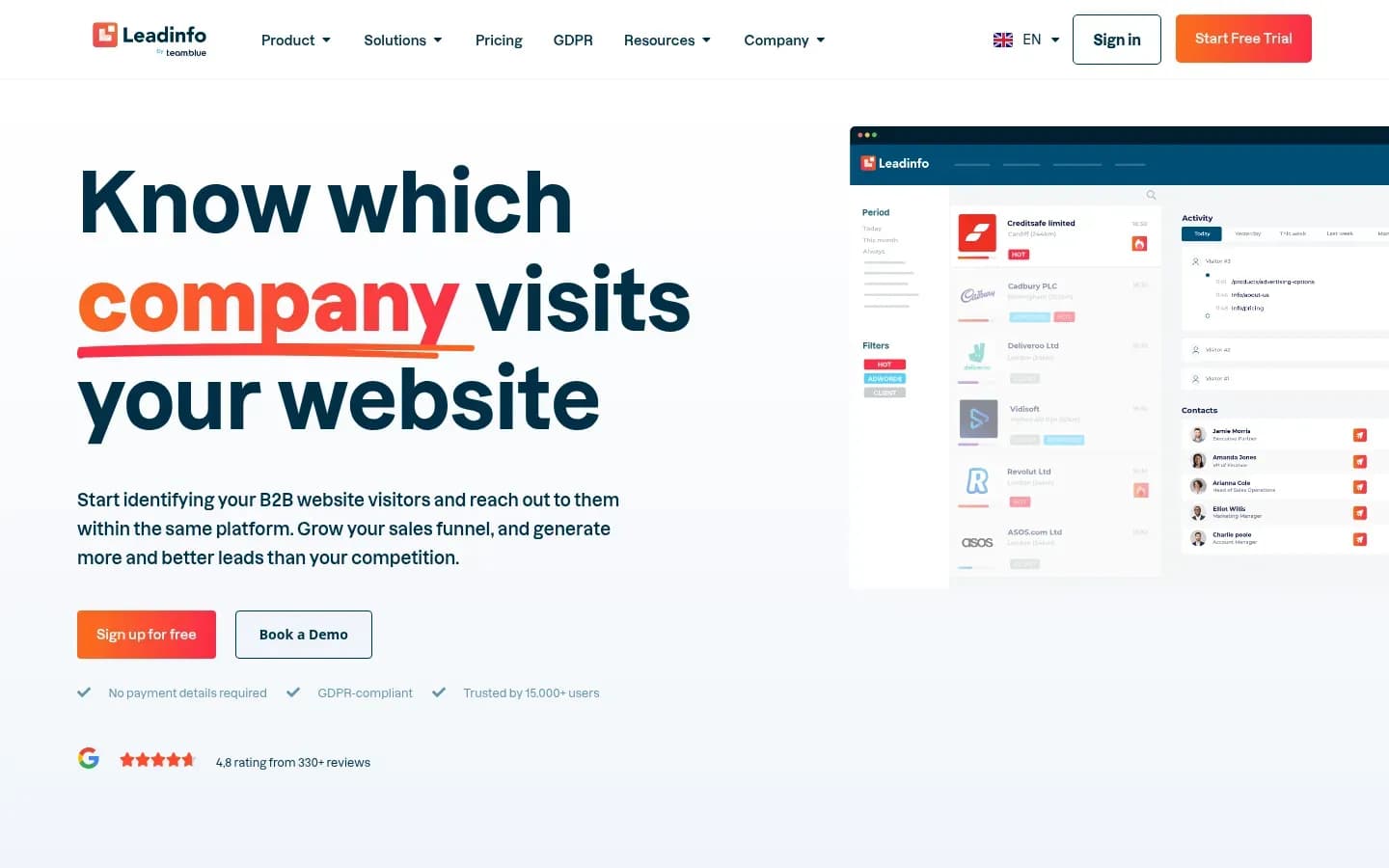
Leadinfo fits European small and mid-sized B2B teams best, and its reach is widening after Leadinfo acquired Visitor Queue to build a global visitor intelligence platform under team.blue. The deal was reported on 20 January 2026, and Leadinfo has been a team.blue brand since 2022 with more than 9,000 customers.
Leadinfo
B2B website visitor identification software that links visits to company data so sales and marketing teams can generate leads.
Leadinfo links website visits to company data so sales and marketing teams can follow up on the businesses showing interest. It suits European small and mid-sized teams that want company recognition on business networks.
- Free trial
- 14 days, no card needed
- Compliance
- GDPR
- Ratings
- G2 4.3/5 (836 reviews)
Verdict: The choice for a European SMB with mostly business-network traffic that wants company recognition plus form and email identification, without paying for the deepest filtering.
How It Recognises Accounts: Leadinfo's tracking code reads the visitor's IP address and matches it to a company name. It recognises companies from all countries when the visitor is on a business IP, and has run a worldwide database since 2021.
Firmographics And Filters: Company information comes from publicly known sources, and Leadinfo cites 220 million European business profiles behind it.
Confidence And Match Evidence: Leadinfo puts identification for quality platforms at 35-40% in Europe and lower outside Europe. It also puts identified companies at roughly 30% of website visitors. All of these figures are Leadinfo's own.
Activation And Integrations: Leadinfo connects to more than 70 CRM and marketing automation tools, so identified companies can flow into the systems a small team already runs.
Privacy Posture: Leadinfo's privacy-statement template says it places two first-party cookies and recognises company visits by IP address, with an opt-out. Persona Insights adds form and email campaign tracking, which Leadinfo says must be disclosed separately.
Best Fit: European SMBs with mostly business-network traffic that want company recognition plus form and email identification. It is less suited to teams whose traffic is mainly outside Europe.
Limitation: On G2, lack of information (12 mentions) and filtering issues (11) are the leading cons, against ease of use (45) and lead generation (33) as the leading pros. Leadinfo itself says identification is lower outside Europe.
Leadinfo pricing
| Plan | Price | Billing | Notes |
|---|---|---|---|
| Starter |
|
| |
| Scale |
|
| |
| Pro |
|
|
Albacross
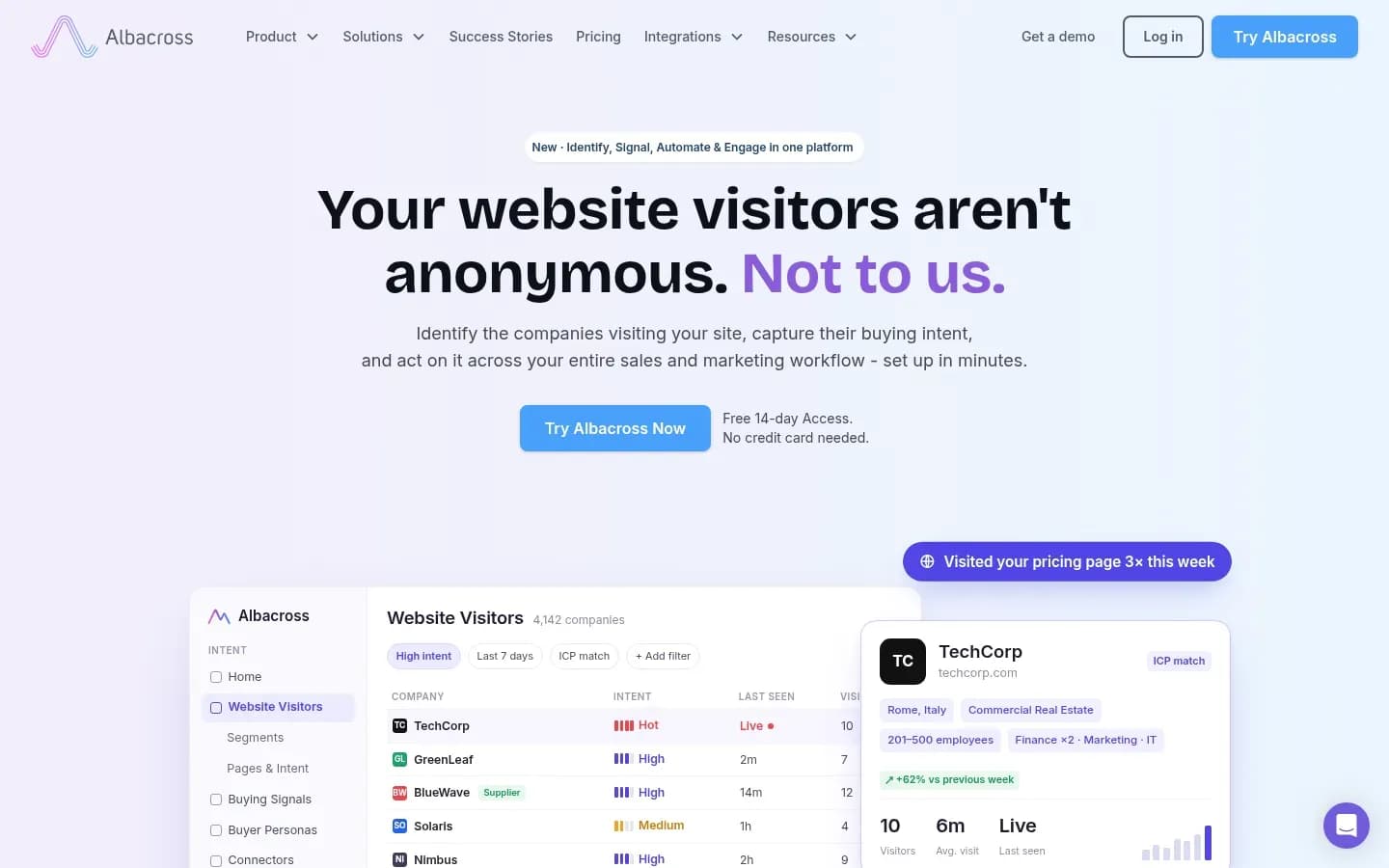
Albacross is the pick for teams that act on account scores, because its Signal feature folds company size, industry, tech stack, CRM status and on-site intent into one priority score that can feed LinkedIn audiences.
Albacross
B2B website visitor identification and buying-intent platform that shows sales and marketing teams which companies visit their site and syncs scored accounts to their CRM.
Albacross identifies the companies visiting a site, scores them on fit and buying intent, and syncs scored accounts to the CRM. It suits marketing teams that run account-based scoring and advertising.
- Free trial
- 14 days, no card needed
- Platforms
- Chrome extension
- Public API
- Yes
- Compliance
- GDPR
- Ratings
- G2 4.6/5 (129 reviews)
Verdict: The best match for teams that turn identified accounts into scores and ad audiences rather than call lists.
How It Recognises Accounts: Albacross layers IP intelligence with form and download capture, email link tracking and first-party cookies, so that accounts are not missed behind VPNs or blockers. It ties earlier anonymous visits to a person once they identify.
Firmographics And Filters: Account data includes industry, employee count, revenue and tech stack.
Confidence And Match Evidence: Albacross claims "#1 identification rates in the EU" and says customer tests show identification 1.7x higher than most intent data platforms, with no published method. It says its database maps over 3 billion events monthly.
Activation And Integrations: Signal combines behaviour, firmographics, CRM history and third-party intent into a single priority score. Fit inputs are company size, industry, tech stack and CRM status, and intent inputs are pricing visits, repeat sessions and content engagement. Customers can bring their own intent data and custom attributes. Native integrations cover Salesforce, HubSpot, Pipedrive and Attio, plus Slack, Microsoft Teams and LinkedIn Matched Audiences, with 30+ integrations in all and display and LinkedIn ads to reach target accounts.
Best Fit: Marketing teams running account scoring and LinkedIn or display campaigns against target accounts. It is less suited to a sales team that only wants a daily list of visiting companies.
Limitation: Its display and LinkedIn ad features add value only if you run account-based ads, and its headline identification claims ("#1 in the EU", 1.7x most intent data platforms) come with no published method.
Albacross pricing
| Plan | Price | Billing | Notes |
|---|---|---|---|
| Starter |
|
| |
| Professional |
|
| |
| Organisation | Custom pricing |
Lead Forensics
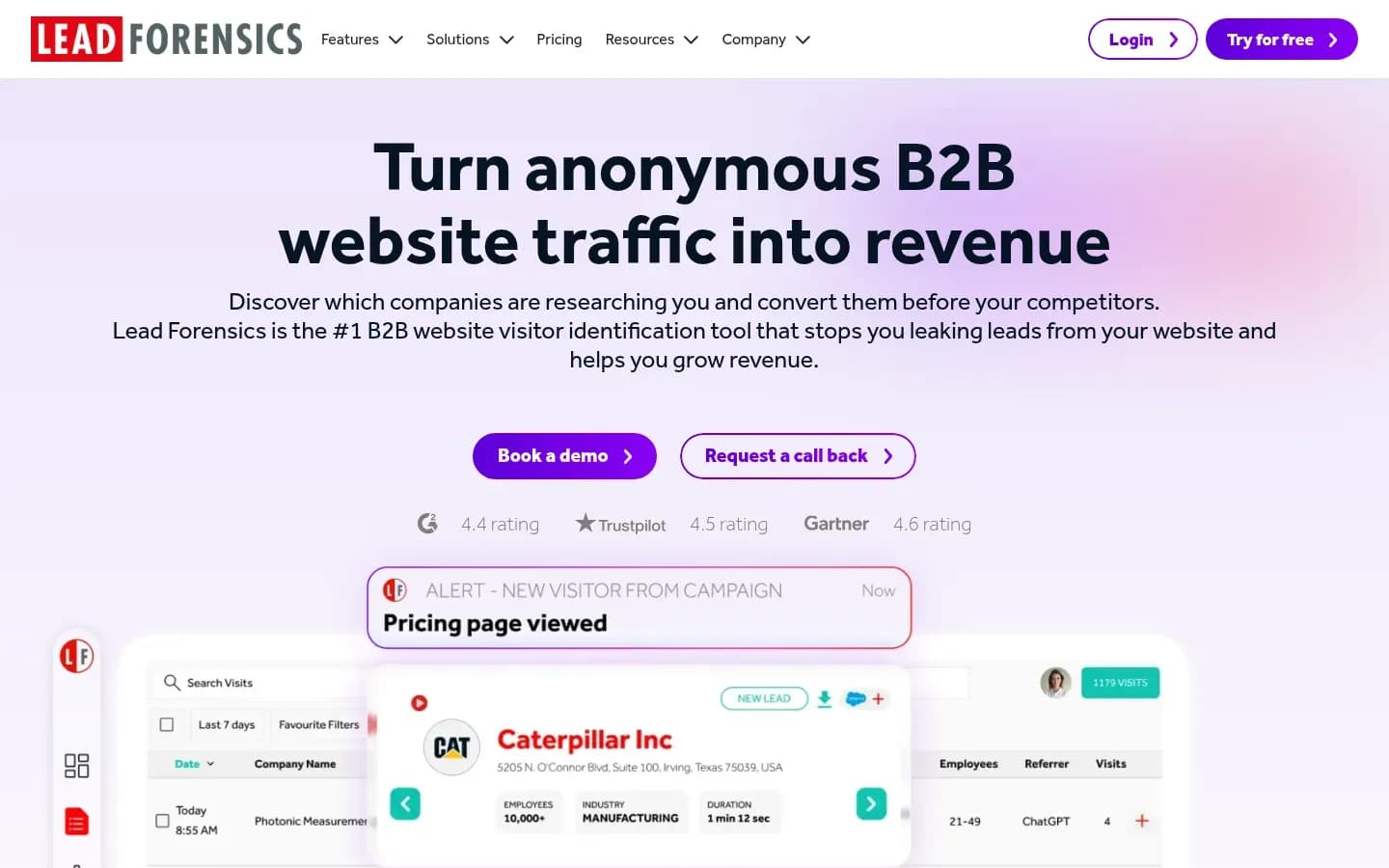
Lead Forensics suits sales-led teams that want decision-maker contacts delivered with each identified company, though GetApp reviewers rate value for money lowest and a minority report difficulty cancelling contracts.
Lead Forensics
B2B website visitor identification tool that shows the companies behind anonymous site visits.
Lead Forensics shows the companies behind anonymous B2B site visits, with decision-maker contacts where available and a trail of each visit. It suits sales-led teams that want accounts and people to call in one place.
- Compliance
- GDPR, ISO 27001
- Ratings
- Capterra 4.5/5 (262 reviews)
Verdict: The pick for sales teams that want a named contact with each company match and are comfortable with a sales-led contract.
How It Recognises Accounts: A tracking code captures visitor IP addresses, which are matched against Lead Forensics' in-house proprietary B2B IP database.
Firmographics And Filters: Each identified business shows company name, industry, size and location, contact details for key decision makers where available, and visit details such as pages viewed, time on site, traffic source and return visits.
Confidence And Match Evidence: Lead Forensics says it "identifies up to 80% of B2B visits" and "beats competitors in side-by-side comparisons", citing "96% of demos", with no published method. It says data is validated across multiple sources before it is shown, and that match rates vary by industry, geography, audience and traffic source.
Activation And Integrations: Instant alerts and custom triggers notify sales when a target account returns. Lead Forensics lists 60+ integrations, including Salesforce, HubSpot, Pipedrive, Zoho and Microsoft Dynamics, and onboarding runs through a dedicated account manager.
Best Fit: Sales-led teams that want decision-maker contacts with each visiting company and onboarding led by an account manager. It is less suited to self-serve teams that want to start and stop freely.
Limitation: On GetApp, support and dedicated account managers earn the highest sub-rating, while value for money earns the lowest, and some reviewers report outdated or incomplete contact information. On G2, missing information (23 mentions) is the leading con, against ease of use (149), helpful (129) and lead quality (35) as the leading pros.
How Accurate Are Company-Level Visitor Identification Tools?
Company-level match rates published by vendors range from Leadinfo's 35-40% for Europe to Lead Forensics' "up to 80%", but each is the vendor's own measurement on its own denominator, and published figures for a single person-level tool, RB2B, differ nearly tenfold. None of them is an independent audit, so treat each as a ceiling to test rather than a promise.
Here is what each vendor claims, in its own terms:
Vendor match claims, as each vendor states them
| Vendor | Claim | Method published |
|---|---|---|
| Leadfeeder | Up to 45% of visiting companies | Own measurement |
| Leadfeeder | 38.0% five core regions, 30.8% US and Canada | Own data, August 2026 |
| Leadinfo | 35-40% in Europe, lower elsewhere | Vendor claim |
| Lead Forensics | Up to 80% of B2B visits | No |
| Albacross | 1.7x most intent data platforms | No |
Why the numbers differ: Each vendor picks its own denominator (all sessions, engaged sessions or visiting companies), its own regions and its own customer mix. An analysis by Knock2 found that published match rates for a single person-level tool range from 5-20% to 15-45%, a spread of nearly 10x, purely from different denominators and traffic profiles. Leadfeeder's own split shows the regional effect, with 38.0% across its core regions against 30.8% in the US and Canada.
What goes unmatched: Traffic from home broadband, mobile carriers, carrier-grade NAT and VPNs often cannot be tied to a company. Snitcher shows those visits as anonymous with an approximate location. Leadfeeder says stale network ranges also weaken matching. A team whose buyers work remotely or browse on phones will see lower rates than one whose buyers sit in offices.
What a match does not tell you: Even a correct company match does not show which employee visited.
How vendors frame confidence: Each vendor describes confidence in its own way. Snitcher grades accuracy by network type. Lead Forensics says it validates data across multiple sources before showing it. Leadfeeder calls each match an assessment rather than a definitive lookup.
The practical answer is to expect a meaningful share of visits to stay anonymous with any tool, and to judge tools on how many ICP-fit accounts they surface, not on the headline rate.
How Do I Choose A Visitor Identification Tool?
Choose a company-level visitor identification tool by where your traffic comes from first, because Leadinfo itself reports lower identification outside Europe, then by the firmographic fields your account scoring needs and what the tool does after a match. Contacts, privacy fit and the billing meter settle the rest.
Work through these six checks in order:
- Map where your traffic comes from, EU-heavy or US-heavy
- List the firmographic fields your ICP scoring needs
- Decide what should happen after a match
- Decide whether you need contacts or accounts only
- Check privacy posture and consent fit
- Find out what the bill is metered on
1. Traffic geography: If most visits come from Europe, judge tools on their European figures. Leadinfo's own claim of 35-40% applies to Europe, and it says rates are lower elsewhere. Leadfeeder publishes a separate figure for the US and Canada, which helps if North American traffic matters.
2. Firmographic fields: An ICP model that scores on revenue or tech stack needs Albacross, which documents both, or Leadfeeder with its 100+ filters. Snitcher documents five core fields (name and domain, industry, employee count, headquarters and social profiles), which is enough for size-and-industry scoring.
3. After the match: Decide whether the output is a score, an alert, a CRM record or an ad audience. Albacross feeds a priority score into LinkedIn Matched Audiences. Leadfeeder scores by fit and intent and connects to Google Ads. Snitcher and Lead Forensics push alerts to sales through Slack, Microsoft Teams or custom triggers.
4. Contacts or accounts: Lead Forensics shows decision-maker contacts where available alongside each company. The others identify the account and leave contact discovery to a separate step, unless the visitor identifies themselves.
5. Privacy and consent: Snitcher offers a waitForConsent setting and supports major consent management platforms. Leadfeeder hosts data in Ireland and states a legitimate-interest basis. Leadinfo provides a privacy-statement template.
6. The billing meter: Leadinfo prices its tiers on companies identified. Ask every vendor what drives the bill and model it on your own traffic before signing.
A tool that wins on the first two checks but fails the fifth will cost you more in legal review than it saves in setup time. Weigh the checks against how your team actually works.
How Do I Test Visitor Identification Match Rates?
The fairest test runs two tools side by side for 14 days and divides identified visitors by engaged sessions rather than raw sessions, then spot-checks the matches against companies you already know visited. Leadfeeder, itself a vendor, recommends at least two weeks on your own traffic before judging any tool.
Use this plan for a like-for-like comparison:
- Install both tracking scripts on the same pages on the same day
- Run both tools for 14 days without changing campaigns
- Use engaged sessions as the denominator
- Spot-check matches against customers, partners and your own office
- Count ICP-fit accounts, not raw matches
- Check how many matched accounts reach the CRM
Use engaged sessions: An engaged session lasts 10 seconds or more, or includes two or more pageviews, following Google Analytics' definition. Divide each tool's identified visitors by engaged sessions, not raw sessions, so both tools are measured against the same base.
Spot-check against known visitors: Your own office, current customers logging in to docs and partners you have just emailed are visits you can verify. A tool that names the wrong company for your own office network has a data problem you will not see in its dashboard.
Count the accounts that matter: A tool that matches more companies but fewer in your ICP is worth less than one with a smaller, better-fitting list. Filter both tools' matches by your ICP rules before comparing.
Check what reaches the CRM: A match that never syncs, or syncs without the fields your scoring needs, does not help sales. Count the records that arrive complete.
Disclose both tools in your privacy policy for the test window and wire both to your consent banner, so the comparison runs on the same consented traffic.
Is Company-Level Visitor Identification GDPR Compliant?
Company-level identification is lower-risk than naming individuals but not exempt from privacy law, because in the UK PECR requires prior consent before a site stores or accesses information on a visitor's device unless an exception applies. IP addresses can also count as personal data before the company match appears.
The ICO adds that the organisation must give clear and comprehensive information about the purposes of the storage or access. A tracking script that sets cookies or reads device storage falls within that rule.
Leadfeeder's explainer makes the same point from the other side. It rates company-level exposure as lower than person-level, but says the position "remains contested because the process may still involve personal data before the company match appears".
Three practical steps cover most of the ground:
- Disclose the tool. Name it in your privacy policy. Snitcher recommends this, and Leadinfo provides a privacy-statement template that describes its two first-party cookies and IP-based company recognition.
- Disclose identity features separately. Leadinfo says Persona Insights, which adds form and email campaign tracking, must be disclosed separately.
- Wire it to your consent banner. Snitcher supports major consent management platforms and offers a waitForConsent option that holds tracking until the visitor agrees.
If you rely on legitimate interest rather than consent for the processing itself, run and record your own balancing test, as Leadfeeder did for its own processing with external counsel.
This section is general information, not legal advice.
How Much Do Company-Level Visitor Identification Tools Cost To Run?
The real cost of a company-level visitor identification tool follows what it meters, and Leadinfo, for example, prices its tiers on the number of companies identified, so traffic growth raises the bill even when lead quality does not. Contacts, ad audiences and contract terms move it further.
Each tool's plans sit in the pricing table in its own section above. What those tables do not show is how a realistic setup grows:
- Identified companies: Leadinfo meters on companies identified, which it puts at roughly 30% of website visitors. A content push that doubles traffic can move you up a tier even if few of the new visitors fit your ICP.
- Contact data: Leadfeeder's 400M-contact sales database and Lead Forensics' decision-maker contacts go beyond the company match. Ask which plan includes them.
- Ad audiences: Albacross's LinkedIn Matched Audiences and display ads add value only if you spend on account-based ads, and that ad spend sits on top of the tool.
- Contract terms: Lead Forensics sells through account managers, and a minority of GetApp reviewers report difficulty cancelling contracts. Read the notice period and renewal terms before signing.
Reviewers notice the cost. "Expensive" appears among the leading G2 cons for both Leadfeeder (five mentions) and Snitcher (ten mentions).
The most useful number is cost per identified ICP account per month. Divide the monthly price by the ICP-fit accounts each tool surfaced in your test. A cheaper tool that surfaces half as many ICP accounts costs more per account that sales can use.
Which Company-Level Visitor Identification Tool Should I Choose?
If your traffic is mostly European and you need data hosted in the EU, choose Leadfeeder; if ease of use and consent-mode tracking matter most, choose Snitcher; if you act on account scores and LinkedIn audiences, choose Albacross. Leadinfo suits European small businesses with business-network traffic, and Lead Forensics suits sales-led teams that want decision-maker contacts where available.
Pick by situation:
- Mid-market team with EU traffic and deep filtering needs: Leadfeeder, for its 100+ filters, fit-and-intent scoring and AWS Ireland hosting.
- SaaS team that wants ease of use, consent-mode support and strong support: Snitcher, for its waitForConsent option, plain documentation and the support reviewers praise.
- European SMB wanting company recognition with form and email identification: Leadinfo, for its business-IP matching and Persona Insights.
- Team running account scoring and LinkedIn ads: Albacross, for its Signal priority score and LinkedIn Matched Audiences.
- Sales-led team that wants decision-maker contacts with each match: Lead Forensics, if you accept a sales-led contract and check the cancellation terms.
If you need named individuals visiting from the US rather than accounts, a company-level tool is the wrong category. Our broader roundup covers person-level options.
Frequently Asked Questions
Can company-level tools identify remote workers?
Only partly. Company-level tools struggle with remote workers on home broadband, because consumer ISP addresses often cannot be tied to a company. Leadfeeder says it can still identify some companies when employees work remotely, and Snitcher points to email capture and email link tracking for residential traffic.
Will a company-level tool tell me who visited?
No. A company-level tool names the organisation behind a visit, not the person. Leadfeeder notes that even a correct company match does not show which employee visited. Some tools add a person only after the visitor identifies themselves through a form or email link, as Snitcher's identity layer and Leadinfo's Persona Insights do.
Can I run two visitor identification tools at once?
Yes, and running two side by side is the fairest way to compare them. Put both tracking scripts on the same pages for 14 days, measure each against engaged sessions rather than raw sessions, and spot-check matches against companies you know visited. Disclose both tools in your privacy policy and wire both to your consent banner.
Do visitor identification tools work on mobile traffic?
Mostly not. Mobile carrier IP addresses often cannot be tied to a company, so Snitcher shows such visits as anonymous with an approximate location and rates accuracy on mobile connections as limited. Leadfeeder likewise says matching is less reliable on mobile connections and behind carrier-grade NAT. Office-network traffic is where company-level tools perform best.
Sources
Sources