Five B2B website visitor identification tools stand out, and they differ most on three things: who they identify, where your traffic comes from and what happens after a match.
These picks apply to B2B sites whose visitors browse from company networks or identify themselves. The choice turns on identity level, where your traffic comes from and what should happen after a match. Every tool identifies only a share of visits, and each vendor measures its match rate its own way, so compare tools on your own traffic before committing.
How does website visitor identification work?
Website visitor identification tools match anonymous B2B site visits to a company and, in some cases, to a person: Leadfeeder and Leadinfo match a visitor's IP address to a company database, RB2B resolves US visitors to named individuals, and Snitcher names a person only after that visitor identifies themselves on your site.
Website visitor identification uses three methods. Each one gives a different kind of evidence, so it helps to separate them before comparing tools.
1. IP-to-company matching (reverse IP). Leadfeeder's Web Visitors product checks each visit's IP address against a continuously updated IP-to-company database and reports the company, not the individual. Leadinfo works the same way, matching the visitor's IP address against its own database, and claims coverage of 214 countries. Snitcher also resolves IP addresses to companies and offers this as an API.
2. Third-party person resolution. RB2B goes a step further on US traffic. It combines first- and third-party cookies, device IDs and IP addresses with Demandbase's reverse-IP network to resolve a visitor to a named person. Its person-level database covers the US only; outside the US it identifies companies through the Demandbase partnership.
3. First-party person identification. Snitcher's Identity Layer names a person only after that person gives their identity to your site: an email in a submitted form, a login or signup that calls Snitcher's identify function, or a click on a tracked email link. It uses no third-party cookies or third-party data.
The three identification methods
| Method | What it names | Example tools |
|---|---|---|
| IP-to-company | The organisation | Leadfeeder, Leadinfo, Snitcher |
| Third-party person resolution | A named person (US traffic) | RB2B |
| First-party identification | A person who identified themselves | Snitcher |
The method matters more than the brand. A company match tells you an account is researching; a person match tells you who to contact. Where your visitors are located decides which of those you can get at all.
Best website visitor identification tools compared
The five website visitor identification tools compared here split by identity level: Leadfeeder and Leadinfo identify companies, RB2B identifies people on US traffic, Warmly identifies people and companies and acts on them with AI agents, and Snitcher identifies companies by IP and people only through first-party signals.
| Tool | Pricing model | Free trial | G2 rating | Identity level | Strongest geography | After identification |
|---|---|---|---|---|---|---|
| Leadfeeder | Freemium | 14 days, no card needed | 4.3/5 (869 reviews) | Company | EU-hosted, Europe | CRM sync, ads, alerts |
| RB2B | Freemium | 7 days, no card needed | 4.5/5 (284 reviews) | Person (US), company (global) | United States | Slack, CRM, Clay push |
| Warmly | Paid | 4.5/5 (250 reviews) | Person and company | United States (vendor figures) | AI agents, chat, outreach | |
| Snitcher | Paid | 14 days, no card needed | 4.8/5 (247 reviews) |
| Global (IP-based) | CRM sync, Slack, API |
| Leadinfo | Paid | 14 days, no card needed | 4.3/5 (836 reviews) | Company | Europe, plus North America | Inbox, triggers, CRM sync |
Read the identity column first. If your team needs named people, RB2B, Warmly and Snitcher's first-party route are the visitor-identification products here that provide them, each under different conditions. Leadfeeder keeps named contacts in a separate sales intelligence product. Geography comes next: RB2B's person data stops at the US border, while Leadfeeder hosts its data in Ireland and Leadinfo's client base is mainly European. The last column shows what each tool does with a match, from a CRM record to an AI agent that starts a conversation.
Each tool's section below covers how it identifies visitors, its standout features, its pricing table, who it fits, its limitations and its integrations.
How we chose these tools
Growth Tribune included a visitor identification tool only when identifying B2B website visitors is its main job and it hands those visitors to a sales or marketing workflow, then compared the five that qualified on identity level, geography, activation, privacy posture and ownership status.
The bar for inclusion had two parts: visitor identification must be the product's core job, not one module of a larger suite, and a team must be able to sign up without a sales-led platform deal. Eleven tools were considered and five qualified.
The criteria, in order of weight:
- Identity level and method: company, third-party person or first-party person
- Geographic fit: where the identity data works and where it is hosted
- Activation: what happens after a match, from CRM sync to AI agents
- Privacy posture: the legal basis each vendor uses and what it asks of the site owner
- Ownership status: who owns the vendor now, since ownership and branding moved recently for three of the five
Ownership moved fast in this category. Dealfront rebranded as Leadfeeder in March 2026, HubSpot acquired Warmly, and Leadinfo acquired Visitor Queue in January 2026. Each tool's section covers what changed.
Match rates are reported by the vendors themselves and measured on different bases, so they inform the comparison but do not set the order. Many ranking lists in this category are published by a vendor that places its own product first; the order here follows the criteria above. For the wider category, see our coverage of website and conversion tools.
Considered, not included
| Tool | Why not included |
|---|---|
| 6sense |
|
| ZoomInfo WebSights | Add-on to ZoomInfo's data platform, not standalone |
| Clearbit (now HubSpot Breeze Intelligence) | Sold inside HubSpot, not as a standalone visitor ID tool |
| Apollo.io |
|
| Lead Forensics | Company-level reverse IP, a job Leadfeeder and Leadinfo cover here |
| Albacross | Company-level reverse IP, a job Leadfeeder and Leadinfo cover here |
Leadfeeder
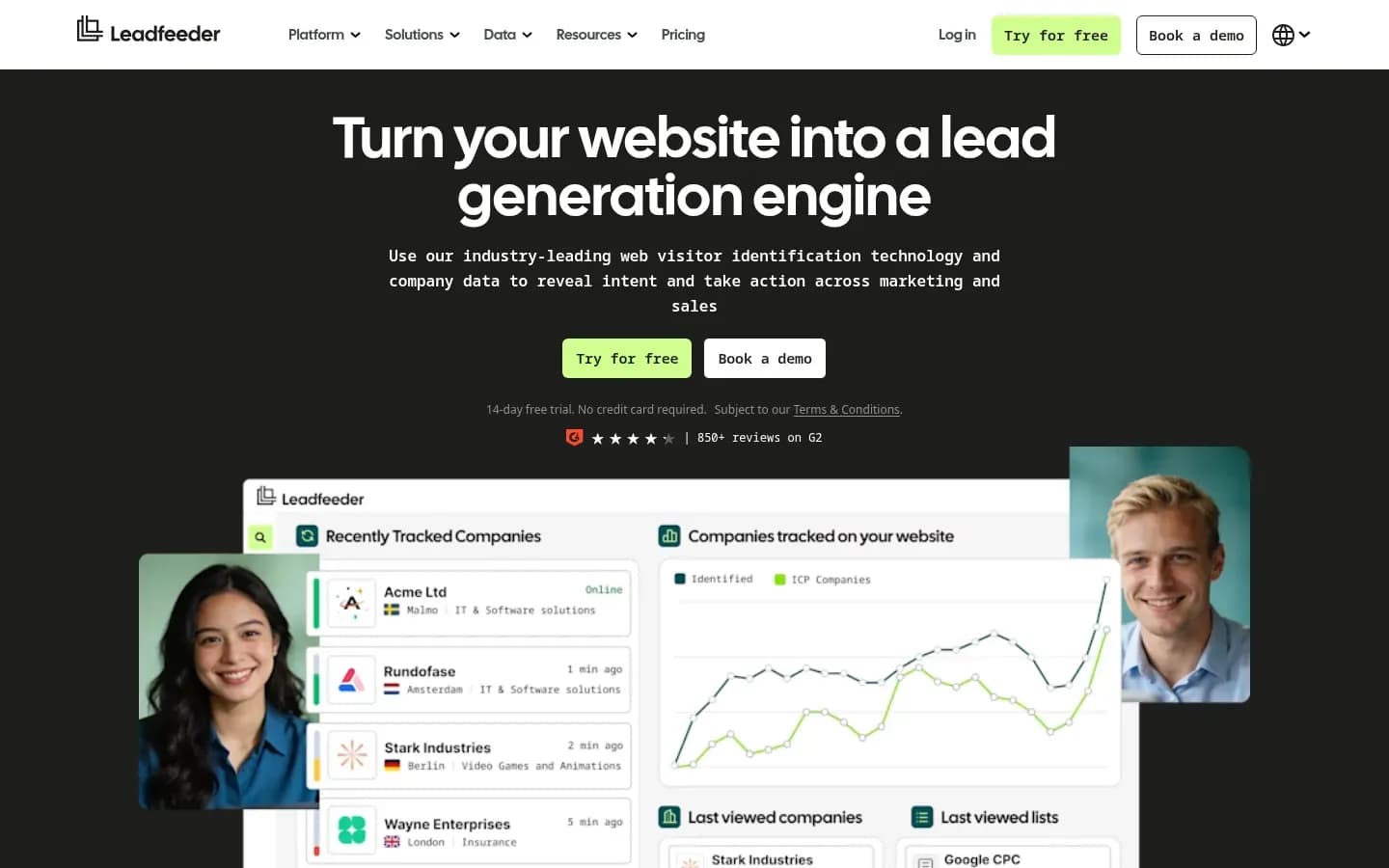
Leadfeeder (formerly Dealfront) is the strongest pick here for European B2B traffic: it matches visitor IP addresses to companies, hosts its data on AWS in Ireland, and syncs identified companies to Salesforce, HubSpot, Pipedrive, Zoho or Microsoft Dynamics.
Dealfront rebranded as Leadfeeder on 24 March 2026. The company calls it a brand change, not a contract change, and no feature was removed. The product once called Leadfeeder is now Web Visitors, Promote is now Campaigns, and the Dealfront API is now the Leadfeeder API.
How Leadfeeder identifies visitors
Web Visitors identifies the B2B companies visiting your site, not the individual people. It matches each visit's IP address against a continuously updated IP-to-company database. Named contacts live in Leadfeeder's separate sales intelligence product.
Leadfeeder says it identifies up to 45% of the companies that visit a website. That is the vendor's own figure, not an independent measurement.
Leadfeeder features
- Web Visitors: which companies visited, and what they viewed
- Companies: define your ideal customer profile and build audiences
- Lists: enrichment and CRM sync
- Campaigns: B2B display ads aimed at specific companies
- Buying-intent segments: groups of accounts showing purchase signals
Leadfeeder pricing
Leadfeeder pricing
| Plan | Price | Billing | Notes |
|---|---|---|---|
| Lite | €0 | per month | |
| Discover | €79 | per month, billed annually | |
| Activate | €369 | per month, billed annually | |
| Scale | €599 | per month, billed annually | |
| Enterprise | Custom pricing |
Who Leadfeeder fits
Leadfeeder fits teams whose traffic is mostly European. It processes personal data under legitimate interest (GDPR Article 6(1)(f)) and hosts its servers and data on Amazon Web Services in Ireland.
Best for
- EU-heavy B2B traffic that needs company accounts in the CRM
- Teams that want to retarget visiting accounts with display ads
Not for
- Reps who expect a named person behind every visit
Leadfeeder limitations
Web Visitors stops at the company. A rep still needs a contact source, either Leadfeeder's own sales intelligence product or another tool, before outreach can start. The rebrand also means older reviews, tutorials and help articles use the Dealfront name, so research on the product spans two brands.
Leadfeeder integrations
Leadfeeder syncs with Salesforce, HubSpot, Pipedrive, Zoho and Microsoft Dynamics. It also connects to Slack for alerts, Google Ads and GA4 for campaigns and analytics, and Zapier for everything else.
RB2B
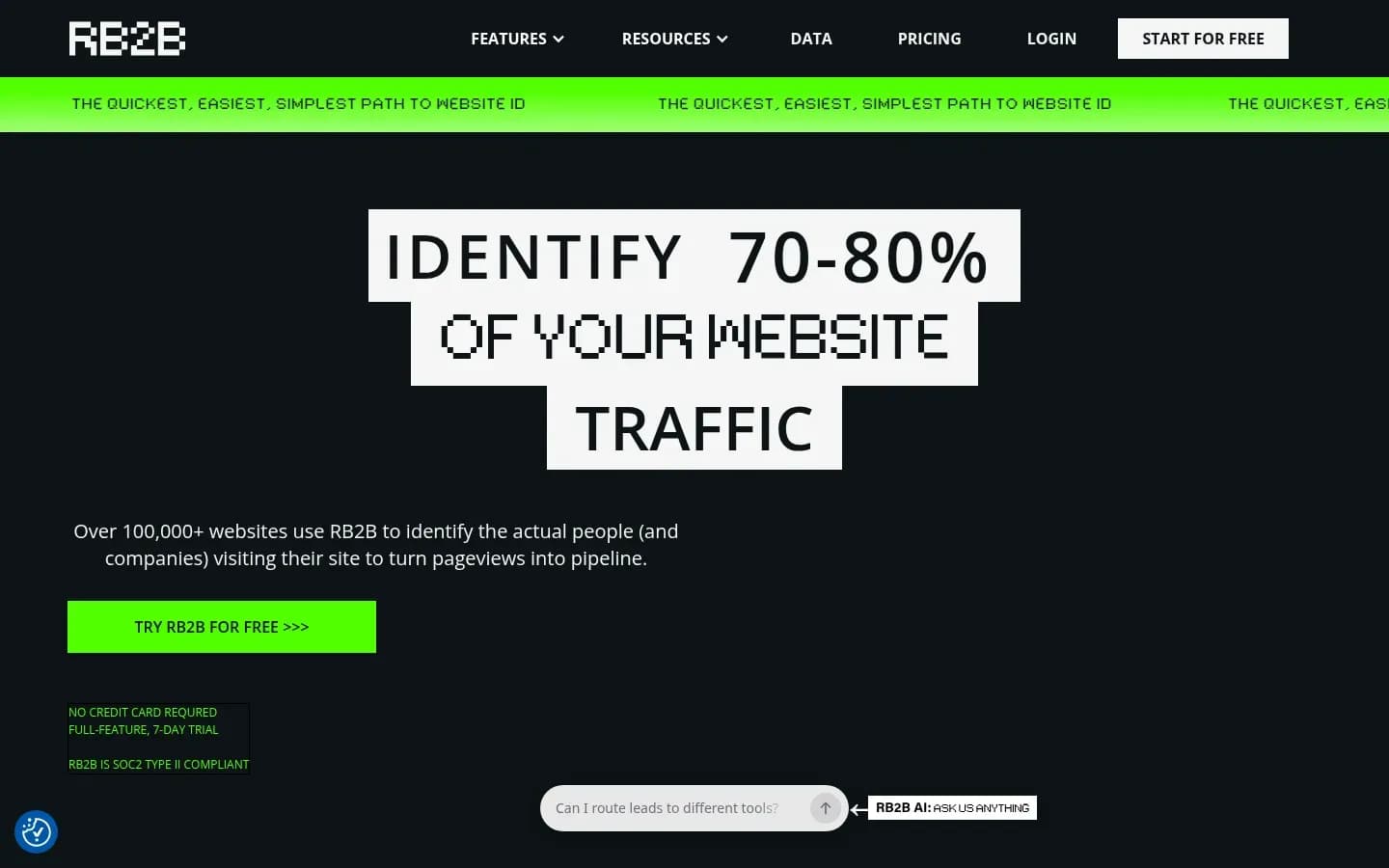
RB2B identifies individual people only on US website traffic, using a US-only database, and identifies companies globally through its partnership with Demandbase, then pushes each match to Slack, Microsoft Teams, a CRM or Clay.
RB2B resolves US visitors to named people. It suits sales teams that work named prospects rather than accounts.
How RB2B identifies visitors
RB2B resolves US visitors to people using first- and third-party cookies, device IDs and IP addresses, plus Demandbase's proprietary reverse-IP network. Outside the US, it identifies companies only.
RB2B claims it identifies 70-80% of website traffic when person-level and company-level identification are combined. It also says customers typically see 30-40% of US visitors identified at person level. Both are RB2B's own figures.
RB2B features
- Pushes identified visitors to Slack, Microsoft Teams, CRMs and Clay
- Filters matches by company revenue, company size, seniority, department, category and geography
- Global company-level identification through Demandbase
RB2B pricing
RB2B pricing
| Plan | Price | Billing | Notes |
|---|---|---|---|
| Free | $0 | per month | |
| Starter | $79 | per month | |
| Pro | $149 | per month | |
| Pro+ | $199 | per month |
RB2B meters its plans in monthly resolutions, meaning identified visitors per month. Spend therefore scales with how many visitors it resolves, so a traffic spike or a new campaign raises the bill.
Who RB2B fits
Best for
- US-focused teams whose reps want named people in Slack
- Teams that enrich and route leads through Clay
Not for
- Teams whose buyers are mostly in Europe or the UK
RB2B limitations
RB2B's person-level product resolves US traffic only, and its database is built to exclude personal data of EU and UK residents. Teams that deploy its global company-level identification must use a consent management solution. For a European audience, RB2B is a company-level tool.
RB2B integrations
RB2B connects to more than 50 apps, including Slack, Microsoft Teams, Clay and the main CRMs.
Warmly
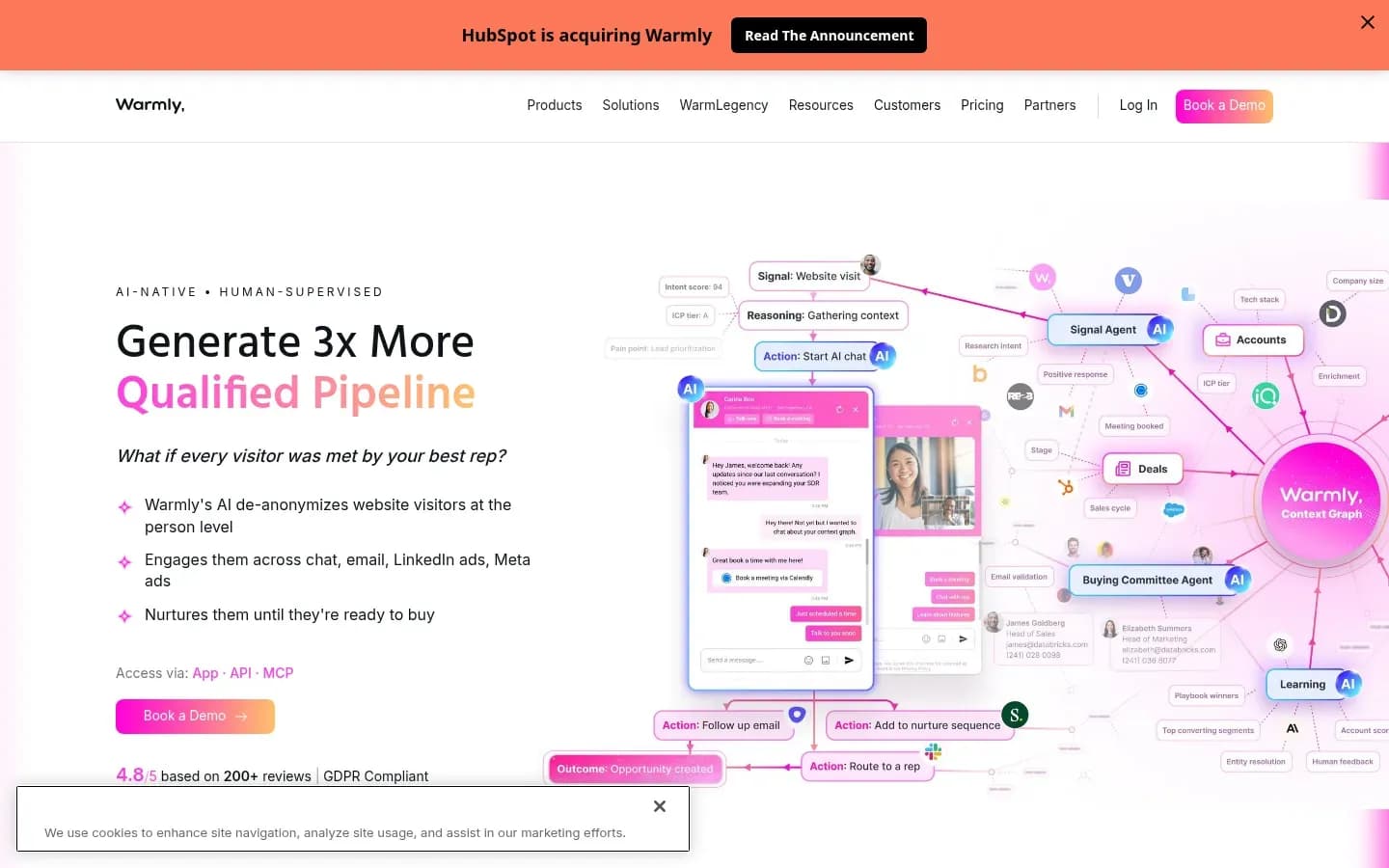
Warmly identifies website visitors at person and company level and acts on them with AI agents for chat, routing and outbound, and HubSpot acquired Warmly in 2026, with existing contracts and product experience staying unchanged.
The acquisition was reported on 1 July 2026. Warmly said existing customer contracts, pricing and product experience stay unchanged, with deeper HubSpot integration planned over time.
How Warmly identifies visitors
Warmly de-anonymizes visitors at the person level and adds account intelligence on the companies behind them. Opensend, a competing vendor, reports Warmly's self-reported figures as about 65% company-level and about 15% person-level identification on predominantly US B2B traffic.
Warmly features
Warmly is a platform of AI sales agents built on top of identification:
- Inbound Agent and TAM Agent to act on visitors and target accounts
- AI chatbot and live human chat on your site
- Intent signals: first-party web, second-party social and third-party research intent
- Outbound orchestration across email, LinkedIn, ads and an AI call agent
Warmly pricing
Warmly AI Web-Deanonymization pricing
| Plan | Price | Billing | Notes |
|---|---|---|---|
| AI Web-Deanonymization |
|
|
Warmly Inbound Chat pricing
| Plan | Price | Billing | Notes |
|---|---|---|---|
| Inbound Chat |
|
|
Warmly AI Inbound Autopilot pricing
| Plan | Price | Billing | Notes |
|---|---|---|---|
| AI Inbound Autopilot |
|
|
Who Warmly fits
Best for
- Teams that want identification to trigger chat, routing and outreach
- HubSpot users who want visitor intent inside their CRM
Not for
- Teams that only need a feed of identified companies
Warmly limitations
Warmly is a platform commitment, not a data feed. Opensend's review describes its paid plans as a meaningful budget for smaller teams and notes limited CRM support beyond HubSpot and Salesforce. The same review flags uncertainty about Warmly's standalone direction now that HubSpot owns it.
Warmly integrations
Warmly connects to more than 40 apps and has an integration with RB2B.
Snitcher
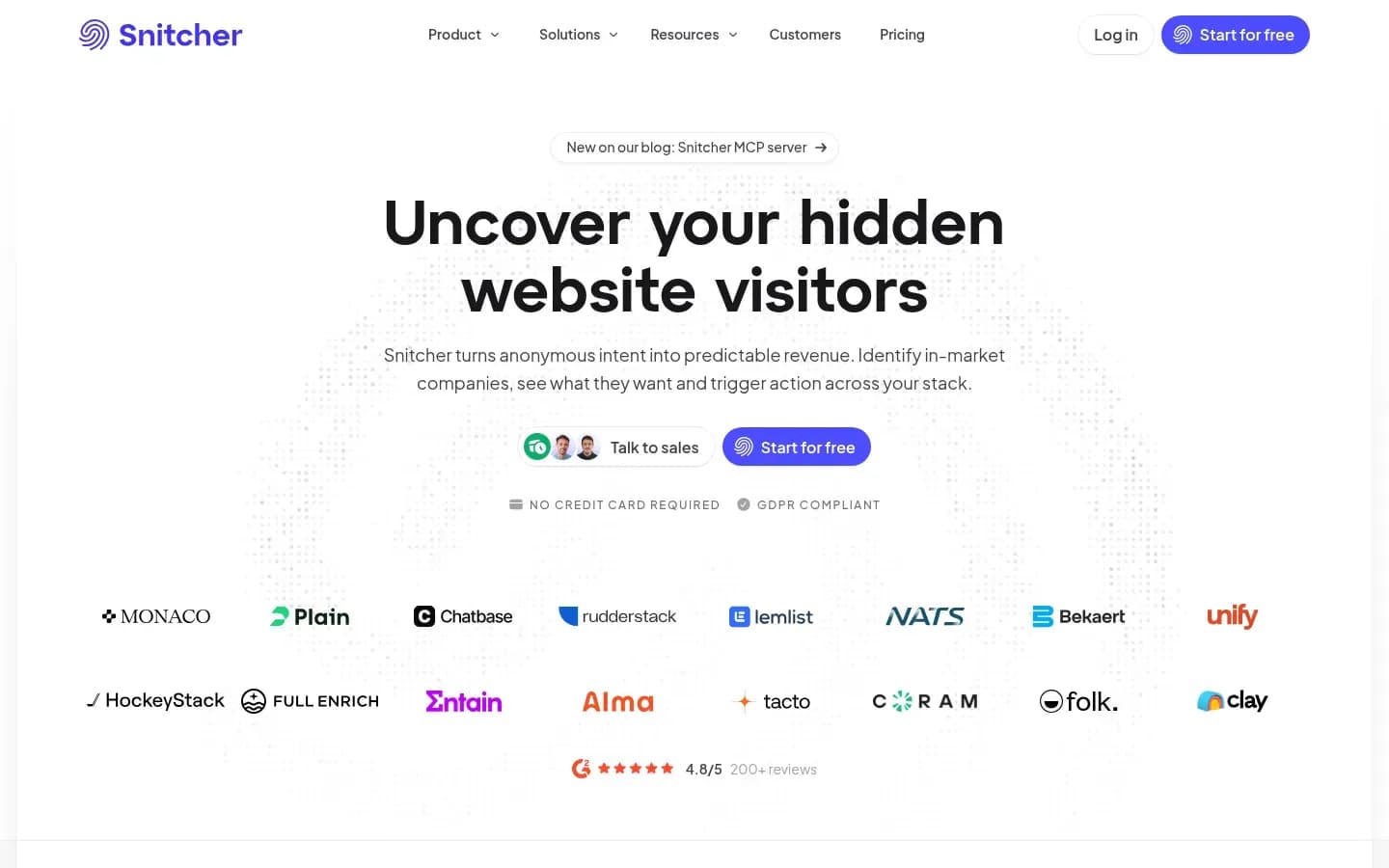
Snitcher identifies companies from visitor IP addresses and names individual people only from first-party signals, such as a form submission, a login that calls its identify function or a click on a tracked email link, without third-party cookies or data.
That makes Snitcher the option for person data with a clear first-party basis.
How Snitcher identifies visitors
Snitcher's Identity Layer connects an anonymous visitor to a known user through three first-party interactions:
- emails captured automatically from submitted forms
Snitcher.identify()calls after login, signup or single sign-on- tracked email links
Once a user is identified, the identity persists across sessions and devices. Every other visitor is matched at company level from IP intelligence.
Snitcher features
- Company identification from IP intelligence
- An IP-to-company API that resolves any IP to a company
- Live intent tracking across the site and campaigns
- Lead routing and Slack alerts
- A CRM feed of contacts and intent
Snitcher pricing
Snitcher Platform pricing
| Plan | Price | Billing | Notes |
|---|---|---|---|
| Platform 0-50 company IDs |
|
| |
| Platform 51-100 company IDs |
|
| |
| Platform 101-250 company IDs |
|
| |
| Platform 251-500 company IDs |
|
| |
| Platform 501-750 company IDs |
|
| |
| Platform 751-1,000 company IDs |
|
| |
| Platform 1,001-2,000 company IDs |
|
| |
| Platform 2,001-3,000 company IDs |
|
| |
| Platform 3,001-4,000 company IDs |
|
| |
| Platform 4,001-5,000 company IDs |
|
| |
| Platform Custom | Custom pricing |
Who Snitcher fits
Best for
- Products with logins, gated content or email traffic
- Developers who want an IP-to-company API
Not for
- Teams that want names for visitors who never identify themselves
Snitcher limitations
Visitors who never fill a form, log in or click a tracked link stay at company level. On a marketing site with little gated content, Snitcher works much like a company-level tool.
Snitcher integrations
Snitcher integrates with Google Analytics, HubSpot, Salesforce, Slack, Zapier, Apollo, Pipedrive, Attio, Close, Google Ads, Lemlist, Microsoft Dynamics, Microsoft Teams and Smartlead.
Leadinfo
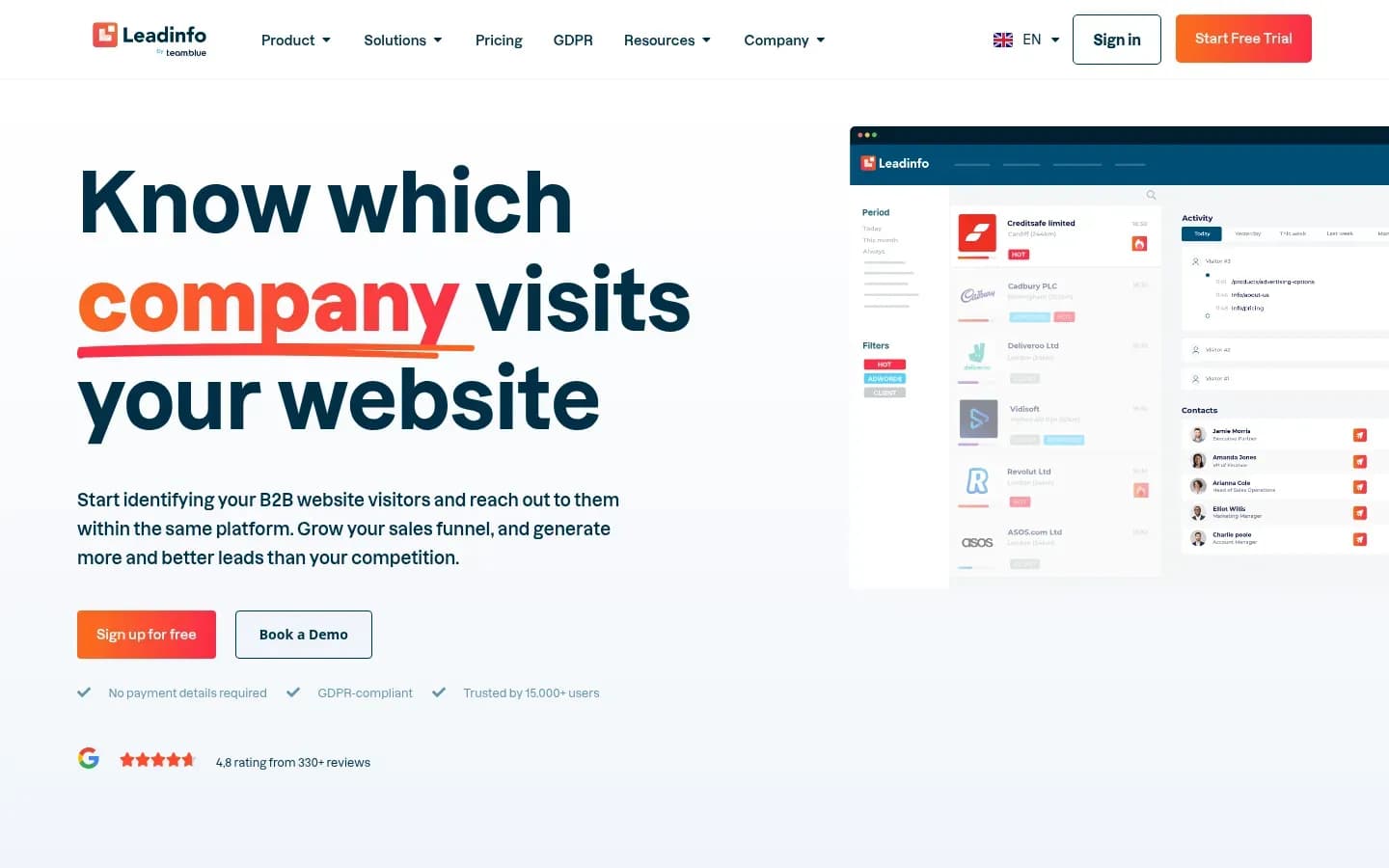
Leadinfo is a company-level visitor identification tool built for European B2B teams, and Leadinfo acquired Visitor Queue in January 2026 to extend its reach into North America.
Leadinfo is a team.blue brand based in the Netherlands. Visitor Queue, the company it bought on 20 January 2026, is based in Canada.
How Leadinfo identifies visitors
Leadinfo identifies which company visits a website by matching the visitor's IP address against its database. It claims worldwide coverage of 214 countries.
Leadinfo features
- An email-style inbox of visiting companies
- Triggers that act on specific visitors
- Automatic lead scoring by time on site
- Screen recording
- Colour-coded tags and team comments
- LinkedIn export and a Google Ads integration
Leadinfo pricing
Leadinfo pricing
| Plan | Price | Billing | Notes |
|---|---|---|---|
| Starter |
|
| |
| Scale |
|
| |
| Pro |
|
|
Who Leadinfo fits
Leadinfo has more than 9,000 clients in Europe and operates in the Netherlands, Germany, Belgium, the UK and Denmark. It fits European SMB sales teams that want a simple inbox and triggers rather than a full platform.
Best for
- European SMB sales teams wanting a simple visitor inbox
- Teams that want triggers on specific visiting companies
Not for
- Teams that need named people behind each visit
Leadinfo limitations
Leadinfo stops at the company, so finding the right contact is a separate step. Leadinfo relies on legitimate interest as the legal basis for processing, but EU site owners still need to check the consent rules for the tracking script itself, covered in the GDPR section below.
Leadinfo integrations
Leadinfo integrates with more than 70 CRM and marketing automation systems.
Company-level vs person-level visitor identification: which do you need?
Company-level identification tells you which organisation visited, while person-level identification names the individual, and the two differ by geography: RB2B resolves people only on US traffic, so European teams usually pair company-level tools such as Leadfeeder or Leadinfo with a separate contact source.
Company-level data tells you which account is researching. Leadfeeder, Leadinfo and Snitcher all provide it from IP matching. Person-level data tells you who, and it arrives in one of two ways:
- Third-party resolution on US traffic, as RB2B offers
- First-party identification of visitors who identified themselves, as Snitcher offers
Warmly describes its own product as de-anonymizing visitors at the person level, with account intelligence on the companies behind them.
Identity methods side by side
| Method | What you get | Where it works | Tools |
|---|---|---|---|
| IP-to-company | The visiting organisation | Global | Leadfeeder, Leadinfo, Snitcher |
| Third-party person resolution | A named visitor | US traffic | RB2B |
| First-party identification | A visitor who identified themselves | Any site with forms or logins | Snitcher |
Use this decision rule:
- Buyers and traffic mostly in Europe: plan on company-level identification plus a contact source. RB2B excludes EU and UK personal data from its database, so person-level resolution is not an option there. Pair the company match with email-finding tools to reach the right person.
- Most traffic in the US, reps working named prospects: person-level resolution adds value, because reps get a name instead of an account to research.
- Logins, gated content or email traffic: first-party identification gives you people without third-party data, wherever your visitors are.
Many teams combine levels. A European SaaS company with a product login could use company-level matches for anonymous traffic and first-party identification for signed-in users.
How accurate is website visitor identification?
Visitor identification match rates are vendor-reported and measured differently, so they cannot be compared directly: RB2B reports identifying 70-80% of traffic when person- and company-level matching are combined, while Leadfeeder reports identifying up to 45% of the companies visiting a site.
Published match-rate claims, by owner
| Vendor | Claim | What it measures |
|---|---|---|
| Leadfeeder | Up to 45% | Companies visiting a site |
| RB2B | 70-80% combined | Traffic, person and company matches together |
| RB2B | 30-40% person-level | US visitors named as people |
| Warmly | About 65% company, 15% person | Mostly US B2B traffic (self-reported, via Opensend) |
The figures measure different things:
- Different units. Leadfeeder counts companies; RB2B counts traffic; Warmly splits company and person matches.
- Different traffic. RB2B's person rate and Warmly's figures come from mostly US traffic; Leadfeeder's applies to whatever companies visit.
- Different conditions. Visitors on home networks or mobile connections do not carry a company IP address, so the share of remote workers in your audience changes every tool's result.
A higher match rate is only useful if the matches are accounts you would sell to. Use this rule during evaluation: run two tools side by side on the same traffic for the same period, then count the identified accounts that fit your ideal customer profile. That number, not the raw match rate, shows which tool earns its place.
Is website visitor identification GDPR compliant?
Website visitor identification can be used lawfully in the EU, but the European Data Protection Board's guidelines on Article 5(3) of the ePrivacy Directive treat tracking pixels and scripts that access a visitor's device as needing consent, whatever legal basis the vendor uses for processing the data afterwards.
The EDPB's Guidelines 2/2023 (version 2.0 adopted on 7 October 2024) place tracking pixels, tracking links and JavaScript that accesses information on the user's device within Article 5(3). That article requires consent unless an exemption applies. A vendor's "GDPR compliant" label does not remove this duty from the site owner.
The vendors take these positions:
- Leadfeeder processes personal data under legitimate interest (GDPR Article 6(1)(f)) and hosts its data on AWS in Ireland.
- Leadinfo relies on legitimate interest and says it is the only legal justification its customers need. That is the vendor's position, not regulator guidance.
- RB2B says its database is designed to exclude personal data of EU and UK residents, and requires a consent management solution for its global company-level identification.
- Snitcher identifies people only through first-party interactions and uses no third-party cookies or data.
In practice, an EU site owner should load the identification script through a consent management platform and record the legal basis for the processing that follows. US teams using person-level tools should review state privacy laws, such as California's CCPA, with their privacy counsel.
Which visitor identification tool should I choose?
Choose a visitor identification tool by where your traffic comes from and what your team does next: Leadfeeder for European company-level data in the CRM, RB2B for named US visitors in Slack, Warmly for AI-led follow-up, Snitcher for first-party person data and Leadinfo for a simple European SMB inbox.
Match your situation to a pick:
- Mostly EU traffic, need company accounts in the CRM: Leadfeeder. It identifies companies, not people, hosts data in Ireland and syncs to the main CRMs.
- Mostly US traffic, reps want named people in Slack: RB2B. Its person-level resolution covers US traffic and pushes each match to Slack, Teams, a CRM or Clay.
- Identification should start chat, routing and outreach automatically, and you run HubSpot: Warmly. Its agents act on visitors, and HubSpot now owns it.
- Logins, gated content or email traffic, or you need an IP-to-company API: Snitcher. It names people only from first-party signals.
- European SMB team that wants a simple inbox and triggers: Leadinfo. Its inbox and triggers are built for European sales teams.
Before you sign, run this evaluation:
- Install two shortlisted tools on the same traffic for the same period
- Count identified accounts that fit your ICP, not total matches
- Confirm your consent setup loads the script lawfully for EU visitors
- Check that matches sync to the right CRM objects and owners
- Check who owns the vendor now and what that means for its roadmap
What to do after identifying website visitors
Identified visitors turn into pipeline only with relevant, low-pressure follow-up, because 67% of B2B buyers prefer a rep-free experience according to a Gartner survey of 646 buyers.
Gartner ran the survey in August and September 2025. In the same survey, 45% of respondents said they used AI during a recent purchase. Buyers research on their own before they talk to sales, so cold-calling every match works against how they buy.
A follow-up rule that respects that:
- Filter to ICP accounts. Drop students, competitors and companies you would never sell to. RB2B filters matches by company revenue, company size, seniority, department, category and geography; Leadfeeder's Companies feature defines your ideal customer profile and builds audiences from it.
- Route by intent. Pricing and comparison pages signal more than a single blog visit. Snitcher tracks live intent across the site and campaigns and routes leads; Leadinfo scores leads automatically by time on site and runs triggers on specific visiting companies.
- Alert the owning rep. Send each match to the rep who owns the account, not to a shared channel. RB2B pushes matches to Slack, Microsoft Teams, a CRM or Clay, and Leadfeeder and Snitcher send Slack alerts.
- Add contacts. Company-level matches need a contact source before outreach. Leadfeeder keeps named contacts in its separate sales intelligence product; with Leadinfo, finding the person is a separate step.
- Warm up accounts that are not ready. An account that read one blog post is not ready for a sales call. Leadfeeder Campaigns runs B2B display ads aimed at specific companies, Leadinfo integrates with Google Ads, and Warmly orchestrates outreach across email, LinkedIn, ads and an AI call agent.
Who gets the alert depends on the identity level. A person-level match from RB2B or Warmly can go straight to the rep who owns that account. A company-level match from Leadfeeder or Leadinfo goes first to whoever finds the right contact, then to the rep.
Low-pressure follow-up means one relevant message about the problem the account was researching, with something useful attached, such as a comparison or a short answer to the question its pages suggest. If the account keeps returning to pricing pages, offering a call becomes reasonable.
Frequently asked questions
How is visitor identification different from Google Analytics?
Google Analytics shows how many anonymous sessions reached your site and from where, while visitor identification tools such as Leadfeeder and Snitcher match those visits to named companies and, in some cases, to people. Analytics measures traffic; visitor identification tells sales which accounts to act on, so the two work side by side.
What is the difference between visitor identification and intent data?
Visitor identification uses first-party activity: who visits your own site and what they view. Intent data also covers research that happens elsewhere. Warmly, for example, combines first-party web intent with second-party social and third-party research intent signals, so it can flag accounts researching a topic before they ever reach your site.
Can visitor identification tools identify visitors outside the US?
Yes, at company level. RB2B identifies companies globally through Demandbase, and Leadinfo claims coverage of 214 countries. Person-level identification is narrower: RB2B resolves people on US traffic only. First-party identification, such as Snitcher's form and login capture, names people anywhere because the visitor supplies their own identity.
Is visitor identification worth it for a small team or a low-traffic site?
It depends on how much B2B traffic you get. If few companies visit, there is little to identify and little to act on. Start with a company-level tool, using a free plan or trial where the comparison table shows one, and judge it by the ICP accounts it surfaces each week.
Sources
Sources
- HubSpot acquires AI sales intelligence startup Warmly to embed website visitor intent detection and prospect outreach agents into its CRM · shopifreaks.com
- team.blue brand Leadinfo acquires Visitor Queue to boost global visitor intelligence · tools.prnewswire.com
- Guidelines 2/2023 on Technical Scope of Art. 5(3) of ePrivacy Directive · edpb.europa.eu
- Gartner Sales Survey Finds 67% of B2B Buyers Prefer a Rep-Free Experience · gartner.com