When a buyer asks an AI assistant which software to shortlist, the answer can name your product, a competitor or neither. Below, five AI visibility tools are compared for B2B SaaS teams on the three things that matter for this job: buyer-intent prompt tracking, product-category competitor sets and conversion context.
These picks apply to B2B SaaS teams tracking how AI assistants describe and recommend them against product-category competitors on buyer-intent prompts. Scores from different tools measure different things and vary from run to run, so compare tools on your own prompt set and judge trends, not snapshots.
Best AI Visibility Tools for B2B SaaS
The best AI visibility tools for B2B SaaS are Profound, Peec AI, Promptwatch, Scrunch and Conductor, and they split on one question: whether you only sample buyer prompts or also tie AI crawler and referral data to conversions.
AI visibility tools for B2B SaaS compared
| Tool | Best for | Engines named | Data beyond prompt scores | Content action |
|---|---|---|---|---|
| Profound | Enterprise demand and conversions | Seven, incl. AI Overviews | Server-log AI visits and conversions | Drafts pages for approval |
| Peec AI | Daily tagged prompt tracking | Up to 11 (Enterprise) | Used versus cited sources | Recommends G2, Reddit, PR work |
| Promptwatch | Lean SaaS content teams | Six, incl. AI Overviews | Crawler logs, citations, clicks | Publishes to WordPress, Webflow, Framer |
| Scrunch | Persona-segmented tracking | Five, incl. AI Overviews | Real-time AI bot crawl feed | Agent-ready pages (AXP) |
| Conductor | Enterprise SEO suite users | Four, plus search rankings | GA4 and Adobe conversions | Content and Technical Agents |
The picks differ because each tool measures a different slice of the problem. Peec AI and Scrunch centre on prompt sampling: they run your prompts through AI assistants and report presence, position, sentiment and sources. Peec AI splits the sources that informed an answer from those it named, and Scrunch adds a real-time feed of how AI bots crawl your site. Profound, Promptwatch and Conductor also read what happens after the answer. Profound reads server logs to show which AI bots access your content and how many AI-referred visitors convert. Promptwatch combines crawler logs, citations and human clicks per topic. Conductor joins AI traffic to GA4 or Adobe engagement and conversion data.
For a B2B SaaS team, that split decides the shortlist. If your board asks whether AI answers create pipeline, a pure prompt tracker shows presence in AI answers but none of the three pipeline layers described below. If your problem is that a competitor shows up in AI answers and you do not, prompt sampling with good source data may be all you need.
How We Chose These AI Visibility Tools
To make this list, an AI visibility tool had to track brand presence across at least four major answer engines, show which sources those engines cite, and let a B2B SaaS team define its own buyer-intent prompts and competitor set. It also had to offer a way to connect AI visibility to site traffic or to content work.
AI search visibility is measured in different ways: some tools count mentions, some count citations, and some read crawler and referral data. The five tools are ranked by fit for B2B SaaS buyer-intent tracking and conversion context, not by the size of their engine list.
The method has one limit worth stating plainly: scores from different tools are not comparable. Some tools count a brand name in prose the same as a linked source, and prompts drawn from real sales questions give more useful, usually lower, scores than default prompts generated from keywords. Compare tools on the same prompt set, never on their headline scores.
Several tools that appear often in other rankings were considered and left out of this B2B SaaS list.
Considered, not included
| Tool | Why it is not on this list |
|---|---|
| Otterly.ai | Standalone monitoring aimed at lean teams, without the conversion context this list requires |
| AthenaHQ | Revenue attribution built around Shopify, a better fit for e-commerce |
| Semrush AI toolkit | An add-on toolkit within an SEO platform, not a standalone AI visibility product |
| Ahrefs Brand Radar | AI visibility bundled into an SEO platform rather than a dedicated tool |
If you want engine coverage and running cost compared for every kind of team, see the roundup of general-purpose AI visibility platforms.
Profound
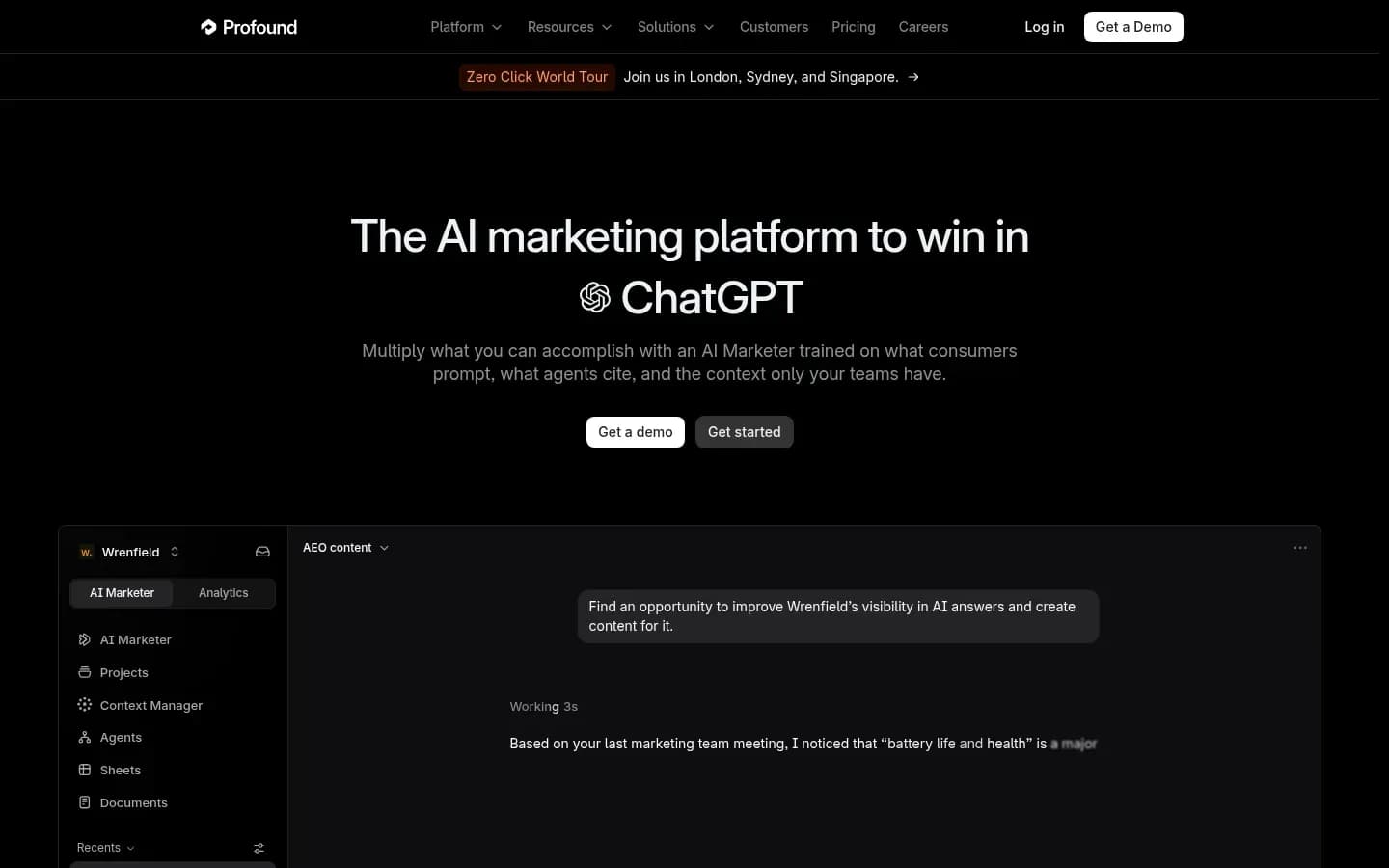
Profound suits B2B SaaS teams that need two answers in one place, which buyer prompts carry real demand and which AI-referred visits convert, and it is backed by a $96 million Series C at a $1 billion valuation in February 2026.
Profound
AI marketing platform that shows marketing and AEO teams what customers ask AI tools and how their brand appears in the answers.
Profound is an AI marketing platform that shows marketing and AEO teams what customers ask AI tools and how their brand appears in the answers. It tracks ChatGPT, Perplexity, Claude, Gemini, Microsoft Copilot, DeepSeek and Google AI Overviews, with citation analytics and a visibility score by platform.
- Free plan
- No
- Compliance
- SOC 2
- Ratings
- G2 4.5/5 (1,137 reviews)
Verdict: the pick when a SaaS team wants to know which buyer prompts carry demand and which AI visits convert, and has people to act on what it finds.
What it does for B2B SaaS: Profound runs your prompts across seven AI engines, scores visibility per platform and shows which sources each engine cites. For a SaaS team, that means seeing which review sites, comparison pages and docs feed the answers buyers read.
Standout features:
- Prompt Volumes: conversation data licensed from double-opt-in consumer panels across ChatGPT, Gemini, Claude and Perplexity, classified by intent (informational, commercial, conversational, generative), refreshed weekly and covering ten countries, including the US and UK. These are modelled estimates from panels, not counts of every conversation.
- Competitor gaps: Prompt Volumes lists prompts where a competitor is cited and your brand is not.
- AI Marketer: identifies content work, drafts it and asks for approval. It can rewrite pages with declining citations, stage them in a CMS and build pages for questions nobody answers yet.
Pricing: Profound's plans are shown below. For a SaaS setup, scope the number of prompts and engines, whether the team will use Agent Analytics and AI Marketer, and how many seats need role-based access.
Profound pricing
| Plan | Price | Billing | Notes |
|---|---|---|---|
| Agency Enterprise (agency tab) | Custom pricing | ||
| Agency Growth (agency tab) | Custom pricing | ||
| Enterprise | Custom pricing | ||
| Trial | Custom pricing |
Best fit: enterprise and scaling SaaS marketing teams with a content or SEO lead who can act on findings each week. Profound reported more than 700 enterprise customers, naming Ramp, MongoDB and Figma among them.
Limitations: DataDab's packaging comparison calls Profound a poor first buy if nobody can approve and publish what an agent produces. Prompt Volumes figures are modelled from panels, so treat them as a guide to relative demand, not exact search counts.
Integrations: Agent Analytics uses server logs rather than JavaScript trackers, with connectors for AWS, Akamai, Cloudflare, Fastly, Google Cloud Platform, Netlify, Vercel, WordPress, Shopify and Adobe. It reports which AI bots access your content and how many human visitors arrive from AI search and convert. Governance covers RBAC and SCIM.
Why it's on the list: Profound pairs modelled prompt demand data with log-based conversion data in one product, which covers both the prompt-set question and the pipeline question a SaaS team faces.
Peec AI
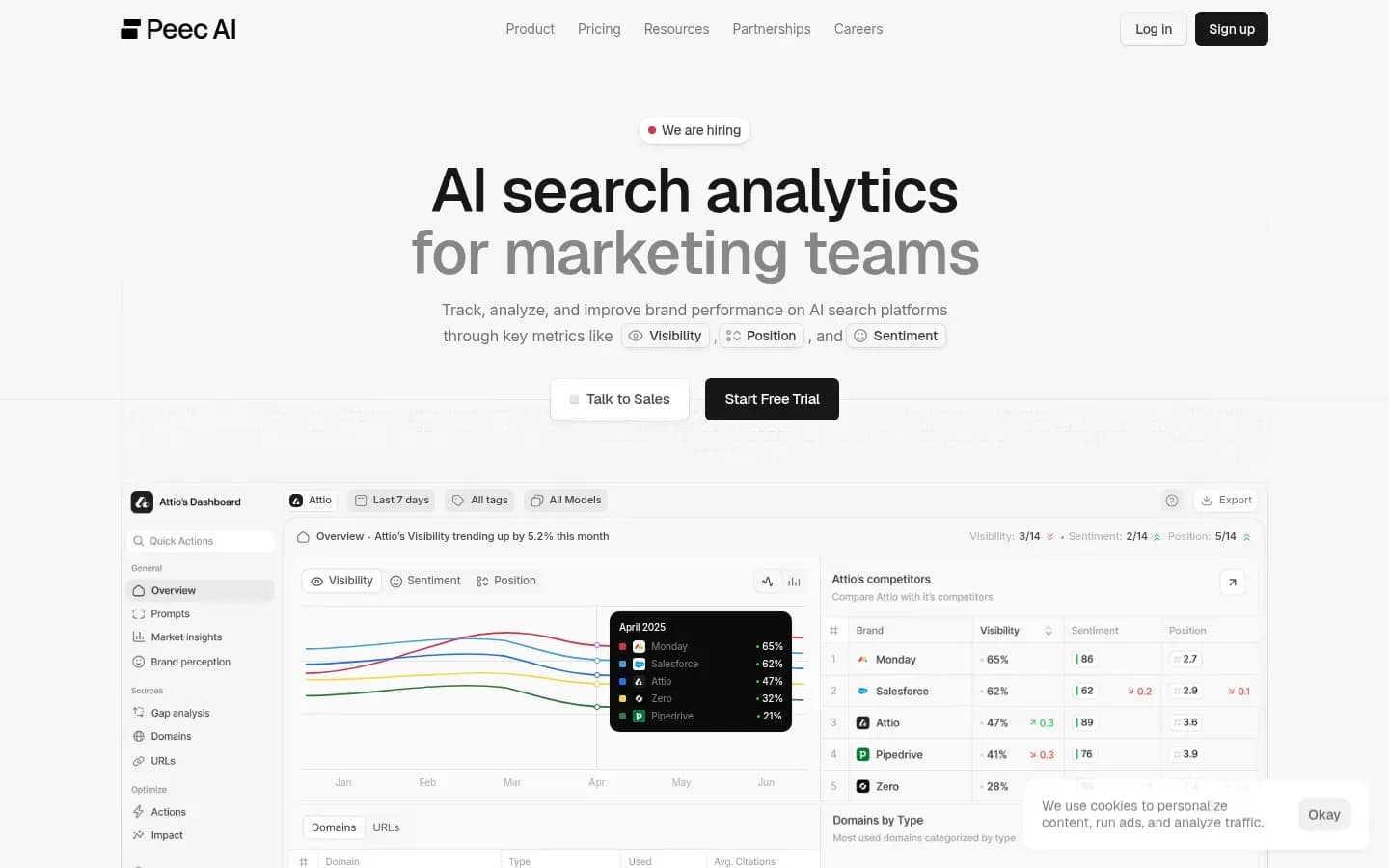
Peec AI runs every tracked prompt once every 24 hours on each AI model a team selects, which makes it a practical daily tracker for a B2B SaaS buyer-intent prompt set tagged by use case, competitor and country.
Peec AI
AI search analytics platform for marketing teams and agencies that tracks brand visibility, position and sentiment in AI search tools.
Peec AI is an AI search analytics platform for marketing teams and agencies that tracks brand visibility, position and sentiment in AI search tools. Prompts run daily across platforms such as ChatGPT, Gemini and Copilot, and can be tagged and filtered by model, country and tag.
- Free plan
- No
- Free trial
- Yes
- Platforms
- API
- Public API
- Yes
- Ratings
- G2 4.7/5 (21 reviews)
Verdict: the pick for daily tracking of a tagged buyer-intent prompt set: Peec AI runs each tagged prompt daily on every selected model and defines visibility, position and sentiment in its docs.
What it does for B2B SaaS: Peec AI's docs define visibility as how often the brand is mentioned across AI responses, position as where it ranks when it appears, and sentiment as positive, neutral or negative. Prompts can be tagged by buyer moment or competitor and filtered by model and country, with AI-suggested prompts and search volumes to fill gaps in the set.
Standout features:
- Used versus cited sources: Peec AI separates sources whose content informed the answer from sources whose URL is named, at domain or URL level. That shows a SaaS team whether a review site is shaping answers even when it is not linked.
- Visibility-sentiment quadrant: maps your brand and competitors on visibility against sentiment, so a team sees whether it is visible and well described or visible and criticised.
- Recommendations: suggested actions include earning G2 reviews, joining relevant subreddit discussions and digital PR, all work a SaaS marketing team can own.
Pricing: Peec AI's plans are shown below. Because each prompt runs daily on every selected model, the prompt count multiplied by the model count drives what a realistic setup costs.
Peec AI pricing
| Plan | Price | Billing | Notes |
|---|---|---|---|
| Starter |
|
| |
| Pro |
|
| |
| Advanced |
|
| |
| Enterprise | Custom pricing |
Best fit: mid-market SaaS teams and multi-market programmes that map neatly to projects and countries. On the Enterprise plan each brand, market and team gets its own project with project-level access control and single sign-on. The vendor says more than 3,500 brands and agencies use it.
Limitations: DataDab rates Peec AI a weaker fit when procurement needs the selected models, projects, countries and access terms confirmed in writing before a trial. The full list of 11 models (ChatGPT, Perplexity, AI Overviews, AI Mode, Gemini, Copilot, Claude, DeepSeek, Grok, Mistral and Qwen) is stated for Enterprise, so agree which models your plan includes before you build the prompt set.
Integrations: a Looker Studio community connector, MCP connections to Claude, Cursor and n8n, and CSV export.
Why it's on the list: daily runs on every selected model give each trend line more data points, which matters because single AI answers vary so much from run to run.
Promptwatch
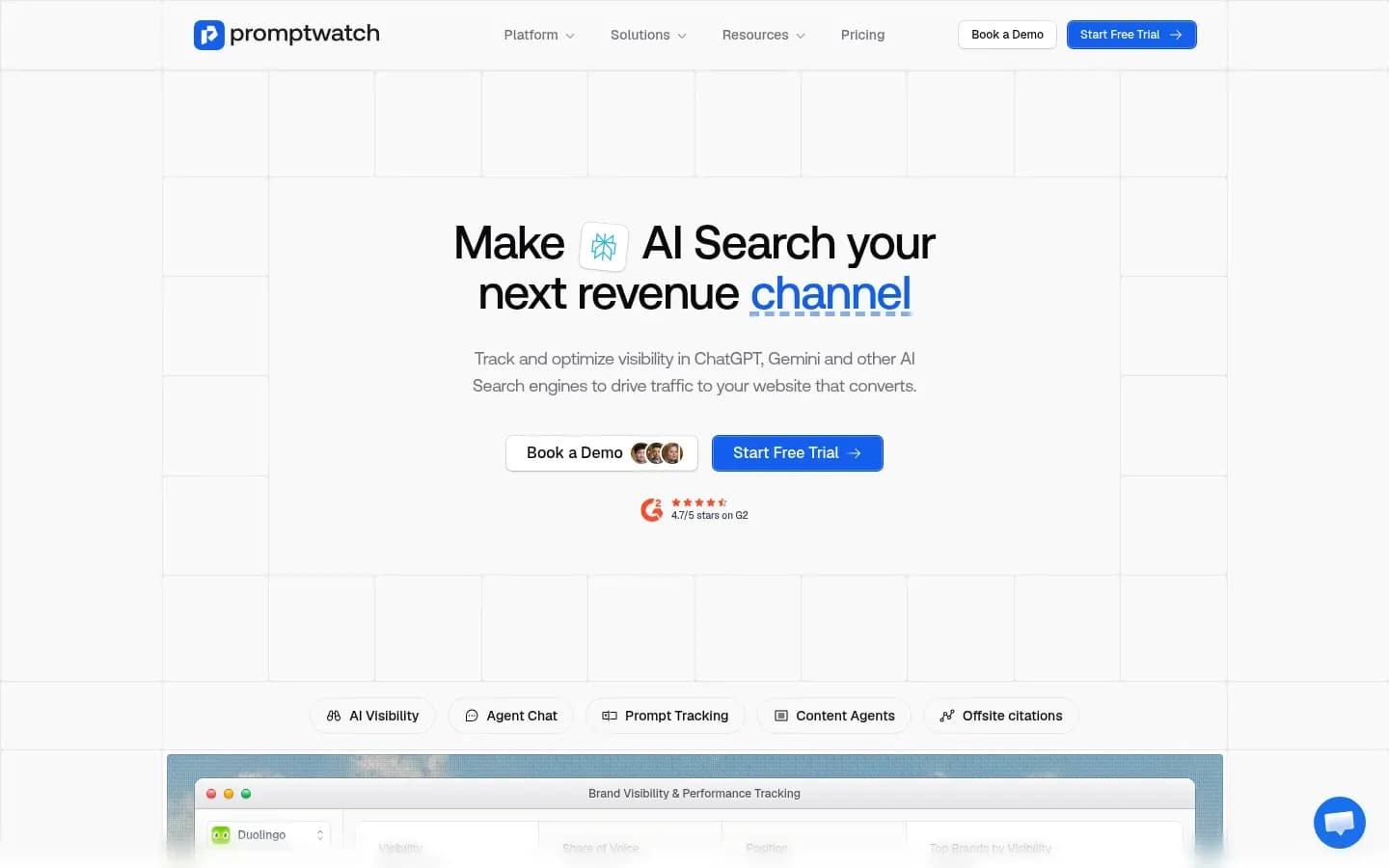
Promptwatch suits lean B2B SaaS content teams because it maps their pages against AI answers, turns citation gaps into drafted pages, and can turn existing Google Search Console queries into tracked prompts.
Promptwatch
AI search visibility platform that tracks how brands appear in AI answers and helps create content designed to be cited, for marketers, SEO teams and agencies.
Promptwatch is an AI search visibility platform that tracks how brands appear in AI answers and helps create content designed to be cited. It tracks ChatGPT, Claude, Gemini, Perplexity, Google AI Overviews and DeepSeek.
- Free trial
- 7 days
- Platforms
- Chrome extension
- Public API
- Yes
- Ratings
- G2 4.6/5 (21 reviews)
Verdict: the pick for a lean SaaS team that wants citation gaps turned into published pages, not just reported.
What it does for B2B SaaS: Promptwatch tracks your brand across six AI engines and shows which Reddit threads and YouTube videos AI models cite in your category. For a SaaS team, that points to the community threads and videos worth joining or making.
Standout features:
- Content gap analysis: maps your site's content against AI responses to show where answers rely on someone else's page.
- Content agent: turns citation gaps into new pages and refreshes, fact-checks claims and publishes to WordPress, Webflow or Framer.
- Search data as prompts: Google Search Console and Bing queries can be turned into tracked prompts, so the prompt set starts from real demand.
Pricing: Promptwatch's plans are shown below. Each project is the workspace for one brand, so the number of brands, the prompt count and whether you add crawler tracking shape what a setup costs.
Promptwatch pricing
| Plan | Price | Billing | Notes |
|---|---|---|---|
| Essential | $95 | per month | |
| Professional | $245 | per month | |
| Business | $579 | per month |
Best fit: small content and SEO teams at seed and Series A SaaS companies that publish often and want one tool to find gaps and fill them. Setup is quick to reason about: a project starts with your URL, sitemap and first prompts.
Limitations: agent-written pages need an editorial review gate before they go live, or the tool publishes faster than anyone checks. Crawler and agent traffic connect through Cloudflare, Fastly and Vercel, and crawler tracking is a separate setup step, so a site hosted elsewhere needs another route for log data.
Integrations: Cloudflare, Fastly and Vercel for crawler logs; Google Search Console and Bing for queries; WordPress, Webflow and Framer for publishing; and an MCP server that connects Claude, ChatGPT and Cursor.
Why it's on the list: Promptwatch combines crawler logs, citations and human clicks per topic and turns Search Console queries into tracked prompts, a practical bridge from the SEO data a SaaS team already has to AI tracking.
Scrunch
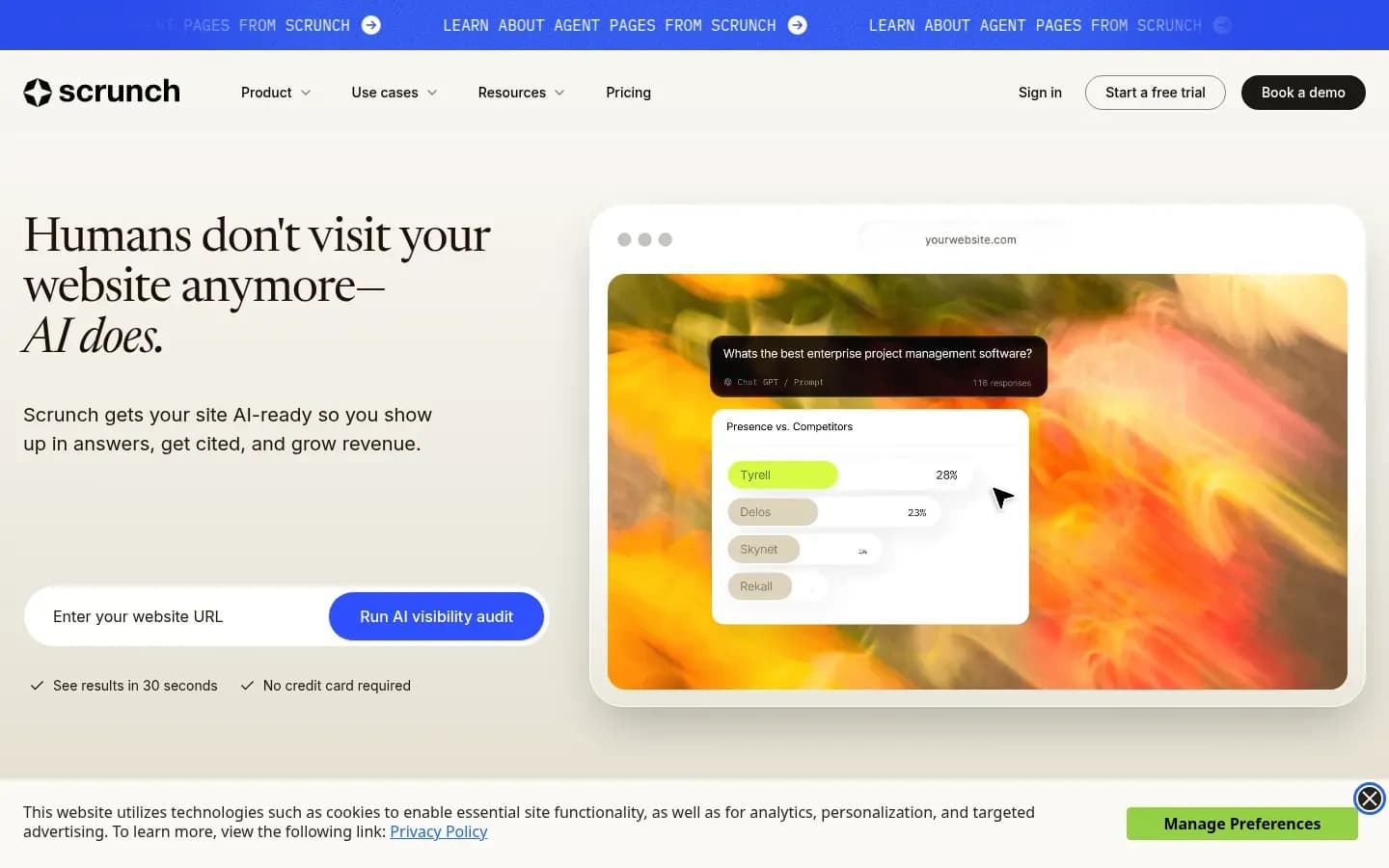
Scrunch, which Sitecore acquired in June 2026, suits B2B SaaS teams that sell to several personas, because it filters AI visibility by persona, topic, model and region and can serve AI agents a machine-readable version of the site.
Scrunch
AI search visibility platform for marketing teams and agencies that tracks how a brand appears in AI answers and serves AI-optimized pages to AI agents.
Scrunch is an AI search visibility platform for marketing teams and agencies that tracks how a brand appears in AI answers and serves AI-optimised pages to AI agents. It monitors ChatGPT, Claude, Gemini, Perplexity and Google AI Overviews, and now describes itself as a Sitecore company.
- Free trial
- 7 days, no card needed
- Compliance
- SOC 2
- Ratings
- G2 4.6/5 (74 reviews)
Verdict: the pick for persona-segmented tracking and for serving agent-ready pages, especially for teams already on Sitecore.
What it does for B2B SaaS: Scrunch lets a team filter results by topic, persona, model and region and see presence, position and sentiment per prompt. It also shows how often your own domain and third-party domains are cited, so you can see which outside sources speak for you.
Standout features:
- Agent Experience Platform (AXP): serves a parallel, lightweight, machine-readable version of the site to AI agents without changing the human-facing design. Akamai reported a 364% increase in appearances in AI answers to non-branded prompts after using AXP-enabled pages; that is a vendor-reported customer result cited in the acquisition release, not an independent study.
- Bot crawl feed: a real-time view of how AI bots crawl the site.
Pricing: Scrunch's plans are shown below. The number of brands, regions and sites in scope, and whether you need recurring site audits alongside monitoring, drive the setup cost.
Scrunch pricing
| Plan | Price | Billing | Notes |
|---|---|---|---|
| Starter |
|
| |
| Growth |
|
| |
| Enterprise | Custom pricing |
Best fit: one-brand SaaS teams with distinct buyer personas, and teams already running Sitecore. DataDab rates Scrunch a fit when one brand and a bounded geography match the plan and when recurring site-audit capacity matters alongside monitoring. Sitecore's release says more than 500 brands and agencies use Scrunch.
Limitations: in DataDab's packaging comparison, Scrunch is a weaker fit when a team needs several countries or enterprise identity controls from day one, even though Scrunch lists role-based access across brands, regions and languages. Scrunch and SitecoreAI now form a connected platform, which favours teams already on Sitecore.
Integrations: a data feed into internal dashboards and role-based access control across multiple brands, sites, regions and languages.
Why it's on the list: persona filters match the size of a B2B buying group, which Forrester puts at 13 internal stakeholders and nine external influencers in a typical decision.
Conductor
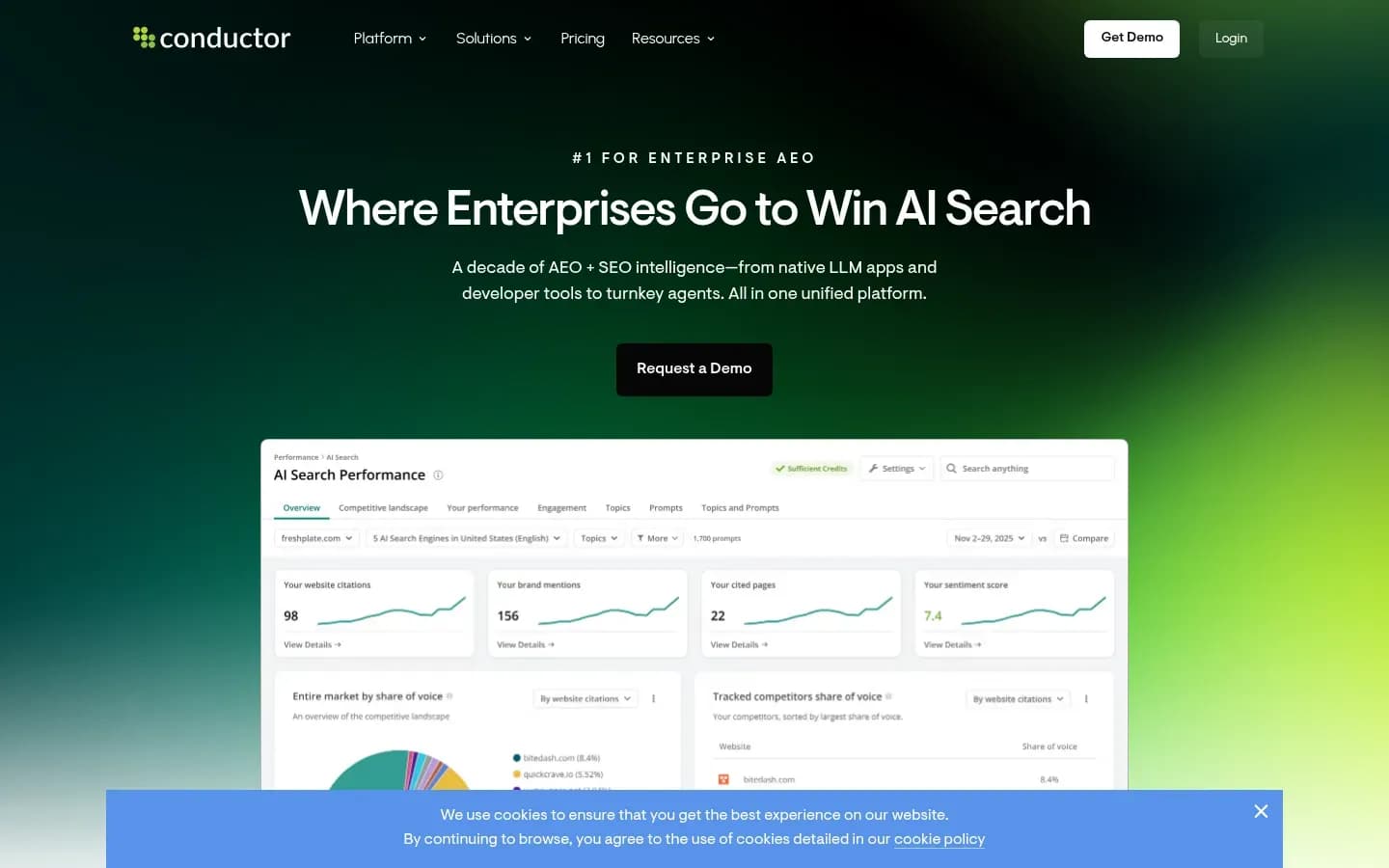
Conductor suits enterprise B2B SaaS teams that already run SEO in one suite, because it tracks mentions, citations and sentiment in ChatGPT, Gemini, Copilot and Claude next to traditional rankings and analyses AI traffic with GA4 or Adobe conversion data.
Conductor
Enterprise SEO and answer engine optimization platform for tracking and improving visibility in search and AI answers.
Conductor is an enterprise SEO and answer engine optimisation platform for tracking and improving visibility in search and AI answers. Conductor Intelligence covers brand mentions, citations and sentiment in answer engines alongside traditional search rankings across all of a company's domains.
- Compliance
- GDPR, ISO 27001, SOC 2
- Ratings
- G2 4.5/5 (824 reviews)
Verdict: the pick for enterprise SaaS teams that want AI visibility inside the SEO suite they already report from.
What it does for B2B SaaS: Conductor compares your market share across AI answers and traditional search, so the SEO team reports both in one view instead of two tools.
Standout features:
- AI traffic with conversion data: connects AI visibility, search and website performance with GA4 and Adobe analytics to analyse AI traffic alongside engagement and conversion metrics.
- AI bot crawl monitoring: 24/7 website monitoring of how AI bots crawl the site.
- Agents: a Content Agent and a Technical Agent for acting on what the data shows.
Pricing: Conductor's plans are shown below. Scope depends on the number of domains and pages you need covered, since the platform is built to report on millions of pages.
Conductor pricing
| Plan | Price | Billing | Notes |
|---|---|---|---|
| Enterprise | Custom pricing | ||
| Essentials | Custom pricing | ||
| Growth | Custom pricing |
Best fit: enterprise SaaS companies with many domains and an in-house SEO team that already lives in a suite.
Limitations: G2 reviewers of Conductor most often tag "Learning Curve" (41 mentions) and "Lack of Features" (25 mentions) as dislikes, a pattern across reviews rather than one complaint. It is built for enterprise scale, so a single-product startup will pay in setup time for capacity it does not use.
Integrations: GA4 and Adobe analytics, plus an MCP server for intent, content and technical signals.
Why it's on the list: Conductor reports AI and traditional search market share side by side, which suits teams that must defend one search budget across both channels.
How to Choose AI Visibility Software for B2B SaaS
Choose AI visibility software for B2B SaaS by its prompt set first: only 12% of links that ChatGPT, Gemini and Copilot cite rank in Google's top 10 for the same prompt, so a tool built on your SEO keyword list will miss most of what AI answers rely on. Ahrefs found Perplexity had the highest overlap, at 28.6%, across 15,000 long-tail prompts.
Run this checklist before any demo. Ask the vendor to show each point on your own prompts, not a sample account.
- Own the prompt set: build it from real sales questions, not keyword-generated defaults, which tend to flatter the score.
- Match engine coverage to where your buyers research: ChatGPT, Gemini, Perplexity, Claude, Copilot and Google AI Overviews are not interchangeable.
- Separate mentions from citations: check whether the tool counts a brand name in prose the same as a linked source, and whether it splits used from cited sources.
- Connect visibility to traffic and conversions: ask for server-log, CDN or analytics connections, not just prompt scores.
- Decide who acts on findings: monitoring-only tools need a team to act; agent tools need someone to approve and publish.
- Ask the vendor to show its sampling method: how often each prompt runs and how it handles run-to-run variance.
Mentions and citations deserve a second look. A mention means the AI named your product; a citation means it linked a source. Ask each vendor which of the two its score counts, and whether it shows which third-party pages the answers drew on.
Score each tool against your own requirement list before a demo, so the sales call answers your questions rather than setting them.
Which Buyer-Intent Prompts Should a B2B SaaS Company Track?
A B2B SaaS company should track prompts for each buyer moment, from category discovery and alternatives to integration, security and pricing questions, because AI chatbots are now the top source influencing B2B software shortlists. In G2's survey of 1,076 buyers, 69% chose a different vendor than planned because it appeared in a chatbot recommendation.
The same G2 survey, fielded in March 2026, found 51% of buyers start software research with an AI chatbot more often than with Google, up from 29% in G2's 2025 report, and 71% use AI chatbots at some point in their research.
Group prompts by the moments a SaaS buyer passes through: category discovery, alternatives to the incumbent, integration checks, security and procurement, pricing, and implementation risk. Then repeat the set for each ICP segment, because answers differ by company size: a product may be recommended to startups and left out for enterprises.
ICP segment: <segment, e.g. 50-500 employees, fintech>
Competitor set: <competitor 1>, <competitor 2>, <incumbent>

Category discovery
- What is the best <category> software for a <segment> company?
- Which <category> tools do <role> teams use?

Alternatives to the incumbent
- What are the best alternatives to <incumbent>?
- <incumbent> vs <competitor 1>: which is better for <use case>?

Integration checks
- Which <category> tools integrate with <integration>?
- Does <your product> work with <integration>?

Security and procurement
- Which <category> tools offer SSO and SOC 2 for <segment> teams?
- Is <your product> GDPR compliant?

Pricing
- How much does <category> software cost for a team of <n>?

Implementation risk
- How long does it take to implement <category> software?
- What goes wrong when switching from <incumbent>?

Tags per prompt: moment | segment | competitor | country
Define the product-category competitor set from the vendors your buyers already compare you against, taken from lost-deal notes and sales calls, not from the SEO competitors that share your keywords. Then track the prompts where a competitor is cited and you are not. Profound's Prompt Volumes shows those gaps directly; in other tools, tag each prompt by competitor and filter for answers that name them without you.
How Do You Connect AI Visibility to Pipeline?
Connecting AI visibility to pipeline takes three layers, AI crawler and referral data from server logs, AI traffic joined to analytics conversions, and a CRM source field on demo and trial forms, because no single tool's prompt score shows revenue. Each layer catches influence that the one before it misses.
Three layers that tie AI visibility to pipeline
| Layer | What it shows | Where the data comes from | What it misses |
|---|---|---|---|
| AI crawler and referral data | Which AI bots read which pages, and AI-referred visits | Server logs or CDN connectors (Profound, Promptwatch, Conductor) | Answers that never send a click |
| AI traffic joined to conversions | Which AI-referred visits engage and convert |
| Buyers who return later through another channel |
| CRM attribution | Which demos and opportunities name AI as a source | UTMs, a "how did you hear about us?" field, an opportunity source field | Buyers who do not remember or report it |
The third layer is a process, not a product. Tag AI-referred links with UTMs, add a "how did you hear about us?" field to demo and trial forms, reconcile self-reported and platform attribution monthly, and carry the source into a CRM opportunity field. Expect GA4, HubSpot and Salesforce to report different numbers; the monthly reconciliation is where you decide which one to trust for each question.
Referral analytics will always undercount. An AI answer can shape a shortlist without sending a click, and the typical B2B buying decision includes 13 internal stakeholders and nine external influencers, according to Forrester. Pipeline influence is broader than tracked visits, so read the three layers together.
To see which accounts sit behind AI-referred visits, pair the first two layers with one of the website visitor identification tools that match visits to companies.
How Reliable Is AI Visibility Data?
AI visibility data is reliable as a trend, not as a snapshot: ChatGPT and Google's AI returned the same brand list less than 1% of the time across repeated runs, so visibility share across many runs means more than a single rank position. Read every score as a sample, and judge its direction over months.
The SparkToro study, run with Gumshoe.ai and reported in January 2026, ran twelve brand-recommendation prompts 60 to 100 times each across ChatGPT, Claude and Google AI Overviews and AI Mode, across 2,961 prompts in total. The same list in the same order came back less than 0.1% of the time. Visibility across many runs was more stable than ranking position. The study is not peer-reviewed and was sponsored by an AI tracking startup.
Three rules follow for a SaaS team:
- Trust share, not rank. "Mentioned in 40% of runs" is a usable number; "ranked third" on one run is not.
- Ignore small weekly moves. A change from 31% to 34% across 200 prompts can be noise, and most vendors do not report confidence intervals.
- Report monthly, analyse quarterly. Monthly figures smooth the variance; quarterly trends show whether content work moved the needle.
Buyers treat AI answers with the same caution. The same Forrester research finds AI search tools often deliver incomplete or unreliable information, so buyers seek validation from trusted sources such as peers and review sites.
What Drives the Cost of an AI Visibility Tool?
The cost of an AI visibility tool is driven by prompts multiplied by AI models multiplied by how often each prompt runs, and adding models or countries multiplies that volume. Projects, seats and content agents then sit on top of that base volume.
The drivers show up differently in each tool. Peec AI's Enterprise plan lists up to 11 models and runs each prompt every 24 hours on every selected model. Peec AI and Promptwatch set up each brand or market as its own project. Peec AI includes single sign-on on Enterprise, Profound lists RBAC and SCIM, and Profound's AI Marketer and Promptwatch's content agent go beyond monitoring.
Cost drivers and what to ask the vendor
| Driver | Why it raises cost | What to ask |
|---|---|---|
| Prompts | One sampling unit each | Do variants count separately? |
| AI models | Each prompt runs per model | Which models are included? |
| Run frequency | Daily runs multiply volume | How often does each prompt run? |
| Projects and countries | One project per brand or market | Is each country a project? |
| Seats and identity | SSO, RBAC and SCIM needs | Which plan includes SSO? |
| Agent features | Work beyond monitoring | Who approves agent output? |
Run the multiplication before any demo. A set of 100 prompts on 4 models, run daily, is 400 answers a day, about 12,000 a month. Moving to 8 models doubles that to about 24,000 without adding a single prompt.
Vendors package usage in different units, such as prompts, responses or credits, and DataDab's comparison notes that no public comparison normalises cost per engine. Normalise every quote to cost per prompt per engine per month on your own shortlist. Each tool's plans appear in its pricing table in the tool sections above.
Which AI Visibility Tool Should a B2B SaaS Company Choose?
If you run a lean B2B SaaS content team, choose Promptwatch; if you track a defined prompt set across a few markets, choose Peec AI; if you need prompt demand and conversion data at enterprise scale, choose Profound. Persona-heavy selling points to Scrunch, and an existing enterprise SEO suite points to Conductor.
Pick by situation
| Situation | Pick | Have in place |
|---|---|---|
| Seed or Series A, lean team | Promptwatch | Cloudflare, Fastly or Vercel |
| Growth stage, a few markets | Peec AI | A prompt set per country |
| Enterprise, conversion data | Profound | A team to act weekly |
| Multi-persona or Sitecore | Scrunch | One brand or Sitecore |
| Many domains, SEO suite | Conductor | GA4 or Adobe |
Read each row as a rule: Promptwatch if you publish weekly, Peec AI if you need daily tagged tracking, Profound if you need prompt demand and log-based conversions, Scrunch if you need persona filters, and Conductor if you need AI and search share in one report.
Whichever you pick, start with the prompt set from the template above and run it for a full month before judging the tool. A month of daily data tells you more than any demo.
If you run AI visibility for clients rather than for one product, the roundup of AI visibility tools for agencies covers client separation and white-label reporting.
FAQ
What is an AI visibility tool?
An AI visibility tool runs a set of prompts through AI assistants such as ChatGPT, Gemini and Perplexity and reports how often your brand is mentioned or cited, where it appears and which sources the answers rely on. Most also benchmark the same prompts against a competitor set you define.
Do AI visibility tools replace SEO tools?
No. AI visibility tools sit beside SEO tools rather than replacing them. Ahrefs found that only 12% of links cited by ChatGPT, Gemini and Copilot rank in Google's top 10 for the same prompt, so the two measure different surfaces. Conductor reports both in one suite for teams that want a single view.
Do AI visibility tools track Google AI Overviews?
Most do, but check each tool's engine list. Profound, Promptwatch and Scrunch name Google AI Overviews among the engines they track, and Peec AI's Enterprise model list includes both AI Overviews and AI Mode. Conductor names ChatGPT, Gemini, Copilot and Claude, reported next to traditional search rankings.
How often should you report AI visibility?
Report AI visibility monthly and analyse trends quarterly. Prompt-sampling scores are samples, so a move from 31% to 34% across 200 prompts in one week can be noise, and most vendors do not publish confidence intervals. Daily runs, such as Peec AI's, give each monthly figure more data points.
Sources
Sources
- In the Answer Economy, Don't Win the Click — Win the Answer · company.g2.com
- AI Recommendations Change With Nearly Every Query: SparkToro · searchenginejournal.com
- gracker.ai
- tryprofound.com
- Exclusive: As AI threatens search, Profound raises $96 million to help brands stay visible · fortune.com
- Sitecore acquires Scrunch to help brands influence discovery and buying decisions in the AI-search era · sitecore.com
- Only 12% of AI Cited URLs Rank in Google's Top 10 for the Original Prompt · ahrefs.com
- Forrester's 2026 Buyer Insights: GenAI Is Upending B2B Buying · businesswire.com
- tryprofound.com
- scrunch.com